

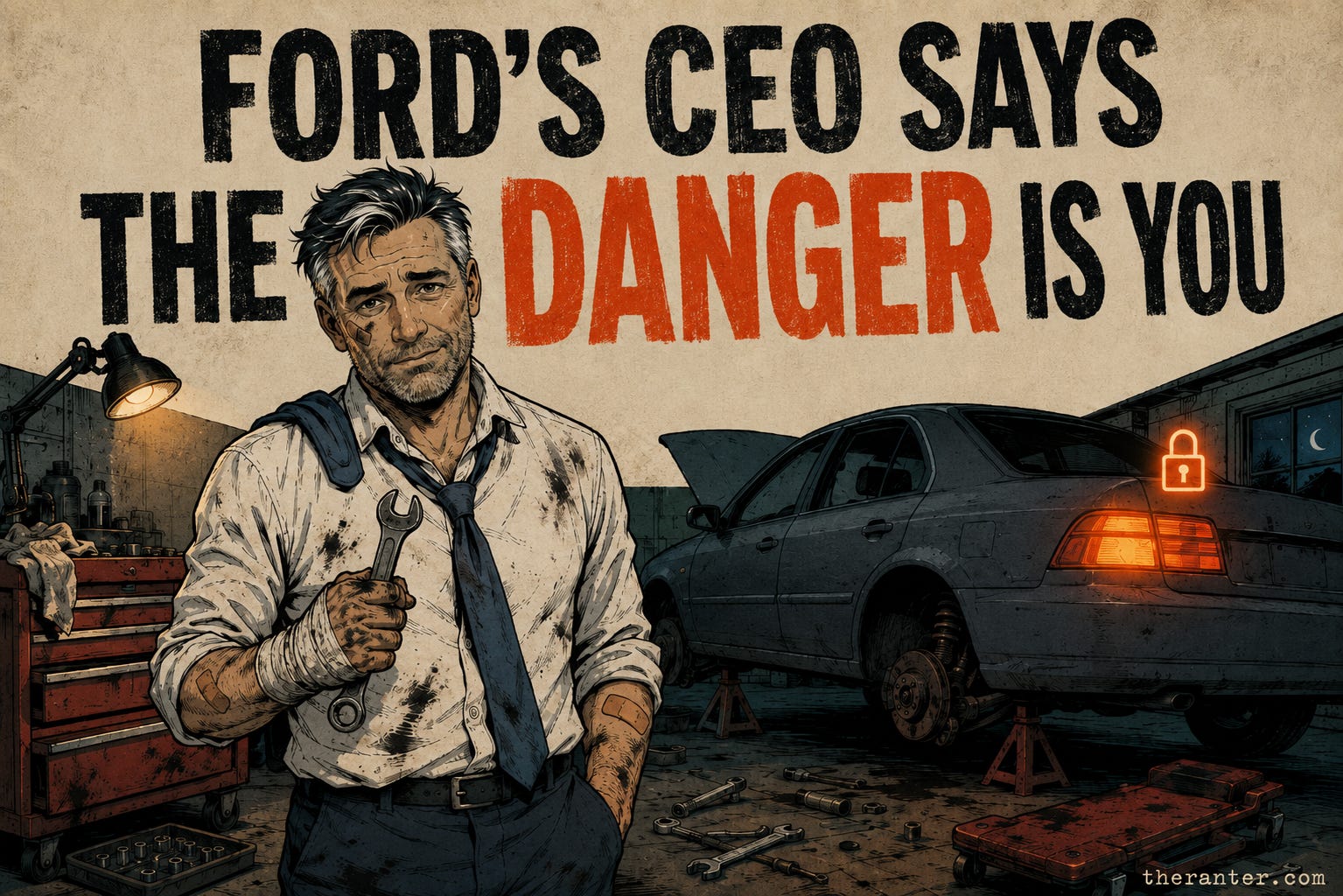
Ford’s recall record runs into the millions of vehicles. Backup cameras that go dark, door latches, fuel pumps, the campaigns pile up. The man who runs the company looked at that record and decided the real danger is you, in your own driveway, holding a socket wrench.
Ford CEO Jim Farley told the Detroit Free Press that Ford would rather handle warranty repairs itself, and warned that owners doing their own warranty work on modern cars is a safety risk. Pressed on whether he wanted people fixing their own cars at all, he allowed that the rest is fine, just not warranty work. Generous. Not the assembly line, not the recall list. The hazard he settled on is you, with a Saturday afternoon and a YouTube tutorial.
I fix my own car. I build my own computers. I have yet to endanger a single life. The only one I could put at risk is my own, on a Saturday, under my own car. And that is my call to make, not Ford’s.
And there is a price tag under the safety speech. The independent shop across town mostly charges $120 to $160 an hour. The dealership runs about a quarter higher, often $130 to $180 and up, and a luxury service department goes well beyond that. At $150 an hour, you have to wonder: am I paying for a car repair, or a therapy session?
The lock, not the wrench
He says the driveway is ok. So take him up on it and try to fix your own car. Safety is the wrapper. The device underneath is a digital lock.
Take a modern sensor or camera module. Damage it, buy the replacement, bolt it in, and it can still stay dark. It will not wake up until a dealer plugs in a scan tool and programs the new part to the vehicle by serial number. Section 1201 of the DMCA, a 1998 law, turns breaking that kind of lock into a copyright problem. Narrow repair exemptions exist, but they do not force the maker to hand you the key, so the fix still runs on permission. The part is yours, the vehicle is yours, and the right to connect the two gets rented back to you at the service counter. This is exactly the sort of repair Farley said you were free to make. You are not.
That is the whole play. Turn “repair” into “return to the dealer,” where the service bay is the most profitable room in the building.
Ask John Deere how it goes. The tractor giant ran this exact move on farmers for years, then paid $99 million to settle and admitted nothing. For a company that size, a rounding error. The deal came with a promise to open up repair tools, a promise inside a settlement, from the outfit that spent years bolting the door shut. The separate federal case grinds on. Well, fuck that guy.
It is not just the truck
The lock reaches past the car. It is on your phone, your TV, your fridge, your headphones.
Two things landed this week. Trump signed a memo backing repair on automobiles, and even his allies in the movement said the narrow version, aimed mostly at emissions work and aftermarket parts, does not go far enough. Then Connecticut’s new right-to-repair law took effect today, ordering makers of consumer electronics, phones and televisions and the like, to hand over the manuals, parts, and tools. Cars are carved out of that one, but your devices are in.
And it is not only repair they hold. It is capability. Tesla once sold Model S and X cars with a large battery pack software-limited to a smaller capacity, then charged $4,500 to $9,000 to unlock the range already bolted under the floor. When Hurricane Irma hit Florida in 2017, Tesla switched the full battery on remotely so owners could evacuate, an extra 30 to 40 miles, then shut it back off about a week later. The range was in the car the whole time. A line of code decided whether you were allowed to use it.
One lock, and both parties have fed it and fought it. The 1998 statute passed with broad bipartisan cover, and Deere cut checks to everyone, and this week’s memo came from the other side of the aisle.
What you can actually do
One move. Before your next big purchase, ask the boring question: are the parts serialized to the car or the device? If a new part has to phone home to the manufacturer before it works, you are not buying a product, you are leasing permission.
Then check whether your state has a repair law. A growing list already does, some covering electronics, some covering cars, including Colorado, Minnesota, New York, California, and now Connecticut. Back the model, use the independent shop while it still stands, and keep your screwdriver. You were never the danger here.
Related read: You Can’t Fix the F-35. Neither Can the Air Force.
THE RANTER follows the money through the systems that bill you: healthcare, housing, food, labor, debt, political money. Mechanism over motive.
Newsletter: newsletter.theranter.com | Website: theranter.com
YouTube: @TheRanterOfficial | Instagram: @theranterofficial | TikTok: @theranterofficial | X: @RanterMarkus | Bluesky: @rantermarkus.bsky.social
Every figure above is sourced and linked. Think one is wrong? corrections@theranter.com