

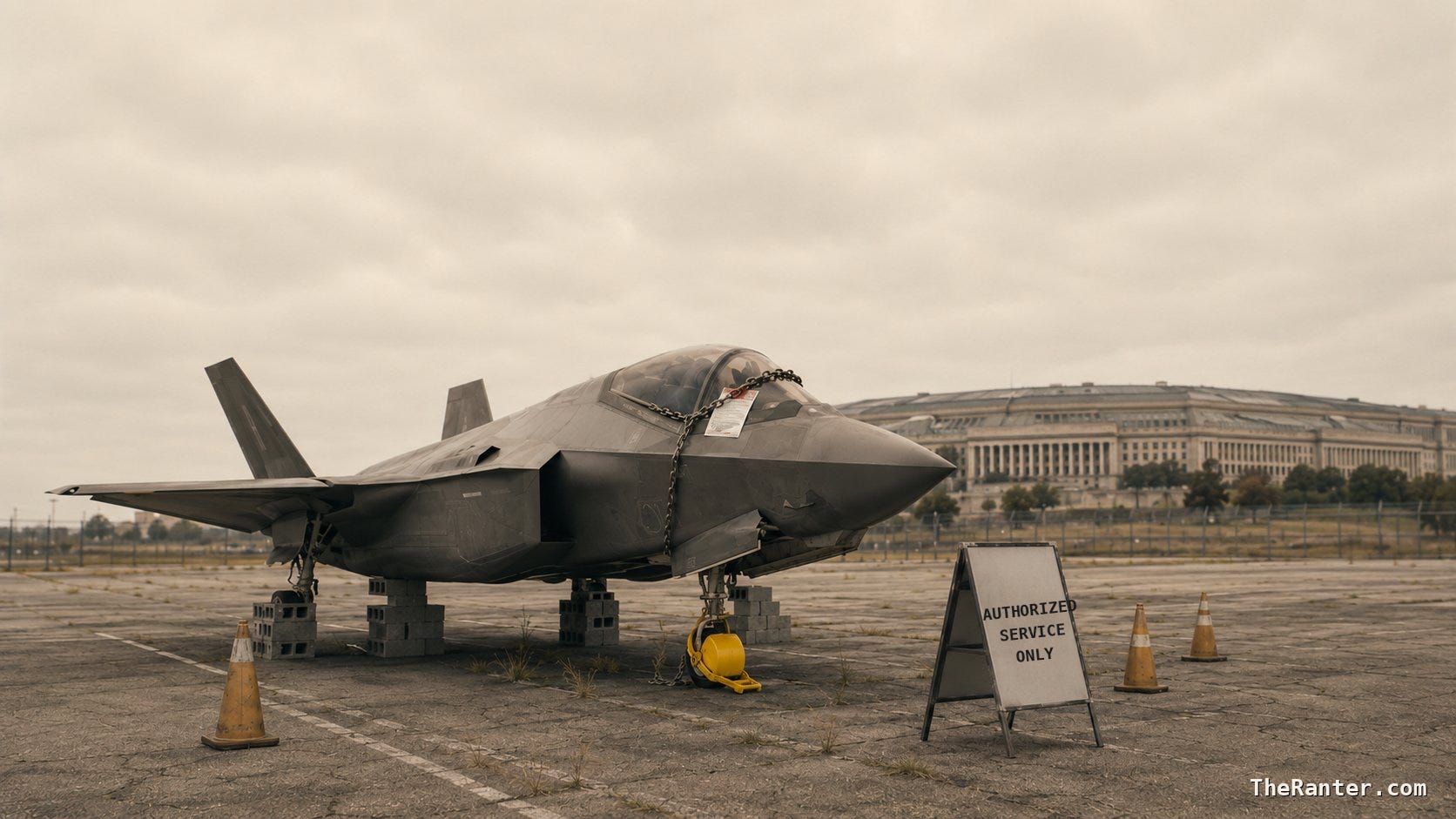
The most expensive machine the United States has ever built is headed toward two trillion dollars, and the people who fly it are not allowed to open the hood.
That is not a figure of speech. F-35 engines cannot be fixed in the field. When one needs serious work, it gets crated up and shipped back to one of a handful of authorized depots in the United States, and the jet sits grounded for the wait. The design and the contracts route the deep repairs through the contractor, not the crew standing next to the plane.
The Army Secretary, Dan Driscoll, recently held up a small part in a room full of people: a fin for the external fuel tank on a Black Hawk helicopter. The vendor charges more than fourteen thousand dollars for that fin. His own team scanned it, reverse-engineered it, and printed one for a few hundred dollars, and he said the printed part came out stronger than the original. And under the contracts the military signed, doing that at any kind of scale is the part nobody is sure they are allowed to do.
The receipts here come from the Government Accountability Office, the federal watchdog that audits this stuff for Congress. GAO’s latest count puts the F-35 program at nearly $1.7 trillion across its life, and projections now run past two trillion. More than $1.58 trillion of that is sustainment, which is the polite word for repairs and upkeep. So the single biggest line item on the most expensive weapon in history is not building the thing. It is fixing it, over and over, for the next sixty years.
Back in 2014, GAO told the Pentagon the program did not even have a plan for who owns the repair data. More than a decade later, GAO still found the Pentagon had not resolved it. In the meantime the repair backlog has at times run past ten thousand parts, and the fleet’s mission capable rate, the share of time the jet is actually ready to fly, sat around fifty-five percent. You are paying the better part of two trillion dollars for a plane that is ready about half the time, and you are not allowed to fix the half that is broken.
Here is how it happened, and why it is the same thing happening in your driveway.
About twenty years ago the Air Force bought the F-35 on what they call a total system approach. In plain English, Lockheed Martin and the other contractors kept the rights to much of the technology, the technical data, and the diagnostic tools. The government came away without the data and software rights it needs to do a lot of its own repairs, or to bring in anyone else, so it leans on the contractor for much of the work. Every serious breakdown effectively has one phone number. The contractor sets the price and the timeline, and makes money on the very breakdown it is being paid to fix. The worse the plane runs, the better the business.
Now look at your own stuff. There is a law from 1998, Section 1201 of the Digital Millennium Copyright Act. It was written to stop people copying DVDs. What it does now is let a company put a software lock on a physical object you own and paid for, so that fixing it yourself becomes a crime. That is why John Deere can stop a farmer from repairing his own tractor unless he hauls it to an authorized dealer. That is why a phone can shut itself down when it sees a battery the manufacturer did not bless.
The Pentagon and the farmer are getting billed by the same machine, and the whole design of that machine is that the thing you own is the one thing you are not allowed to maintain. The lobby that fights to keep it this way knows exactly what it is protecting. Well, fuck that lobby.
This one is live right now, so here is where to point. Last week the House Armed Services Committee put right to repair into next year’s defense bill, the FY27 NDAA, on a bipartisan amendment. Good. But versions of this have been pushed before and have not made it into the final law, with defense contractors lobbying against military right to repair. The bill underneath it, the Warrior Right to Repair Act, was written by Elizabeth Warren, a Democrat from Massachusetts, and Tim Sheehy, a Republican from Montana. A D and an R wrote it, and it still has not become law.
So the move is not to cheer the markup vote. The markup is the easy part. Watch the conference committee, the closed-door room where the final bill gets written and where provisions like this tend to get quietly dropped. Call your House member and tell them the F-35 repair language stays in the final bill, not just the draft.
This whole thing got me thinking. I have been on the wrong end of this exact lock for years. The phone battery I could not swap. The TV I could not open the year after the warranty died, over a board I could have replaced for nine bucks if anyone would sell me one. A guy I know two counties over, staring at a tractor he owns free and clear and is not allowed to fix. None of it got a hearing. Nobody in that conference room ever lost a minute over my TV. It took the most expensive fighter jet the government owns, headed toward two trillion dollars, before the lock was suddenly a problem worth a bipartisan amendment. The mechanism never changed. The customer did.
So when they fix it for the F-35, ask whether they are fixing it for you. The same month the administration talked up letting soldiers repair their own gear, Ford and GM were backing a push to make it harder for you to fix your car. Two trillion dollars says the lock is the product. The jet is just the receipt.
THE RANTER follows the money through the systems that bill you: healthcare, housing, food, labor, debt, political money. Mechanism over motive.
Newsletter: newsletter.theranter.com | Website: theranter.com
YouTube: @TheRanterOfficial | Instagram: @theranterofficial | TikTok: @theranterofficial | X: @RanterMarkus | Bluesky: @rantermarkus.bsky.social
Every figure above is sourced and linked. Think one is wrong? corrections@theranter.com