

By Markus Grant | The Ranter
Every time you read something, or hear someone make an argument, there is a set of questions running underneath it whether you realize it or not. Who is this person. What do they actually believe. Who do they work for. Why are they saying this now. What are they really trying to accomplish. Who benefits from you believing it. And what are they not saying.
Those seven questions are the only tools that matter. Every con, every extraction system, every political maneuver that has ever worked on a large number of people worked because it interrupted that sequence before question three.
The interruption has a name. Call it armor.
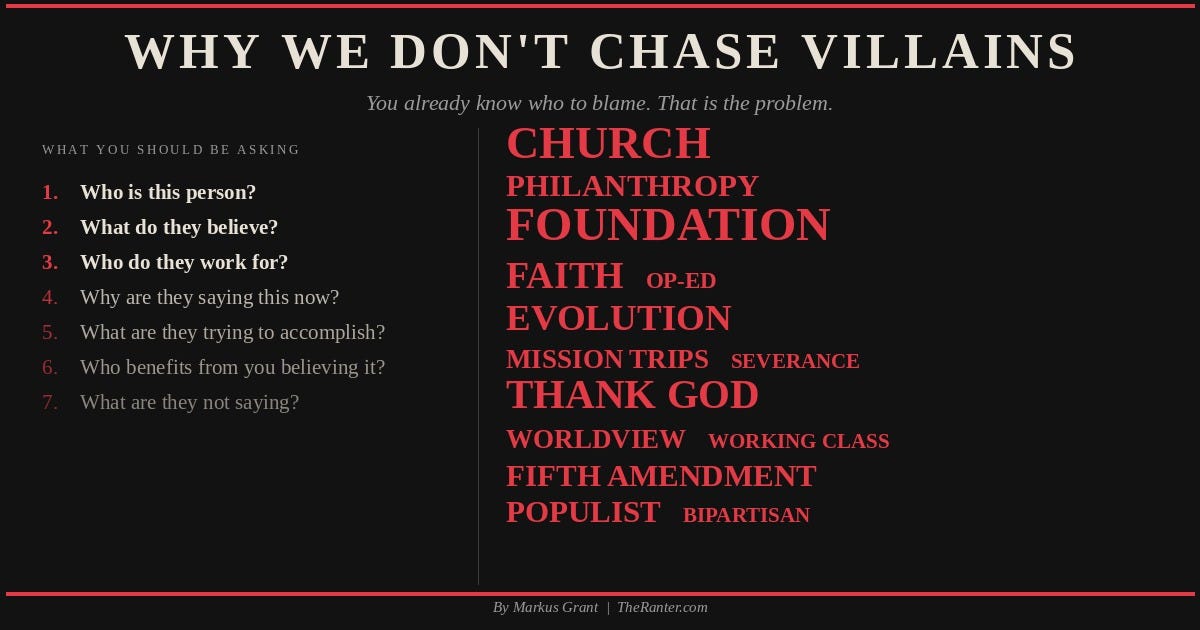
It does not have to be false. That is the part that takes a minute to sit with. The church attendance is real. The philanthropy is documented. The op-ed was published. The reversal was genuine. None of that matters for the mechanism. Armor only has to answer question one loudly enough that questions three through seven never get asked.
In 1993, Bain Capital acquired a steel mill in Kansas City, Missouri, for $8.3 million. [1] The firm merged it with another plant to form GS Industries, loaded the new company with debt, and began collecting consulting fees. Over the life of the deal, Bain pulled in more than $4.5 million in fees alone. When the company filed for bankruptcy in 2001, 750 workers lost their jobs, their severance was denied, their health insurance disappeared, and the pension fund came up $44 million short. The federal Pension Benefit Guaranty Corporation covered the shortfall in the end. [2]
Bain still made money. The firm received $12 million on its $8.3 million investment, plus the consulting fees. The workers received a federal bailout of the pension their employer had underfunded while paying advisory fees to the firm that owned it.
At the time of the acquisition, Mitt Romney was running Bain Capital.
After leaving Bain, Romney ran the Salt Lake City Olympics, became governor of Massachusetts, ran for president twice, won the Republican nomination, and served in the United States Senate. His tax returns along the way showed he gave $7 million to charity over two years, roughly $4.1 million of it to the Church of Jesus Christ of Latter-day Saints. [3] Over a twelve-year period, more than $9 million went to the church. He tithed at or above the expected 10 percent, established a charitable foundation bearing his family’s name, and gave $1 million to Brigham Young University to create an institute of public management named after his father. [4]
None of that is fake. The giving is real. The faith is documented. The foundation files its taxes.
None of it changes what happened at the steel mill. But it changes whether anyone can make the steel mill stick. That is the function of armor. Not to disprove the record. To make it irrelevant.
Some armor goes further. Speaker Mike Johnson has stated publicly that the Bible is his worldview and that he runs legislative decisions through Scripture. Oil and gas has been his top contributing industry since he entered Congress, and his lifetime League of Conservation Voters score is 2 percent. [24] When his constituents ask why he votes the way he does, the answer available to them is God. Technically, God did create the oil. Bob Menendez stood outside a Manhattan federal courthouse in July 2024, while a jury deliberated on 16 counts of bribery, extortion, and obstruction, and told reporters: “I have faith in God and the jury.” He was convicted on all 16 counts and sentenced to 11 years. [25] The armor did not prevent the verdict. That is not what armor is for. It is for the people who were never going to read the indictment anyway.
In May 2025, Senator Josh Hawley of Missouri published an opinion piece in the New York Times under the headline “Don’t Cut Medicaid.” He argued that slashing health coverage for the working poor was “both morally wrong and politically suicidal,” and he called on Republicans to ignore the Wall Street wing of the party pushing for cuts. [26]
Seven weeks later, Hawley voted for the One Big Beautiful Bill Act.
The Congressional Budget Office estimated the bill would cut federal Medicaid spending by $1.02 trillion over ten years, the largest rollback of the program in its history. [27] Two weeks after casting that vote, Hawley introduced legislation to undo some of the Medicaid cuts he had just helped pass. [28]
The op-ed is still on the Times website. The vote is in the congressional record. Both exist simultaneously because they serve different audiences. His career total from the Republican and conservative ideological donor network is $5.8 million. [20]
The op-ed and the vote do not contradict each other. They complete each other.
Now do the same exercise on the other side of the aisle.
In January 2017, Senator Cory Booker of New Jersey voted against an amendment co-sponsored by Bernie Sanders and Amy Klobuchar that would have allowed Americans to import prescription drugs from Canada. [5] The amendment failed.
Booker’s stated reason was safety concerns about imported pharmaceuticals. It was the same argument the Pharmaceutical Research and Manufacturers of America had been making for years.
Over the six years before that vote, Booker received $267,338 from pharmaceutical manufacturing companies, more than any other Democratic senator who voted against the amendment. [6] His career total from pharmaceutical and health product interests, including his leadership PAC, reached approximately $468,000. [7]
That is the behavior. Here is the armor.
Booker later reversed his position, co-sponsored a drug reimportation bill with Sanders, and stopped accepting pharmaceutical PAC money. In 2019, during a presidential debate, he claimed he did not take money from the pharmaceutical industry. When it surfaced that he had recently accepted a donation from a pharma executive, he returned it on the spot. [8]
The reversal itself became the shield. He listened. He evolved. He grew. That is the language his supporters used, and it worked. The vote was reframed as a learning moment, not a data point. The $267,338 became backstory. The new position became the story.
You can prove the math. You can prove the behavior. You can prove the incentive structure. What you cannot do is get past the personal brand someone has built to insulate themselves from accountability. The church attendance. The philanthropy. The foundation with their name on it. The public evolution. That is armor, and the system is designed so that proving motive does not matter anyway, because everything they did was technically legal, technically rational, technically within the rules of the game they wrote.
You do not have to believe that Romney wanted 750 steelworkers to lose their pensions. You do not have to believe that Hawley published a piece calling Medicaid cuts morally wrong and then voted for them anyway because the donor math said to. You do not have to believe that Booker voted against drug importation because a pharmaceutical company wrote him a check.
Motive is speculation. Behavior is documented.
Romney’s firm collected consulting fees from a company while its pension went unfunded. Hawley wrote in the New York Times that cutting Medicaid was morally wrong, then voted to cut it by a trillion dollars seven weeks later. Booker voted the same way as the industry that paid him more than any other Democrat in the room. Three documented records. Three different armor types. The same result each time.
Neither of them broke a law. Neither of them violated a rule. The rules were already written to make what they did legal. That is the system working as designed.
If you need proof that this is not about individuals, look at the one tax loophole that connects both sides of this equation.
Carried interest is the provision that allows private equity managers to pay capital gains tax rates on their income instead of ordinary income rates. Three presidents promised to close it. Barack Obama called it a loophole. Donald Trump called it unfair. Joe Biden put it in his budget proposal. [9]
It survived all three.
In 2017, Senate Republicans passed the Tax Cuts and Jobs Act. Senator Pat Toomey of Pennsylvania helped preserve the carried interest provision during negotiations, with private equity lobbyists calling him an “all-star” in that fight. [10] Less than a month after leaving the Senate, in February 2023, he joined the board of Apollo Global Management, with first-year compensation that included $600,000 in restricted stock and a $150,000 cash retainer. [11]
In 2022, the Inflation Reduction Act included a partial fix. Senator Kyrsten Sinema of Arizona removed it from the bill during final negotiations, having received more than $500,000 from private equity interests that cycle. Senate Majority Leader Chuck Schumer, who said there was “no choice” but to accept the change, had received $1.2 million from the same sector. [12]
In the years before all of this, Senator Evan Bayh of Indiana voted against a procedural motion on carried interest reform, then joined Apollo Global Management as a senior advisor seven months later. [13]
Two senators. Two parties. The same firm.
Private equity firms gave $83 million to Democrats and $62 million to Republicans over two election cycles. [14] When House Republicans wrote their reconciliation bill in 2025, they left carried interest untouched as well. [15]
Three presidents. Both parties. Two decades. The loophole outlasted every one of them.
Apollo Global Management, through its LifePoint and ScionHealth platforms, controls approximately 71 rural hospitals. You have been reading about those hospitals for three articles.
Those hospitals are one thread. The system is the whole cloth.
Scott Gottlieb spent two years as FDA Commissioner, regulating every major drug company in the country, then joined Pfizer’s board 83 days after his last day in office. [16] Rick Scott ran the hospital chain that committed the largest healthcare fraud in American history: $1.7 billion in fines, $9.88 million in personal severance, and 75 invocations of the Fifth Amendment in a civil deposition, before going on to serve as governor of Florida and then as a United States senator who votes on healthcare legislation. [17]
Joe Manchin of West Virginia blocked drug pricing reform in the Senate while his daughter, as CEO of Mylan, oversaw a 400 percent increase in the price of the EpiPen. Mylan settled with the Department of Justice for $465 million. [18] Marsha Blackburn of Tennessee introduced a bill in 2016 that the DEA’s own internal memo called the greatest reduction in the Attorney General’s drug enforcement authority since 1970, having received $1.38 million from pharmaceutical interests over her career. [19]
Max Baucus of Montana chaired the committee that shaped the Affordable Care Act while collecting $3.4 million from the health and insurance sector. His former staffer Jeff Forbes helped write the provision banning Medicare from negotiating drug prices, then registered as a lobbyist for PhRMA and defended it. [20]
Five names. Both parties. Not one of them broke a law.
This is why we do not chase villains.
Not because there are no bad actors. There are. Not because accountability does not matter. It does. But because the system does not need villains to function. It needs participants. It needs consulting fees that are legal. Votes that are funded. Tax provisions that survive every election. It needs the armor to be real, because real armor is the kind you cannot take off someone else.
The receipts do not require you to prove that anyone meant to do what they did. They require you to document that they did it, that it was legal, and that the rules were written to make it that way.
The behavior is documented. The incentive structure is visible. The mechanism has a name now.
That is what this publication does. Not chase the people who play the game. Map the game. Name the interruption. And give you back the seven questions armor is designed to stop you from asking.
The next article in this series follows the political money directly: who funded the campaigns, who wrote the legislation, and what the legislation did to the hospitals in the districts of the people who voted for it.
Sources
[1] Reuters, “Special Report: Romney’s steel skeleton in the Bain closet,” January 2012. Washington Post, “Romney’s Bain Capital record shows mixed record on bankruptcies,” 2011. American Bridge PAC compiled court documents and SEC filings.
[2] Reuters, January 2012. Federal Pension Benefit Guaranty Corporation records. PolitiFact fact-check of Obama campaign ad, May 2012.
[3] TIME, “Tax Returns and Tithing: How Mitt Romney Gives Away 16% of His Income,” January 2012. Christian Science Monitor, January 2012.
[4] Boston Globe, “For Mitt Romney, charity centers on Mormon church,” February 2012. Inside Philanthropy, Romney profile. Huffington Post review of IRS documents.
[5] The Intercept, “Cory Booker Joins Senate Republicans to Kill Measure to Import Cheaper Medicine from Canada,” January 2017.
[6] The Intercept, January 2017. MapLight, pharmaceutical manufacturing industry contributions to Booker, 2011-2016.
[7] OpenSecrets, Cory Booker career contributions from pharmaceutical and health product interests, including leadership PAC ($411,948 direct + $56,000 leadership PAC).
[8] PolitiFact, The Hill, ABC News. Coverage of Booker’s reversal on reimportation, pharma PAC decision, and 2019 debate exchange.
[9] CNBC, NPR, NBC News. Coverage of Obama, Trump, and Biden proposals on carried interest.
[10] The Lever, “Private Equity’s Senator Gets Big Payout,” February 22, 2023. Industry lobbyist quote on Toomey as “all-star” in carried interest fight.
[11] Jacobin, “Former Senator Pat Toomey Has Walked Through the Revolving Door,” February 27, 2023. Bloomberg reporting on Apollo director compensation structure.
[12] Jacobin, “Kyrsten Sinema Got $500K From Private Equity, Then Killed the Carried Interest Tax,” August 2022. OpenSecrets, Sinema and Schumer PE contributions. Truthout, August 2022.
[13] Associated Press, October 2016 (Bayh vote record and Apollo timeline). Mother Jones, May 2022. Politico, September 2016. OpenSecrets, Bayh revolving door profile.
[14] OpenSecrets, private equity industry contributions across 2020 and 2022 election cycles.
[15] NOTUS, May 2025. Reporting on House Republican reconciliation bill omitting carried interest reform.
[16] CNBC, “Former FDA Commissioner Scott Gottlieb joins Pfizer’s board of directors,” June 27, 2019. FDA departure date April 5, 2019; Pfizer board appointment June 27, 2019 (83 days). Pfizer press release, June 27, 2019.
[17] DOJ press release, December 14, 2000 ($840M settlement). DOJ press release, June 26, 2003 ($631M second settlement; total $1.7B confirmed). PolitiFact, “Rick Scott took the 5th Amendment 75 times,” June 2014. Wikipedia/settlement records ($9.88M severance per board settlement).
[18] Truthout/The Intercept, 2021 (Manchin/Mylan connection). DOJ settlement ($465M). Congressional testimony, Heather Bresch.
[19] Washington Post / 60 Minutes, October 2017 (DEA internal memo). OpenSecrets, Blackburn career pharma contributions ($1.38M). USA Today, October 2017.
[20] Montana Standard, June 2009 ($3.4M health/insurance sector). Sunlight Foundation (Forbes/PhRMA lobbying registration). Democracy Now, 2009.
[24] League of Conservation Voters, Mike Johnson member page (2% lifetime score confirmed). Inside Climate News, “League of Conservation Voters’ Take on Speaker Mike Johnson’s Voting Record,” November 4, 2023 (LCV official confirms 2% lifetime score, 4 pro-environment votes out of 160+). OpenSecrets, Mike Johnson career industry contributions (oil and gas top industry). E&E News, “Republican speaker candidates flush with fossil fuel cash,” October 2023.
[25] New York Post, “Sen. Bob Menendez ‘has faith’ as jurors deliberate,” July 12, 2024. Wikipedia, Bob Menendez conviction and sentencing. Florida Phoenix and Common Dreams both confirm quote and outcome.
[26] Hawley, Josh. “Don’t Cut Medicaid.” The New York Times, May 12, 2025. Hawley.senate.gov press release, same date.
[27] Center for American Progress, “The Truth About the One Big Beautiful Bill Act’s Cuts to Medicaid and Medicare,” July 2025. CBO, “Estimated Budgetary Effects of Public Law 119-21,” July 21, 2025 ($1.02T confirmed). Signed into law July 4, 2025.
[28] MSNBC/MaddowBlog, “GOP’s Josh Hawley pushes to undo the Medicaid cuts he just voted for,” July 16, 2025. NBC News reporting on Hawley legislation introduced July 15, 2025.
So what do you think we can do about this? It feels like system designs are too entrenched to change. Maybe all we can do at this point is document how a system self destructs?