

I wasn’t shocked.
That’s not a confession. It’s not bravado. It’s not me trying to sound like some edgy internet commenter who saw it coming. I didn’t see it coming. But when it came, the part of my brain that’s supposed to produce shock just... didn’t. It produced recognition. The same way you recognize a sound you’ve been hearing for years but never identified. Oh, that’s what that was.
A man walked up to the CEO of the largest health insurance company in America, shot him in the back outside a hotel in midtown Manhattan, and disappeared into the morning. December 4, 2024. Brian Thompson was on his way to an investor conference. The kind of event where executives present slides about revenue projections and analysts nod and the catering is fine. He never made it inside.
Five days later, Luigi Mangione was sitting in a McDonald’s in Altoona, Pennsylvania, eating, when another customer recognized him. He had a ghost gun in his backpack, fake IDs, and a red notebook. The notebook wasn’t rambling. It was focused. Three pages, clear handwriting, a specific thesis: the health insurance industry is parasitic, and he was the immune response. “I do apologize for any strife or trauma, but it had to be done. Frankly, these parasites simply had it coming.”
He’s 26 now. Ivy League. Wealthy family. Computer science degrees. Valedictorian of his prep school. He co-founded a game development company at Penn. He had chronic back pain that went undertreated. He read the Unabomber’s manifesto and found it persuasive. None of these facts fit together the way we want them to.
Then the internet happened.
Within hours, the jokes started. “Thoughts and prayers, pending prior authorization.” People asked if the hospital Thompson was taken to was in-network. Someone suggested his family should appeal the death. These weren’t coming from the fringes. They were everywhere. Mainstream platforms, group chats, comment sections on news articles from outlets that were still running the story straight.
Polling confirmed what the comments suggested. Among Americans aged 18 to 29, a significant plurality described the killing as “somewhat” or “completely” acceptable. [1] Not excusable. Not understandable. Acceptable. The NYPD’s own Intelligence and Counterterrorism Bureau assessed that Mangione could inspire copycats, that he was already being framed as a martyr.
They weren’t wrong about the martyr part. His legal defense fund on GiveSendGo has attracted well over a million dollars in donations. [2] His attorneys launched a public website because the “extraordinary volume of inquiries and outpouring of support” overwhelmed their office. In January 2026, someone tried to break him out of federal lockup in Brooklyn. The guy brought a barbecue fork and something that looked like a pizza cutter blade. That’s real. That happened. [3]
When the federal judge ruled that Mangione wouldn’t face the death penalty, a technical decision about whether stalking qualifies as a “crime of violence” under Supreme Court precedent, his lawyer called it an “incredible decision” and told reporters, “We’re all very relieved.” As officers escorted him from a later hearing where the state judge scheduled his trial for June 8, Mangione turned to the gallery and said: “It’s the same trial twice. One plus one is two. Double jeopardy by any commonsense definition.” [4]
He’s not acting like a man who thinks he lost.
I need to be careful here, because I can feel myself doing the thing. The thing where you lay out the facts so neatly that understanding starts to look like agreement. So let me say it plainly: I understand why this happened. I do not think it should have happened. Those are two different sentences and I need you to hold both of them at the same time, because the rest of this article won’t work if you drop either one.
I understand why someone with chronic pain, watching an industry post seventeen billion dollars in annual profit while denying claims in 1.2 seconds, might start circling a very dark conclusion. I understand the math that gets you there. That doesn’t make the math right.
But I also can’t pretend the public reaction was irrational. Tens of millions of Americans have been denied care they were promised. They’ve sat on hold. They’ve read letters that say “not medically necessary” about procedures their doctors ordered. They’ve watched family members get sicker during an appeal process designed to outlast their patience. When someone finally put a face on the facelessness of it all, they didn’t recoil. They recognized it.
Criminologists classified the shooting as a “symbolic takedown.” [5] Not random violence, not workplace revenge, not terrorism in the way we usually mean it. Political violence aimed at a specific node of power. It shares DNA with 19th-century anarchist assassinations, targeted acts meant to expose the vulnerability of systems that present themselves as invulnerable.
The system, for its part, did what systems do.
UnitedHealth Group opened at $611.02 on the morning of December 4, 2024. Brian Thompson had been dead for hours by the time the bell rang. The stock closed that day at $610.79. Flat. For much of the trading day, it was actually up. [6]
The market’s verdict: this changes nothing. The machine doesn’t need the man. The man was a component, and components are replaceable.
Day two, the stock dropped 5.2%. By the end of the first week, UnitedHealth had lost $41.6 billion in market cap. CVS fell 25%. Cigna dropped 20%. Humana, 19%. [6] The entire insurance sector bled, and for a few days it looked like the shooting had done something the appeals process never could, made the industry feel consequences.
It didn’t last. UnitedHealth posted better-than-expected Q4 earnings in January 2025. Revenue was up. Profits beat analyst estimates. The CFO opened the call by thanking people for their condolences about Brian. Then he read the numbers. [7]
The stock did eventually collapse. UNH is down roughly 50% from its highs as I write this. Almost none of that decline is about the shooting. In April 2025, the company reported that Medicare Advantage costs came in twice as high as expected, and the stock dropped 22% in a single day. [8] The CEO who replaced Thompson, Andrew Witty, resigned in May after five months. They brought back Stephen Hemsley, the CEO before the CEO before the one who got killed. He got on the earnings call and said, quote: “We apologize for that performance and we are humbly determined to earn back your trust and your confidence.” [9]
Your trust. Investors’ trust. Not yours, the person reading this. Not the family waiting on an appeal. The shareholders.
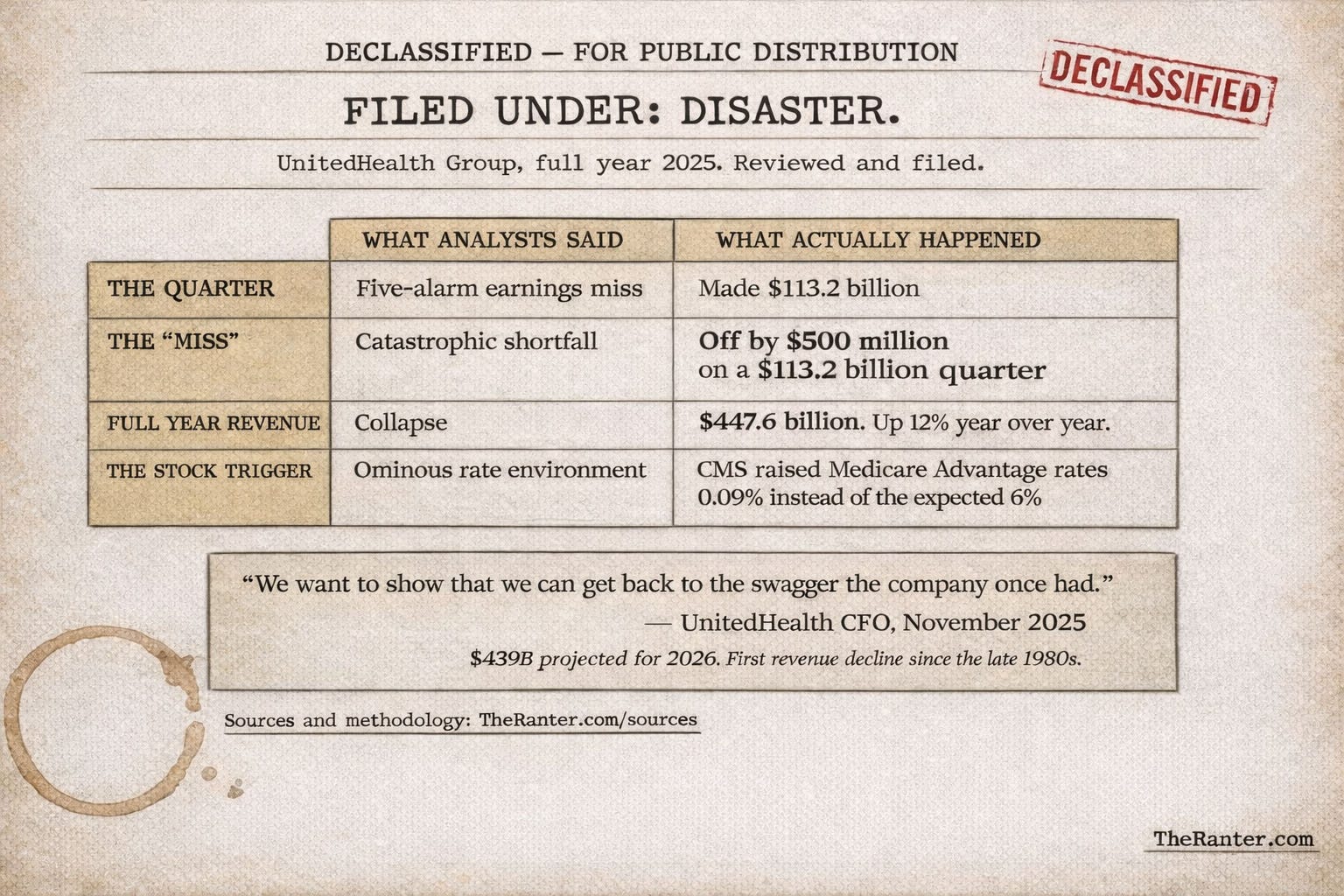
UnitedHealth’s full-year 2025 revenue was $447.6 billion. Up twelve percent from the year before. [9] The quarter Wall Street treated like a five-alarm fire? They brought in $113.2 billion. The “miss” that sent the stock into freefall was that they brought in $113.2 billion instead of $113.7 billion. They were off by half a billion on a hundred-billion-dollar quarter and analysts used the word “ominous.”
For 2026, they’re projecting revenue above $439 billion. [10] It would be their first revenue decline since the late 1980s. A two percent drop. Financial media is covering it like a corporate funeral. The stock dropped another 20% when CMS proposed a Medicare Advantage rate increase of 0.09% instead of the 6% analysts expected.
The company’s CFO told reporters: “We want to show that we can get back to the swagger the company once had.” [9]
Four hundred and thirty-nine billion dollars, and they’re talking about getting their swagger back. Meanwhile, the appeal rate is still under one percent. The algorithm still runs. nH Predict still tells nurses when to discharge your grandmother.
Wall Street didn’t punish UnitedHealth for how they treat patients. Wall Street punished them for how they treated shareholders. The suffering was always priced in. The suffering is the product. The stock price doesn’t measure how much they hurt you. It measures how much they promised to hurt you, and whether they delivered on schedule.
Here’s where I’m supposed to lose you.
My retirement account probably holds UNH stock. Most retirement accounts with index fund exposure do. Yours might too. We didn’t choose that. But we benefit from it, in some fractional, quarterly way. The same company that denies the claim pays into the fund that’s supposed to keep us alive when we stop working, and the fund managers who dumped twenty million shares of UNH in late 2025 didn’t dump them because they read about denied grandmothers. They dumped them because the earnings per share came in at $2.11 instead of $6.81. [8]
Members of Congress traded UNH stock twenty-one times in the last six months. Nine purchases. Twelve sales. [11] They are buying and selling shares of this company while debating healthcare policy. That’s not a conspiracy. That’s a filing. It’s public. You can look it up.
I don’t know what to do with any of this. I can document the mechanism. I can show you the exposed wiring of a system that absorbed a murder the same way it absorbs a denied claim, by processing the paperwork, adjusting the model, and continuing operations. I can tell you that Luigi Mangione’s trial starts this summer, and that major health insurers signed a voluntary pledge to reform prior authorization, and that the pledge has no enforcement mechanism, and that CMS Administrator Mehmet Oz, announcing that voluntary pledge, said the quiet part out loud: “There’s violence in the streets over these issues.” [12]
What I can’t tell you is that it worked.
The stock recovered from the shooting and then crashed for completely unrelated financial reasons. The voluntary reforms are voluntary. The algorithm is still a trade secret. The company that made $447.6 billion last year is apologizing, to its investors, for not making more.
The system’s response to being shot at is the same as its response to being appealed: run the numbers again, adjust the model, continue operations.
Luigi Mangione sits in a cell in Brooklyn with well over a million dollars in donations and a trial that threatens to put the entire industry in the dock beside him. He might be the most supported defendant in modern American history, and UnitedHealth is projecting $439 billion in revenue for the year his trial begins.
I wasn’t shocked when it happened. I’m not shocked by what happened after.
Sources & Notes
[1] Emerson College national poll, December 11-13, 2024. Among voters 18-29, 41% described the killing as “somewhat” or “completely” acceptable vs. 40% unacceptable. Among all voters, 68% called it unacceptable and 17% acceptable.
[2] GiveSendGo defense fund. Over $1.4 million as of January 2026. CNBC confirmed the fund surpassed $1 million in May 2025.
[3] Mark Anderson arrested January 28, 2026 at the Metropolitan Detention Center in Brooklyn after posing as an FBI agent with a court order to free Mangione. ABC News and CNBC reporting.
[4] Federal Judge Margaret Garnett dismissed the death-eligible murder count on January 30, 2026, ruling that stalking does not qualify as a “crime of violence” under Supreme Court precedent. Federal prosecutors declined to appeal February 27, 2026. State trial scheduled June 8, 2026.
[5] PBS NewsHour and academic commentary, December 2024 to January 2025, framing the shooting as a “symbolic takedown.”
[6] UNH stock prices December 4-11, 2024. Sector declines (CVS -25%, Cigna -20%, Humana -19%) via CNBC and Yahoo Finance market data.
[7] UnitedHealth Group Q4 2024 earnings call, January 16, 2025. CFO opened by acknowledging Thompson’s death.
[8] UnitedHealth Group Q1 2025 earnings, April 2025. EPS reported at $2.11 vs. $6.81 analyst estimate. Stock fell 22% in a single session. Andrew Witty resigned as CEO May 2025.
[9] Stephen Hemsley return and investor apology: UNH Q2 2025 earnings call, July 2025. Full-year 2025 revenue of $447.6 billion, up 12%: UNH Q4 FY2025 earnings call, January 27, 2026. “Swagger” quote: Wayne DeVeydt (CFO), reported in Becker’s Payer Issues.
[10] UnitedHealth 2026 revenue guidance above $439 billion, first projected revenue decline since the late 1980s. CMS proposed Medicare Advantage rate increase of 0.09% vs. ~6% analysts had expected.
[11] Congressional trading data via Quiver Quantitative. UNH transactions September 10, 2025 through March 10, 2026: 21 total trades, 9 purchases, 12 sales across both parties.
[12] Mehmet Oz, CMS Administrator, press conference June 23, 2025. Voluntary prior authorization pledge signed by major health insurers including Aetna, UnitedHealthcare, Cigna, Humana, and others. Confirmed by NPR, The Hill, CNN, and HHS.gov.