

Eric Swalwell resigned on April 14. Tony Gonzales resigned the same day. Sheila Cherfilus-McCormick resigned on April 21, minutes before the House Ethics Committee was set to recommend her punishment.
Read the timelines side by side and the mechanism comes into focus.
Swalwell, Democrat of California, was gone inside 100 hours. CNN and the San Francisco Chronicle published allegations from four women on Friday April 10, including a former staffer who said he had sex with her when she could not consent. By Friday night, Nancy Pelosi had called him and told him to drop out of his governor’s race and resign the House seat. By Sunday, three California Democrats including Ro Khanna had publicly called for his resignation and 55 former staffers had signed a letter. By Monday, Hakeem Jeffries had pulled support, the House Ethics Committee had opened a formal investigation, and Swalwell had announced he was leaving. He denied the sexual assault and apologized for “mistakes in judgment.”
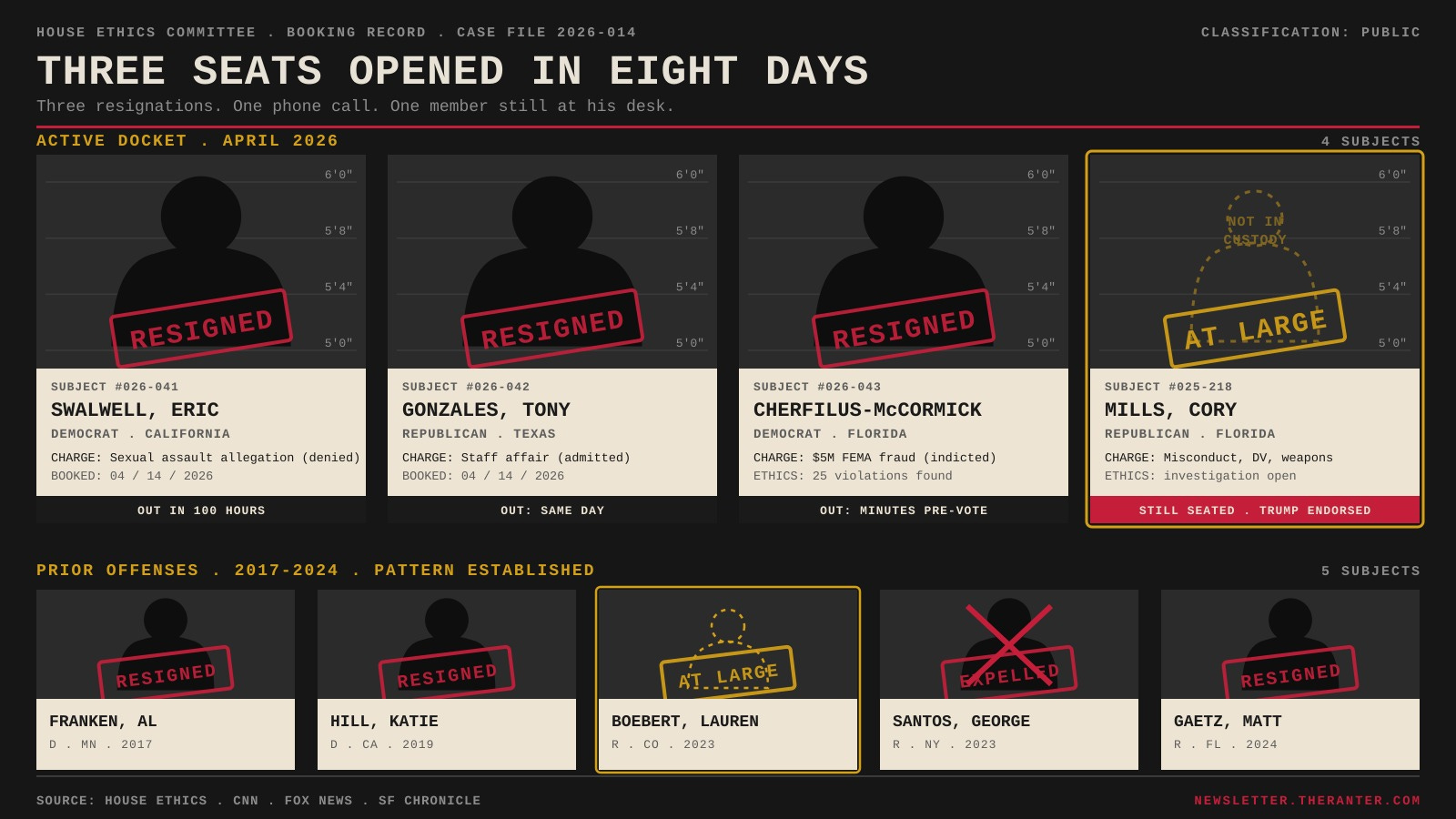
Gonzales, Republican of Texas, had admitted on a podcast in March that he’d had an affair with a former staffer who later died by suicide. He said he wouldn’t run for re-election. He did not resign. He resigned on April 14, the same day Swalwell did, and only after female lawmakers from both parties phoned their colleagues demanding that whatever happened to Swalwell happen to Gonzales too. CNN reported the calls.
Cherfilus-McCormick, Democrat of Florida, was indicted in November 2025 for stealing nearly $5 million in FEMA COVID-19 disaster funds through her family’s healthcare company, some of it used to finance her 2021 campaign. She faces up to 53 years in prison. The House Ethics Committee found her guilty of 25 violations in March. She resigned on April 21 with minutes to spare before the committee’s sanctions vote, after Pelosi went on Fox News and said, on the record, “Let’s just get this over with.”
In the same Fox News interview, Pelosi named a second Florida member who should be removed from Congress. His name is Cory Mills. He is a Republican.
Mills has been under House Ethics Committee investigation since November 2025 for sexual misconduct, dating violence, campaign finance violations, improper gifts, and misuse of congressional resources. A Florida judge issued a restraining order against him in October 2025. An Office of Congressional Ethics report flagged potential federal-law violations tied to nearly $1 million in weapons contracts held through entities connected to him and his wife.
Speaker Mike Johnson, asked on April 14 whether Mills should be expelled, told CNN: “I’m not sure the status of the Ethics Committee investigation. That’s one of the things I’ll be looking into today.”
Donald Trump endorsed Mills for re-election in February.
Two Florida members. Same week. Same kind of Ethics finding. Two party leaders’ responses, a world apart.
The pattern is older than this news cycle.
Al Franken was out 21 days after the Leeann Tweeden photo surfaced in November 2017. Thirty-six Senate Democrats publicly called for his resignation within a day of a seventh allegation. Seven senators later told the New Yorker they regretted the rush. Patrick Leahy called his own vote “one of the biggest mistakes I’ve made.” The mechanism sometimes overshoots. It still operates.
Katie Hill resigned 9 days after RedState first published the affair story in October 2019. Pelosi called her conduct “errors in judgment that made her continued service as a Member untenable.”
Lauren Boebert vaped and groped her date in the Buell Theater in Denver in September 2023. Surveillance video made the initial denial impossible. She apologized after five days. No House Ethics investigation was opened. No Republican leader called for her to resign. She switched to a safer Republican district and won her 2024 election by eleven points with a Trump endorsement.
The only modern Republican expulsion ran through George Santos, and it required 23 federal criminal charges, a House Ethics report finding “substantial evidence” of theft from campaign donors, three separate expulsion resolutions, and even then Speaker Johnson and Majority Leader Scalise publicly opposed removing him. The final vote was 311 to 114. One hundred and five Republicans voted yes. One hundred and twelve voted to keep him seated.
Matt Gaetz was under House Ethics investigation for nearly four years. The committee found substantial evidence he had sex with a 17-year-old and paid roughly $90,000 to twelve women. The final report came out only after he resigned and withdrew from the Attorney General nomination. No expulsion attempt was filed during his tenure.
One party has a mechanism for removing its own. It sometimes overshoots. It sometimes operates on less evidence than the institution deserves. But, it operates.
The other party has a Speaker who is looking into the status. It has a President endorsing an accused member’s re-election. Its one modern expulsion required criminal indictments, Ethics findings, and a majority of its own caucus voting against expulsion anyway.
The leadership receipts drive the mechanism observation here. Pelosi picked up the phone and Schumer drew the line on Franken. Johnson is looking into the status and Trump endorsed the investigation target.
Cory Mills is still in Congress this morning. So is the Trump endorsement. So is the open investigation. The receipts are not being weighed differently because one side is partisan and the other isn’t. They are being weighed by two different machines.
One of them is running.
THE RANTER follows the money through the systems that bill you: healthcare, housing, food, labor, debt, political money. Mechanism over motive.
Newsletter: newsletter.theranter.com | Website: theranter.com
YouTube: @TheRanterOfficial | Instagram: @theranterofficial | TikTok: @theranterofficial | X: @RanterMarkus | Bluesky: @rantermarkus.bsky.social
Every figure above is sourced and linked. Think one is wrong? corrections@theranter.com