

By Markus Grant | The Ranter
The last article asked why we do not chase villains. This one shows where the villains go after they leave.
Not to jail. Not to retirement. To the industry they just finished regulating.
The path is so well worn it has a name. Washington calls it the revolving door. That makes it sound like an accident, like somebody got turned around on their way out. Nobody gets lost. They leave through the front door with a job offer in hand.
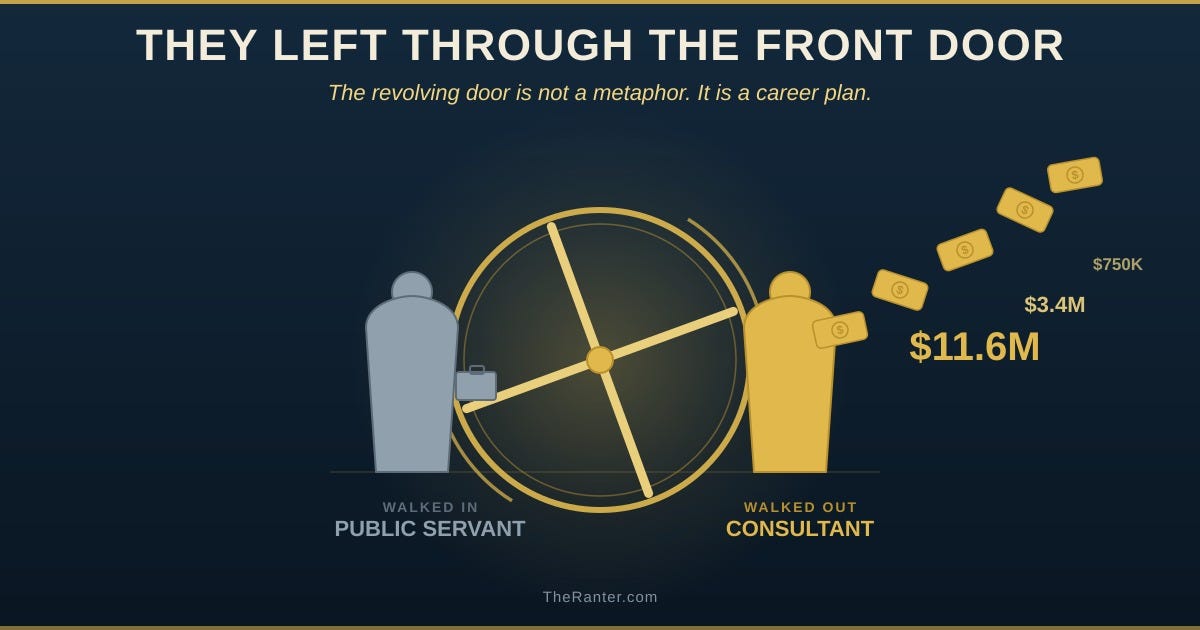
Washington calls it public service. K Street just calls it onboarding.
Billy Tauzin represented Louisiana’s Third Congressional District for 25 years. In his final term, he chaired the House Energy and Commerce Committee. That committee wrote Medicare Part D, the prescription drug benefit that passed in 2003. Built into the law was a single provision that would shape pharmaceutical pricing for the next two decades: Section 1860D-11, which prohibited Medicare from negotiating drug prices. [1]
The Congressional Budget Office later estimated that allowing Medicare to negotiate would have saved more than $450 billion over ten years. [2]
Tauzin left Congress in January 2005. The same day his term ended, he started his new job as president and CEO of PhRMA, the pharmaceutical industry’s trade association. [3] His salary was reported at $2 million per year. In 2010, his final year at PhRMA, his compensation reached $11.6 million. Bloomberg confirmed it made him the highest-paid lobbyist among groups involved in the healthcare debate. [4]
Between those two jobs, Tauzin brokered one more deal. During the 2009 Affordable Care Act negotiations, he sat across from White House Deputy Chief of Staff Jim Messina and secured a cap: the pharmaceutical industry would contribute $80 billion in cost reductions to the ACA. In exchange, two provisions would stay off the table. Drug reimportation from Canada. And Medicare price negotiation. [5]
The man who wrote the law banning negotiation became the man who defended it, and he was paid $11.6 million in a single year to do so.
They are not selling access. They are selling memory. Committee memory. Regulatory memory. All the phone numbers you collect in the name of serving the public.
That is one door. Here is a hallway full of them.
Don Nickles served as a Republican senator from Oklahoma for 24 years. He sat on the Senate Finance Committee. He helped shape Medicare Part D alongside Tauzin. After leaving the Senate in 2005, he founded the Nickles Group, a lobbying firm. Its clients include pharmaceutical companies. Between 2018 and 2025, the firm reported $59.2 million in total lobbying income, with $7.87 million in 2023 alone. [6]
John Breaux served as a Democratic senator from Louisiana. He also sat on the Finance Committee. He also helped shape Part D. He also left the Senate and became a lobbyist. His firm, the Breaux Lott Leadership Group, received $300,000 from pharmaceutical clients in 2009 while lobbying on the Affordable Care Act. ProPublica documented that at least 25 former members or staffers who helped write Part D later registered to lobby for the pharmaceutical industry during the ACA debate. [7]
Two parties. Same committee. Same law. Same exit.
Richard Burr served as a Republican senator from North Carolina for nearly 28 years. For much of that time he sat as either Chair or Ranking Member of the Senate Health, Education, Labor, and Pensions Committee: the committee that controls pharmaceutical and healthcare legislation. Burr left the Senate in January 2023. By February, he was at DLA Piper as Principal Policy Adviser and Chair of their Health Policy Strategic Consulting Practice. [20] DLA Piper’s confirmed healthcare clients include Genentech, Braun Medical, Biohaven, and Intra-Cellular Therapies. He is barred from lobbying his former colleagues for two years. He does not actually need to. “Strategic consulting” on health policy for pharmaceutical clients is not lobbying. It is the same expertise with a different business card. The Washington Examiner called it the Great 2023 Cashout. [21]
Louisiana sent four members through the door in one decade. Tauzin, Breaux, Landrieu, Vitter. Both parties. Both chambers. Pharma, energy, environment, finance. Louisiana ranks near the bottom in education, healthcare, and median income. It currently holds both the Speaker of the House and the Majority Leader. In most states that record would be a scandal. In Louisiana it is a parade. Huey Long said every man a king. He was off by one word. Every chairman a consultant.
Kevin Brady chaired the House Ways and Means Committee for six years. In that role, he was the chief architect of the 2017 Tax Cuts and Jobs Act, the first major rewrite of the federal tax code since 1986. [27] The law cut the corporate tax rate from 35 percent to 21 percent, restructured the treatment of pass-through income, and created new deductions for specific industries. Many of its provisions were written with built-in expiration dates, set to sunset in 2025. Brady left Congress in January 2023. In May 2024, Akin Gump announced he was joining as a Senior Consultant in their Lobbying and Public Policy practice. [28] His focus: advising clients on the extension and modification of the tax law he wrote. The Hill called the hire a strategic move “ahead of the tax fight.” [29] The man who designed the expiration dates is now paid to influence what replaces them.
The Lobbying Disclosure Act was supposed to slow this down. It requires registration for anyone who spends more than 20 percent of their time on lobbying activities. The result was not compliance. The result was “strategic adviser.” Tom Daschle, the former Senate Majority Leader, proved how well the workaround works. After losing his seat in 2004, he joined Alston and Bird at $2.1 million per year and advised healthcare companies for eleven years without registering as a lobbyist. The loophole became so notorious that Politico ended up naming it after him: the Daschle Loophole. [8] [9] Burr uses it. Sinema uses it. Manchin uses it. The title changes. The function does not.
Sometimes they write the law and cash out. Sometimes they skip the word “lobbyist” and cash out anyway. Sometimes they regulated the industry for two years and joined the board before the chair was cold.
Now watch what happens when the door swings from the regulatory side.
Scott Gottlieb led the Food and Drug Administration for two years, from May 2017 to April 2019. During that time, the FDA regulated every major pharmaceutical manufacturer in the country. Eighty-three days after leaving the agency, Gottlieb joined Pfizer’s board of directors. [11]
In November 2025, he joined UnitedHealth Group’s board as well. The nation’s largest health insurer. A former drug regulator now sits on the boards of both a pharmaceutical manufacturer and a health insurance company. [12]
Evan Bayh served as a Democratic senator from Indiana. He sat on the Banking, Housing, and Urban Affairs Committee and the Armed Services Committee. In the Senate, he voted against a procedural motion to advance carried interest reform. Seven months later, he joined Apollo Global Management as a senior adviser. [13]
Apollo, through its LifePoint and ScionHealth platforms, controls approximately 71 rural hospitals.
Pat Toomey served as a Republican senator from Pennsylvania. He sat on the Banking and Finance Committees. During the 2017 Tax Cuts and Jobs Act negotiations, Toomey helped preserve the carried interest loophole. Industry lobbyists called him an “all-star” in that fight. [14] In February 2023, less than a month after leaving the Senate, Toomey joined the board of Apollo Global Management. His first-year compensation included $600,000 in restricted stock and a $150,000 cash retainer. [15]
Joe Manchin served as a Democrat, then an independent senator from West Virginia. He chaired the Senate Energy and Natural Resources Committee. He left the Senate in January 2025. On February 6, Apollo announced that Manchin would serve as an adviser to the firm and join the board of Athene Holding, Apollo’s insurance subsidiary. [30] His advisory focus: energy markets. While Manchin was in the Senate, his daughter Heather Bresch was CEO of Mylan Pharmaceuticals. Between 2007 and 2016, Mylan raised the price of the EpiPen from roughly $100 to more than $600. Bresch’s compensation rose from $2.4 million to $18.9 million over the same period. [24] Manchin received $127,000 in campaign contributions from Mylan executives. [25] His wife, Gayle Manchin, led the National Association of State Boards of Education and pushed to require schools to stock EpiPens. [26] Manchin sat on committees with jurisdiction over pharmaceutical pricing. He did not move to cap the price. Mylan later paid $465 million to settle federal claims that it had overcharged Medicaid by $1.27 billion. Nobody went to jail. Bresch retired in 2020. Manchin left the Senate in 2025 and joined Apollo.
Three senators. Three different political affiliations. The same firm. Bayh arrived in 2016. Toomey in 2023. Manchin in 2025. Apollo does not have a political preference. It has a hiring pattern.
Eric Cantor served as House Majority Leader from 2011 to 2014, the second-ranking position in the House. He controlled which legislation reached the floor: financial reform bills, derivative regulations, capital rules. What advanced and what died quietly in committee was, for years, largely his call. Cantor lost his primary in June 2014 and left Congress on August 18th. Within weeks, Moelis and Company announced he was joining as Vice Chairman and Managing Director. His package: a $400,000 base salary, a $400,000 signing bonus, $1 million in stock options, a minimum $1.2 million cash incentive in year two, and a New York City apartment paid for by the firm. Reported total: $3.4 million. [22] Dennis Kelleher, CEO of financial reform group Better Markets, said Cantor would now be fighting against the same capital rules and carried interest reforms he had helped block in Congress. [23] Cantor did not object. He took the job.
Kyrsten Sinema of Arizona left the Senate in January 2025. By March, she was a senior adviser at Hogan Lovells, a global law firm with $2.96 billion in annual revenue. She does not register as a lobbyist. Emails subsequently surfaced showing local lobbying activity for an AI data center in Chandler, Arizona. Her former Senate aide, Daniel Winkler, registered as a lobbyist at the same firm. [16]
The door swings both directions, and nobody bothers to lock it behind them.
Public Citizen studied the 115th Congress. They found that nearly two-thirds of former members who took private sector jobs went into roles designed to influence federal policy. [19] The revolving door is not an individual scandal. It is a staffing pipeline. The system trains people in government, seasons them with committee assignments and regulatory knowledge, and then the private sector comes back to hire them for exactly the expertise they picked up on the public payroll.
This is not corruption after the fact. It is deferred compensation.
That is why your pharmacy bill survives every election. Why the tax loophole outlasts the congressman who wrote it. The staff changes. The incentive package does not.
The problem is not that the door exists. Every democracy has people who move between public and private life. The problem is that the door is the compensation plan. The congressional salary is the internship. The real paycheck comes after.
Tauzin: $11.6 million. Brady: hired to lobby on the tax law he wrote. Toomey: $750,000 in his first year at Apollo. Cantor: $3.4 million before the first performance review. Gottlieb: board seats at Pfizer and UnitedHealth. Bresch: $18.9 million in the same year her father’s committees declined to act.
These are not exceptions. These are the top performers.
They do not leave government despite what they did there. They leave, precisely, because of it.
The next article in this series follows the money from the other direction: the contributions that arrive before the votes, the committee assignments that determine who gets paid, and the legislative pipeline that connects the check to the chairmanship.
Sources
[1] Social Security Act, Section 1860D-11(i): “the Secretary may not interfere with the negotiations between drug manufacturers and pharmacies and PDP sponsors.” Medicare Modernization Act of 2003.
[2] Congressional Budget Office, H.R. 3 (Elijah E. Cummings Lower Drug Costs Now Act) scoring, December 2019. Projected $456 billion in savings over 10 years.
[3] Sunlight Foundation, “The Legacy of Billy Tauzin: The White House-PhRMA Deal,” February 12, 2010. OpenSecrets Revolving Door profile.
[4] Bloomberg, “Tauzin’s $11.6 Million Made Him Highest-Paid Health-Law Lobbyist,” November 29, 2011.
[5] Sunlight Foundation, February 2010. Bill Moyers, “The Lobbyist Who Made You Pay More at the Drugstore,” March 2016. ProPublica, “Obama’s Deal,” 2009.
[6] OpenLobby, Nickles Group annual revenue 2018-2025. CBS News, “Health Care Lobbyists’ Rise to Power,” 2009.
[7] ProPublica, “Medicare Drug Planners Now Lobbyists, With Billions at Stake,” October 19, 2009. Breaux Lott Leadership Group pharmaceutical client revenue.
[8] Center for Public Integrity, 2009 ($2.1M, Alston and Bird). Tom Daschle financial disclosure filings, 2008.
[9] Politico, “Tom Daschle finally registers as a lobbyist,” March 2016. Public Citizen, “Revolving Congress,” June 2019.
[11] CNBC, “Former FDA Commissioner Scott Gottlieb joins Pfizer’s board of directors,” June 27, 2019. FDA departure: April 5, 2019. Pfizer board: June 27, 2019. 83 days.
[12] Healthcare Dive / Fierce Pharma, November 2025. UnitedHealth Group board appointment.
[13] Associated Press, October 2016. Mother Jones, May 2022. Politico, September 2016. OpenSecrets, Bayh revolving door profile.
[14] The Lever, “Private Equity’s Senator Gets Big Payout,” February 22, 2023.
[15] Jacobin, “Former Senator Pat Toomey Has Walked Through the Revolving Door,” February 27, 2023. Bloomberg, Apollo director compensation structure.
[16] Reuters/Politico, 2025. AZFreeNews, 2025. Hogan Lovells 2024 revenue: $2.96 billion.
[19] Public Citizen, “Revolving Congress: The Revolving Door Class of 2019 Flocks to K Street,” June 2019.
[20] Bloomberg Law, “Ex-Senator Richard Burr Joins DLA Piper as Health Policy Leader,” February 2023. DLA Piper press release, February 7, 2023. STAT News, “Richard Burr to join health care practice at law and lobbying firm,” February 7, 2023.
[21] Washington Examiner, “The Great 2023 Cashout begins with Richard Burr joining lobbying giant DLA Piper,” February 2023.
[22] TIME, “Eric Cantor Joins Wall Street Investment Bank Moelis and Company,” September 2014. Newsweek, “Eric Cantor Lands $3.4 Million Investment Banking Job,” September 2014.
[23] Fortune, “What’s really outrageous about Eric Cantor’s Wall Street gig,” September 4, 2014.
[24] Washington Post, “Senator’s daughter who raised price of EpiPen got paid $19 million salary, perks in 2015,” August 24, 2016. NBC News, “Mylan CEO’s Pay Rose Over 600 Percent as EpiPen Price Rose 400 Percent,” August 2016.
[25] The Intercept, “Heather Bresch, Joe Manchin’s Daughter, Played Direct Part in EpiPen Price Inflation Scandal,” September 7, 2021. NRSC, “Mylan executives open up wallets for Manchin,” April 2018.
[26] The Intercept, September 7, 2021. Washington Free Beacon, “Government Funds to Mylan Spiked After Manchin’s Daughter Became CEO.”
[27] Tax Foundation, “The Tax Cuts and Jobs Act,” December 2017. Joint Committee on Taxation scoring.
[28] Akin Gump press release, “Former Ways and Means Committee Chairman Kevin Brady Joins Akin’s Lobbying and Public Policy Practice,” May 2024.
[29] The Hill, “Lobbying World: Akin snags former Ways and Means chair ahead of tax fight,” May 2024.
[30] Athene Holding / GlobeNewsWire, “Former U.S. Senator Joe Manchin to Serve as Adviser to Apollo and Appointed to Athene Board of Directors,” February 6, 2025.