

Yesterday, 2,775 people in the Quad Cities got a letter telling them their medical debt was gone. About $3.5 million in bills, erased.
Across five states, the same effort cleared more than $30 million for over 26,000 people.
The donation that did it was $200,000.
Good news for 26,000 people, and I am not going to pretend otherwise.
One caveat, since it is my own hook and it should meet the same standard as everything else here. The $200,000 comes from local news coverage, several outlets carrying what reads like the same source material. No release from the foundation or the charity turned up. Take that figure as reported rather than proven. The ones below it are audited.
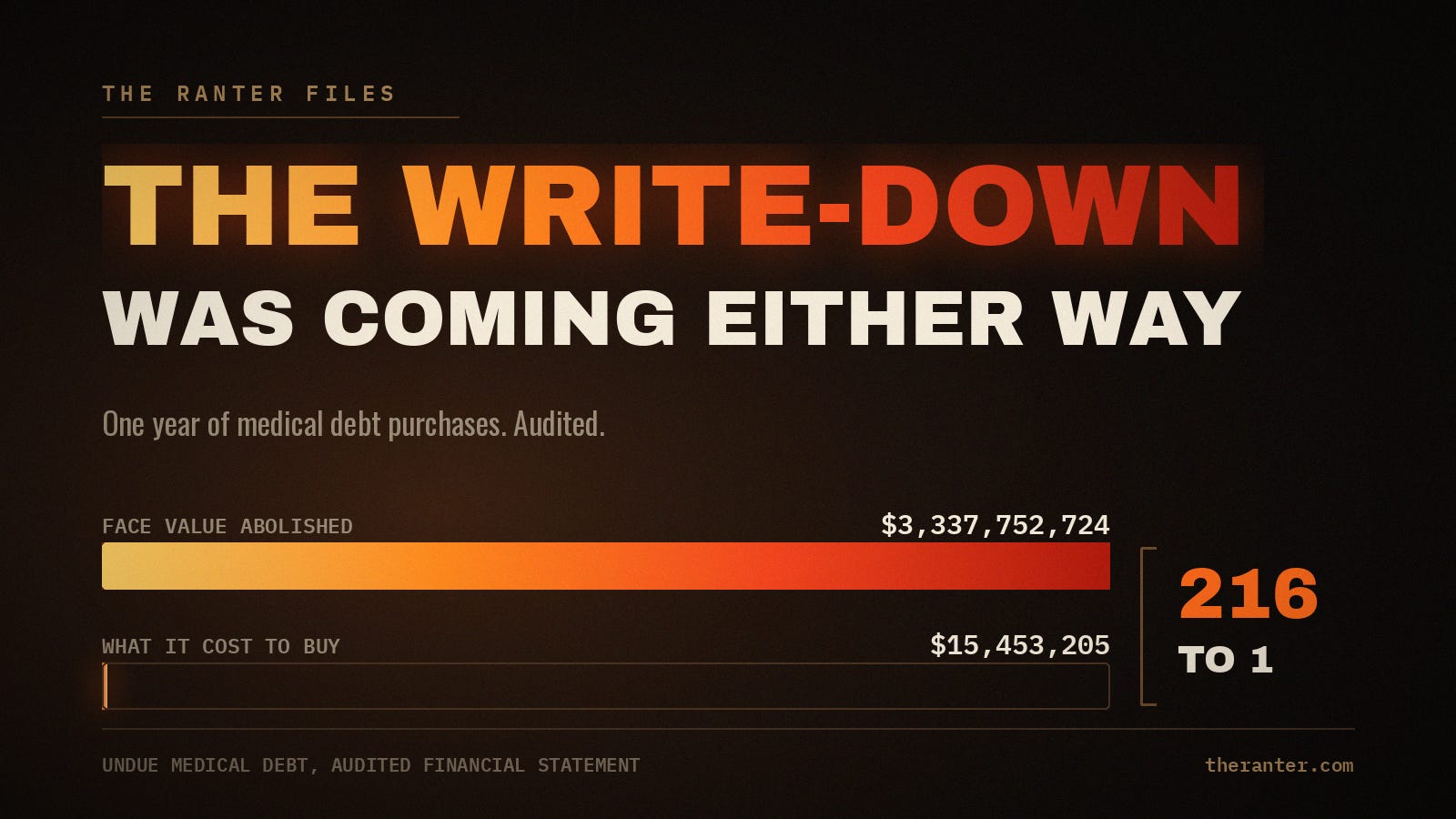
Undue Medical Debt, the outfit that buys this paper, files audited financial statements. In one recent year they spent $15,453,205 and wiped out $3,337,752,724 in face value. 216 dollars of debt for every dollar spent. Half a cent, with an auditor’s name on it.
A medical bill opens at the sticker price. Hospitals keep a master price list, and if you have insurance you never pay those numbers, because your insurer negotiated them down years ago. If you do not, the sticker price is your price. Highest number in the building, handed to whoever has the least protection.
Then you cannot pay, because most people cannot. It moves to collections. When collections stalls, it goes to court.
One hospital system in Colorado filed 24,843 lawsuits against patients over five years, seeking about $76.6 million, according to a study out of George Washington University and Stanford.
The hospital’s name was not on most of the filings. They went out through two collection companies working on its behalf.
CollectionCenter Inc. and Credit Service Company. Somebody chose those names. They are built to sound like a filing cabinet, like weather, like nothing at all, while the hospital with its name on the building and on your wristband never appears on the docket.
Only after all of that fails does the paper get sold. Aged, picked over, dropped into a pool of thousands of accounts nobody can tell apart. Half a cent is what comes out the other end.
The lawsuit happens while the number still has a number attached to it. They are trying to reach you on the way down.
That $200,000 gift worked because the debt had already collapsed. The write-down was coming either way. The only thing still undecided was whether the patient spent five years getting sued first.
Nonprofit hospitals get a tax exemption. In exchange, Section 501(r) requires each of them to write a financial assistance policy, publicize it, post it online, and hand you a paper copy if you ask. It caps what they can charge you. If you qualify, a hospital may not bill you more than it generally bills insured patients.
Before it sues you, garnishes your wages, or reports you, a nonprofit hospital is supposed to make a reasonable effort to find out whether you qualified for help.
Reasonable effort. That phrase has been sitting in the tax code since 2010, and I would love to know what it has cost anybody.
In those sixteen years the public record shows one confirmed case of a hospital losing its exemption over 501(r), through an adverse determination letter in 2017. A law firm reported a second, unnamed case in 2024. The IRS reviews every tax-exempt hospital at least once every three years. What comes out the other side is harder to find.
My first instinct is that nobody there cares, and that is not fair and I know it. Those reviews run off Form 990s and hospital websites. Whether a particular hospital checked a particular patient’s eligibility before filing against them is not the sort of thing that shows up in a filing.
Somebody pays for that exemption, too. A tax exemption is a bill everybody else covers, which makes that financial assistance policy something you have already bought. You are a customer of it whether or not you have ever been a patient in the building.
In January 2025 the CFPB finalized a rule pulling medical debt off credit reports entirely. On July 11, 2025, a federal judge in Texas vacated it by consent, after the CFPB under new leadership joined the industry groups asking for it thrown out. The agency sued alongside the people suing the agency. That October it said federal law preempts state medical debt laws as well.
Medical debt is not off your credit report. The rule that would have done it is dead. What survived is older and much narrower: the three credit bureaus agreed on their own in 2023 to drop paid medical collections and unpaid ones under $500. Plenty of consumer finance sites still describe the vacated rule as though it took effect. If you have been assuming your medical debt cannot reach your credit file, check before you rely on it.
One question, in writing, to the hospital’s billing office:
Was I screened for financial assistance before this went to collections?
Keep the reply. If they went to court without checking, they skipped the step the tax code told them to take, and you have that on paper. Ask for the financial assistance policy and the plain-language summary in the same message, because they have to give you both. If you qualify, tell them you are invoking the cap on what they can bill you.
Do not call and offer them half a cent. That price exists only because the buyer takes thousands of accounts blind and cannot tell which ones will ever pay. Offer it one patient at a time and everybody takes it, including people who could have paid in full. The discount survives only as long as you cannot ask for it.
Maine’s LD 2129 took effect this week and bars liens on your home and wage garnishment over medical debt. California, Colorado, Minnesota, Oregon, Washington, New Jersey, and Maryland have all passed something in the past three years. Check yours.
A charity cancelling your debt arrives as a gift. A hospital or collector forgiving $600 or more directly will generally issue a 1099-C, which the IRS may treat as income unless an exclusion such as insolvency applies.
Twenty-six thousand people got a letter this month saying they were free, and it cost somebody two hundred grand. The debt was never worth what they were being sued for, and everyone holding that paper knew it the whole time.
Your bill has two prices on it. You have only ever been shown the big one.
Related episode: The Billing Trap
Related read: The Bill Says Hospital
THE RANTER follows the money through the systems that bill you: healthcare, housing, food, labor, debt, political money. Mechanism over motive.
Newsletter: newsletter.theranter.com | Website: theranter.com
YouTube: @TheRanterOfficial | Instagram: @theranterofficial | TikTok: @theranterofficial | X: @RanterMarkus | Bluesky: @rantermarkus.bsky.social
Every figure above is sourced and linked. Think one is wrong? corrections@theranter.com