

The Department of Veterans Affairs negotiates prescription drug prices for its beneficiaries. It covers about 9 million people. Medicare covers about 67 million people and is prohibited by statute from negotiating. Per GAO report 21-111, the VA paid on average 54% less per unit than Medicare Part D across 399 brand-name and generic drugs in 2017, even after accounting for Medicare’s rebates and price concessions. For 106 of those drugs, the VA price was at least 75% lower.
The difference between those two outcomes is three words inside a law Congress passed in 2003.
“May not interfere.”
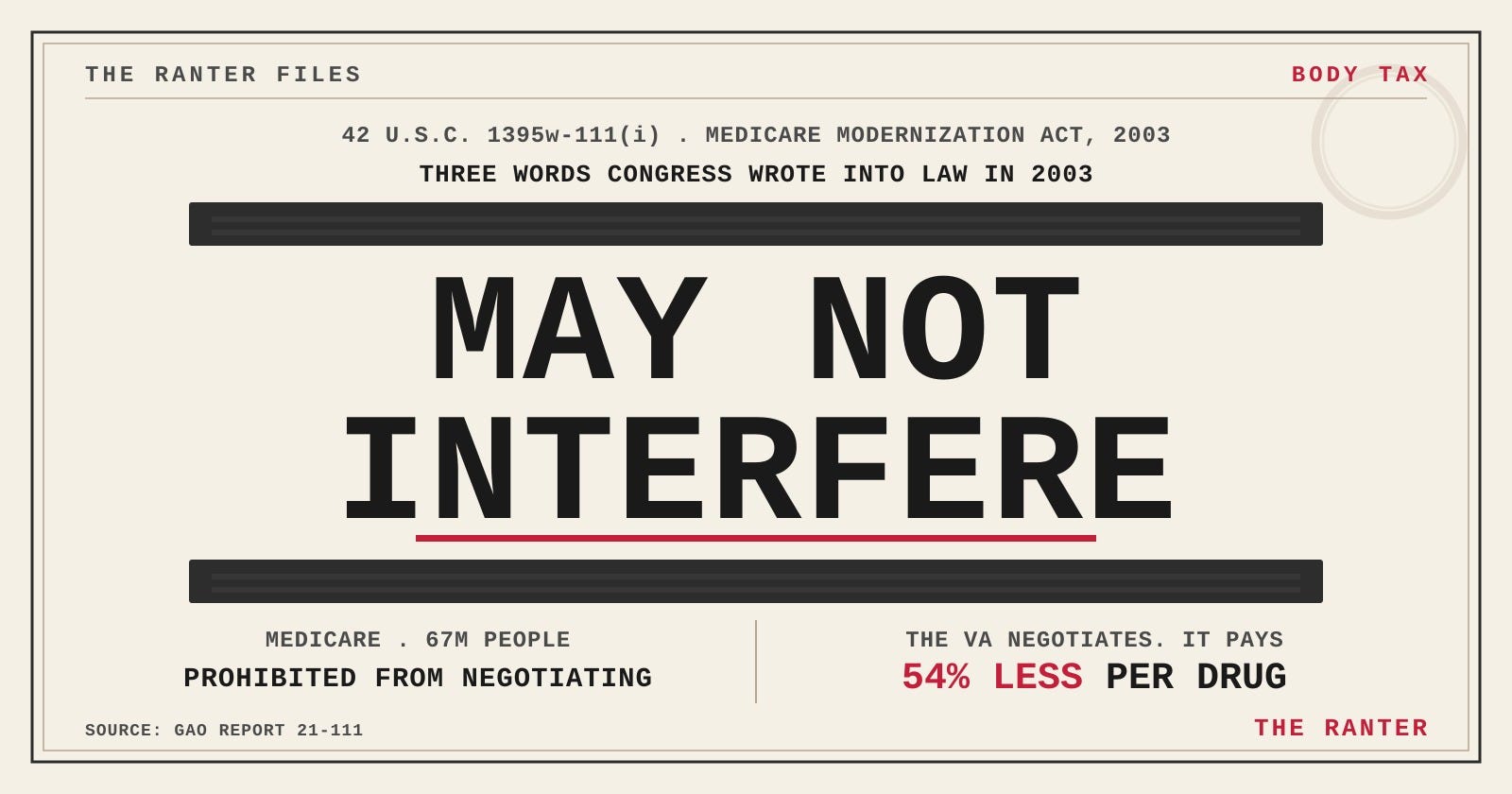
That is the rule. It lives inside 42 U.S.C. Section 1395w-111(i), the Non-Interference Clause of the Medicare Modernization Act. The Secretary of Health and Human Services, who runs the largest drug-buying operation in the country, “may not interfere” with the negotiations between manufacturers and the middlemen who run Medicare drug plans. The biggest single buyer in America, by federal law, does not negotiate.
President George W. Bush signed the MMA on December 8, 2003. The chairman of the House Energy and Commerce Committee that shepherded the bill through was Rep. Billy Tauzin of Louisiana. Tauzin had started his career as a Democrat and switched parties in 1995.
Tauzin left Congress in January 2005. He started at PhRMA that same month. According to a Public Citizen ethics complaint filed in January 2004 and CNN reporting from the same period, PhRMA had opened employment negotiations with Tauzin while he was still in Congress shepherding the MMA to passage. Contemporary reporting pegged his PhRMA starting salary around $2 million. By 2010, his final year at PhRMA, total compensation had climbed to $11.6 million per Bloomberg and National Journal data.
Candidate Barack Obama ran 2008 campaign ads attacking this exact revolving-door sequence.
Then Obama won. And what did a Democratic trifecta do about the three-word ban Tauzin had written?
They kept it.
During the Affordable Care Act fight in 2009, the Obama White House brokered an $80 billion cost-cutting deal with PhRMA, still led by Tauzin. The deal preserved the Non-Interference Clause intact. In exchange, PhRMA spent roughly $100 million on ads backing the ACA. The White House got its votes. Medicare kept its gag.
From 2003 to 2022, Democrats controlled the House for 8 of those 19 years and the Senate for 12 of them, with full trifectas in 2009-2010 and 2021-2022. The sentence stayed.
In August 2022, the Inflation Reduction Act finally chipped at it. Signed by Biden, passed via budget reconciliation without a single Republican senator’s vote. The law authorized Medicare to negotiate prices for ten drugs. On January 1, 2026, those negotiated prices took effect. CMS reported cuts ranging from 38% to 79% off 2023 list prices on Eliquis, Jardiance, Xarelto, Januvia, Farxiga, Entresto, Enbrel, Imbruvica, Stelara, and Fiasp/NovoLog.
Ten drugs.
Medicare’s Part D formulary covers thousands. The IRA schedule adds 15 more drugs in 2027, 15 more in 2028, 20 per year after that. By 2029, after 26 years of the sentence being federal law, roughly 60 drugs will be negotiable. The rest will not.
Washington is already chipping the other way. The 2025 budget reconciliation (signed July 4, 2025 as the One Big Beautiful Bill Act) broadened the IRA’s orphan drug exclusion, narrowing which drugs qualify for negotiation. CBO estimates the change will add $8.8 billion to Medicare spending over the 2025-2034 decade. That is an 80% upward revision from CBO’s earlier $4.9 billion estimate. The Trump administration’s April 2025 Executive Order 14273 modified the program’s implementation further.
“May not interfere” still holds.
Every mechanism downstream of that sentence depends on it holding. The biggest single drug buyer in the country, by statute, is prohibited from doing what every other buyer of anything does when the price is too high. The VA does it. So do Walmart, Costco, Kaiser, and every commercial health insurer in America. What most people assume protects them from paying too much for their prescriptions is the one thing the law explicitly forbids.
Related episode: The Cure Heist: How Drugs Get Priced (EP02)
Related read: Why Paying $72,000 Made Money
THE RANTER follows the money through the systems that bill you: healthcare, housing, food, labor, debt, political money. Mechanism over motive.
Newsletter: newsletter.theranter.com | Website: theranter.com
YouTube: @TheRanterOfficial | Instagram: @theranterofficial | TikTok: @theranterofficial | X: @RanterMarkus | Bluesky: @rantermarkus.bsky.social
Every figure above is sourced and linked. Think one is wrong? corrections@theranter.com