

By Markus Grant | The Ranter
Ron DeSantis appointed all five members of the Florida Public Service Commission. In November 2025, those five commissioners approved a $6.9 billion rate hike for Florida Power & Light, widely described as the largest for a single utility in American history. Twelve million Floridians will pay an average of $175 more per year starting in January 2026, climbing to $289 more by 2028. The Office of Public Counsel (the state’s official consumer advocate) opposed FPL’s proposal and was excluded from the final settlement. Twenty-nine elected officials from both parties wrote a letter asking DeSantis to intervene. He did not.
Gavin Newsom appointed all five members of the California Public Utilities Commission. In July 2019, those five commissioners watched him sign Assembly Bill 1054, creating a $21 billion wildfire liability fund for investor-owned utilities, including PG&E, which was in bankruptcy at the time for killing 85 people. The law changed the liability standard so that utilities are presumed to have acted responsibly after obtaining a safety certificate. Ratepayers pay $10.5 billion of that fund through monthly surcharges. In 2022, state regulators approved PG&E’s safety certification. PG&E then accessed over $609 million from the ratepayer-funded wildfire fund to cover damages from the Dixie Fire, which PG&E’s own equipment had started.
One is a Republican in Florida. The other is a Democrat in California. They agree on one thing that neither will say out loud: the governor appoints the regulators, and the regulated pay the governor.
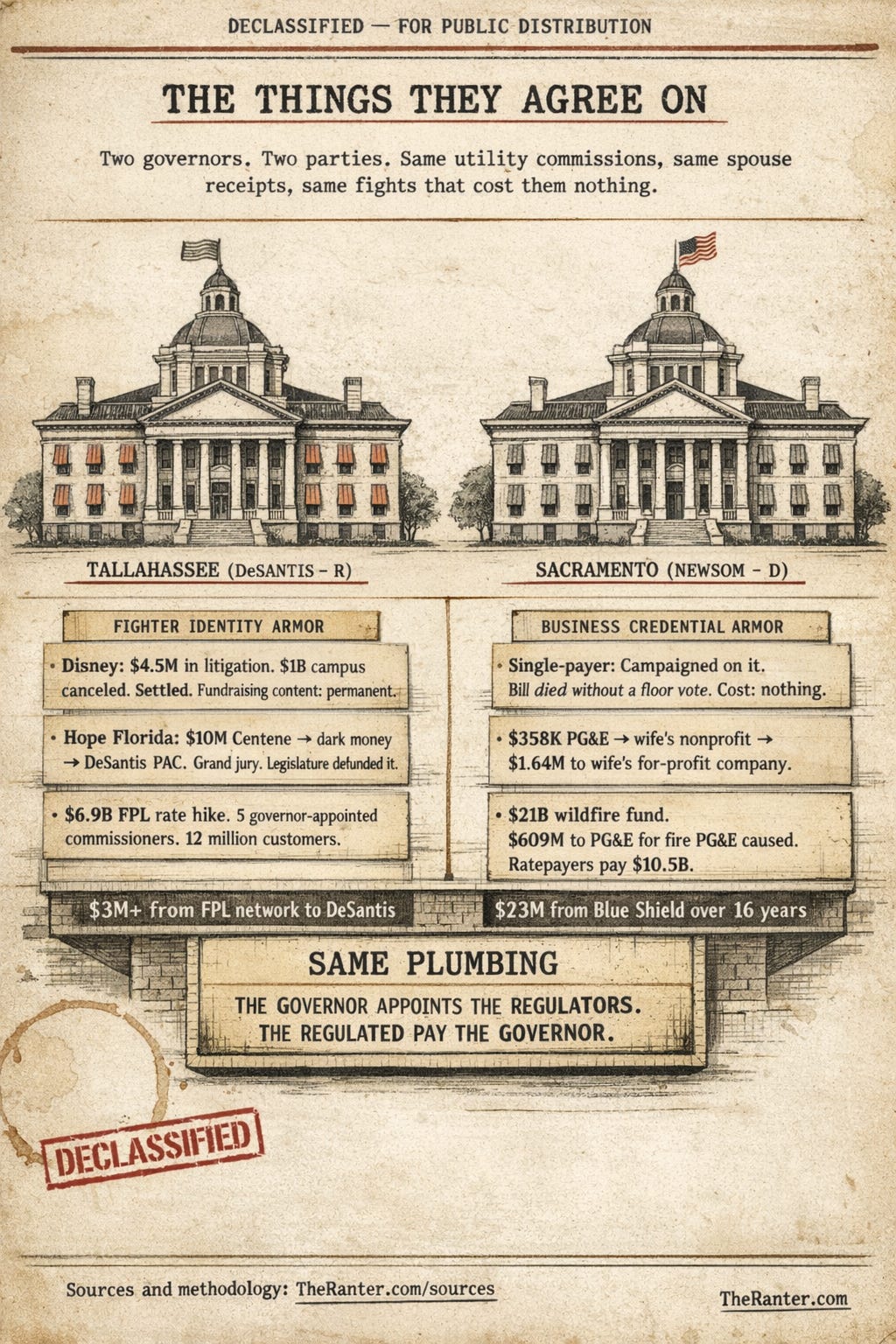
DeSantis received over $3 million from FPL and a network of business front groups and dark money nonprofits that FPL helps fund, per the investigative newsletter Seeking Rents. FPL’s parent company, NextEra Energy, and its subsidiaries poured nearly $6 million into Florida state campaigns during the 2022 cycle alone, per the Energy and Policy Institute. Before the rate hike, DeSantis signed legislation that forced the resignation of J.R. Kelly, the longtime head of the Office of Public Counsel who had fought previous FPL increases. Kelly’s replacement was a former utility lobbyist. DeSantis also signed a bill granting FPL permission to charge customers tens of billions for burying power lines, signed legislation preventing local gas bans that benefited FPL’s sister company Florida City Gas, and gave the company $2.75 million in tax breaks on speculative green hydrogen projects.
Four years before the $6.9 billion approval, DeSantis’s PSC approved a separate $5 billion rate hike for FPL. All four of his appointees voted for the deal. Consumer groups appealed to the Florida Supreme Court. FPL’s lawyers argued the deal should stand because the Office of Public Counsel supported it. The same Office of Public Counsel whose director DeSantis had replaced.
Newsom’s utility math runs through his wife. PG&E’s corporate foundation donated $358,000 to Jennifer Siebel Newsom’s nonprofit, The Representation Project, between 2011 and 2018. The Washington Post found that Newsom, his wife, and various political causes received upward of $700,000 from PG&E over approximately two decades. The most recent cycle added another $700,000 through direct contributions and funding for Siebel Newsom’s film ventures, per California Courier News. PG&E employees gave $58,400 directly to his 2018 campaign. Blue Shield of California gave nearly $23 million to his campaigns and associated causes over sixteen years, per California Healthline.
In 2018, 979 state vendors gave Newsom $10.5 million in campaign donations across his various election cycles. Those same companies received $6.2 billion in state payments. Open the Books, the nonprofit that compiled the data after filing 442 public records requests, noted that pay-to-play is legal in California because no statewide prohibition exists.
The governor appoints the regulators. The regulated pay the governor. The mechanism does not require a party.
Both governors married well for the job.
Casey DeSantis founded the Hope Florida initiative, a welfare program operating through the Florida Department of Children and Families. The Hope Florida Foundation, its fundraising arm, received $10 million from Centene Corporation in September 2024. Centene is Florida’s largest Medicaid managed care contractor, operating under state contracts worth hundreds of millions.
Within days, the Foundation granted $5 million each to two 501(c)(4) dark money organizations. Both organizations had submitted grant proposals promising the money would not be used for political activity. Both redistributed the funds to Keep Florida Clean, a political committee chaired by James Uthmeier, DeSantis’s Chief of Staff. Keep Florida Clean sent $10.5 million to the Republican Party of Florida and $1.1 million to the Florida Freedom Fund, DeSantis’s personal PAC. Uthmeier chaired both.
DeSantis had also made Hope Florida a condition for Medicaid managed care operators selected to receive over $165 billion in contracts, the largest procurement in Florida history, per Politico. If you wanted one of those contracts, supporting the First Lady’s initiative was part of the application.
A Republican state representative, Alex Andrade of Pensacola, stated publicly that he was firmly convinced Uthmeier and Foundation attorney Jeff Aaron engaged in a conspiracy to commit money laundering and wire fraud. A Florida grand jury heard evidence in October 2025. The Florida House investigation halted after the Foundation refused to cooperate. The Republican-controlled legislature defunded Hope Florida in June 2025.
Jennifer Siebel Newsom runs The Representation Project, a nonprofit, and Girls Club Entertainment, a for-profit film production company. The nonprofit has paid the for-profit $1.64 million since 2012 for film production and licensing rights, disclosed as related-party transactions on IRS Form 990 filings. California public schools have paid approximately $1.5 million in licensing fees for her documentaries. The standard license is $270.
The shared donors between Newsom’s campaigns and his wife’s nonprofit include AT&T, Comcast, PG&E, and Kaiser Permanente. Companies regulated by agencies whose commissioners the governor appoints, donating to the governor’s wife’s organization, which then pays the governor’s wife’s company.
Nobody has been charged in either state. Everything documented here was legal at the time it happened.
Both governors also picked a fight they could not lose.
DeSantis went to war with Disney over the company’s criticism of the Parental Rights in Education Act. He signed legislation revoking Disney’s self-governing status in the Reedy Creek Improvement District, appointed a new oversight board, and spent over a year in litigation. The board budgeted $4.5 million for legal fees in 2024 alone. Disney canceled a planned $1 billion employee campus in Orlando.
Then it ended. Disney settled in March 2024, conceding the old development agreements were null and void. DeSantis replaced two Disney critics on the board with Disney supporters the day before the settlement. The Parental Rights Act had already been largely overturned by a court two weeks earlier. The fight was over. The fundraising content it generated was permanent.
DeSantis’s 2022 reelection raised $166.5 million. The culture war machinery, including the Disney fight, drove small-dollar contributions and Republican Governors Association transfers totaling $14.35 million. The fight did not cost him Disney’s money. Lodging and tourism remained his second largest contributing sector at $10.3 million in 2022, behind only Republican ideological organizations.
Newsom campaigned for governor on single-payer healthcare. The California Nurses Association endorsed him. They toured the state with a bus bearing his image and the slogan “Nurses Trust Newsom.” In January 2022, Assemblymember Ash Kalra introduced AB 1400, the California Guaranteed Health Care for All Act. The bill cleared the Assembly Health Committee 10 to 1. Then it died without a floor vote.
Newsom told reporters the bill had not been presented to him. CalMatters reported that as the bill marched toward defeat, the governor remained mum.
Blue Shield of California, which had given nearly $23 million to Newsom’s campaigns and causes over sixteen years, had $27.4 billion in annual revenue. A single-payer system would restructure every dollar of it. Every major health insurer with a California Medicaid contract had donated to Newsom. Centene gave $121,600 in 2018. UnitedHealth gave $63,400 plus subsequent contributions. The industry that would be eliminated by the policy Newsom promised spent millions ensuring he stayed in office. The bill never reached his desk. He expressed no objection to that outcome.
The fight he could not lose was the fight he never had. Disney cost DeSantis a year of litigation and a billion-dollar campus cancellation. Single-payer cost Newsom nothing. He kept the campaign promise on his website and the industry contributions in his account, and the bill died in a chamber his party controlled by a supermajority.
DeSantis wears Fighter Identity armor. The permanent appearance of combat. If you are always at war with Disney, nobody asks about the $6.9 billion rate hike his appointees approved five months later. The fight absorbs the attention. The utility math happens in the background.
Newsom wears Business Credential armor. PlumpJack, the wine empire co-founded with a billionaire heir, is estimated at over $400 million by Forbes. The blind trust. The $13 million reelection. The “pro-business progressive” who signs 31 housing bills and launches a state-branded insulin program. The credential makes the donor alignment sound like competence rather than capture. “I believe in markets AND government” is unfalsifiable, even when 979 vendors have receipts.
Both governors have done real things that cut against the money.
DeSantis fought Disney when the donor class wanted him to stop. Republican senators confirmed his PSC picks 40-0 and 36-0 and 35-1, but the Disney battle drew open criticism from members of his own party and from Trump’s campaign operation. He spent political capital on a culture war fight that his donor base in lodging and tourism had every reason to oppose. The fight was real, even if it was also useful.
Newsom launched CalRx and released state-branded insulin at $11 per pen, bypassing commercial pharmaceutical supply chains. He signed an oil well setback law banning new drilling within 3,200 feet of homes and schools. The oil industry spent over $20 million on a referendum to repeal it. They withdrew before voters could decide. He expanded Medi-Cal to cover 1.6 million undocumented immigrants at a cost of $9.5 billion per year, a program commercial health insurers had financial reason to oppose. He signed the most aggressive corporate climate disclosure laws in the country, covering over 5,300 companies, including many of his own donors.
The mechanism is not total capture. Governors retain selective independence. They choose which fights to have, and the selection is not random. DeSantis picks culture wars. Newsom picks consumer-facing policy with his name on it. The fights they choose are visible. The fights they avoid are where the money sits.
A $6.9 billion rate hike does not fit on a bumper sticker. A dead single-payer bill does not make the highlight reel. A $21 billion wildfire fund with $10.5 billion in ratepayer surcharges does not generate small-dollar donations. A First Lady’s charity routing $10 million through dark money organizations does not trend on the same timeline as a Disney lawsuit.
The things they agree on are the things neither one talks about.
Sources
DeSantis PSC/FPL: Florida Phoenix, November 2025 (PSC approval of $6.9B rate hike). Food & Water Watch, November 2025. Jason Garcia/Seeking Rents, September 2022 ($3M+ from FPL network, $5B rate hike, all DeSantis appointees voted yes, Public Counsel replacement). Energy and Policy Institute, 2022 (~$6M NextEra state-level contributions). Florida Phoenix, February 2026 (new PSC commissioners, $945M base-rate increase 2026). Food & Water Watch, April 2026 (PSC denied reconsideration, case to FL Supreme Court). WUSF, November 2025.
Casey DeSantis/Hope Florida: Tampa Bay Times/Miami Herald campaign finance records review, April 2025 ($10M flow). NYT, April and October 2025 (investigation, grand jury). Politico, April 2025 (Medicaid settlement origin, $165B contract condition). CBS Miami (House investigation halted, Andrade quote). WUSF (timeline). ProPublica Nonprofit Explorer (Foundation Form 990). Florida Politics (defunding).
Newsom CPUC/PG&E: Washington Post, November 2019 ($700K over two decades). California Courier News, 2025 ($700K recent cycle). OpenSecrets, 2018 ($58,400 direct). California Healthline, March 2021 (Blue Shield $23M over 16 years). Open the Books/Substack ($10.5M from 979 vendors, $6.2B in state payments, 442 CPRA requests). Nossaman law firm analysis, July 2019 (AB 1054 structure). KQED, August 2019. PG&E Application No. A.2511001/CPUC filing, November 2025 ($609M Wildfire Fund reimbursements for Dixie Fire). Office of Energy Infrastructure Safety, December 2022 (2022 safety certification).
Siebel Newsom: IRS Form 990 filings via Open the Books ($1.64M to Girls Club Entertainment, $150K salary). Washington Post ($358K PG&E Foundation donations). L.A. Times (shared donors).
DeSantis/Disney: Wikipedia/Disney v. DeSantis (timeline, settlement March 2024). CNBC, April-May 2023 (lawsuit filing, expansion). AllEars, September 2023 ($4.5M litigation budget). NPR, March 2024 (settlement). Axios, November 2023 ($40.3B economic impact). Transparency USA ($166.5M raised, $10.3M lodging/tourism 2022).
Newsom/single-payer: CalMatters (AB 1400 timeline, “governor remained mum”). NYT, 2018 (campaign positioning). California Healthline (CNA endorsement, bus tour). OpenSecrets (Centene $121,600, UnitedHealth $63,400).
Newsom counter-evidence: Governor’s office/Civica Rx, October 2025 (CalRx $11 insulin). CalMatters (oil industry withdrew $20M referendum). Governor’s office, 2022 (Medi-Cal expansion, 1.6M covered, $9.5B/year). Crowell & Moring analysis (SB 253, SB 261 climate disclosure). Forbes, October 2025 (PlumpJack valuation).
DeSantis counter-evidence: Disney fight drew intra-party criticism. Lodging/tourism sector continued donating ($10.3M, 2022). AP News, March 2024 (settlement terms).