

On Monday, U.S. District Court Judge Daniel Traynor struck down North Dakota House Bill 1473, the state’s law expanding access to the federal 340B drug discount program. Traynor was appointed by Donald Trump and confirmed in 2019. His opinion did not read like a friend of the pharmaceutical industry.
He wrote that pharmaceutical manufacturers may have money and may love to litigate, but that does not mean they “should be fleeced“ through state laws that primarily benefit hospital conglomerates. A paragraph later, he noted that the bill benefits hospital conglomerates while “Joe Paycheck sees no difference in the price of his meds.”
He struck the law down anyway, on Supremacy Clause and Dormant Commerce Clause grounds. The ruling permanently enjoined enforcement against AbbVie and PhRMA. North Dakota HB 1473 had passed the state House 71-17 and the state Senate 41-4 in 2025. Republican Governor Kelly Armstrong signed it. The judge appointed by the Republican president struck it down. The drug industry won.
The same day Traynor issued his ruling, the Department of Justice filed a Statement of Interest in the Western District of Washington in a parallel case, Novartis v. Brown. Washington Senate Bill 5981, signed by Democratic Governor Bob Ferguson on March 25, takes effect June 11. It does substantially what North Dakota’s law did. The DOJ argued federal law preempts the Washington statute and sided with the drugmakers.
Two states. One red, one blue. Same legal architecture. Same federal preemption posture from the same Justice Department. The pharmaceutical industry is on track to win both.
The 340B Drug Pricing Program was created in 1992 under President George H.W. Bush. Drug manufacturers participating in Medicare and Medicaid must offer steep discounts (often up to 50 percent off list price) to safety-net hospitals and clinics serving low-income patients. Manufacturers participate because they have to in order to access Medicare and Medicaid revenue.
The program has no charity-care minimum. A hospital can qualify for 340B based on its Medicare disproportionate share adjustment, generate hundreds of millions in 340B drug revenue, and face no requirement to spend any of that money on the low-income patients the statute was written to serve. Drug Channels analysis published April 23 found Minnesota nonprofit hospitals cleared $1.31 billion in 340B profit in 2024, against $358.9 million in uncompensated and charity care the year before. The same week, seven Minnesota safety-net hospitals were reported at risk of closure from Medicaid funding pressure.
The hospitals making the billion are not the same hospitals facing closure.
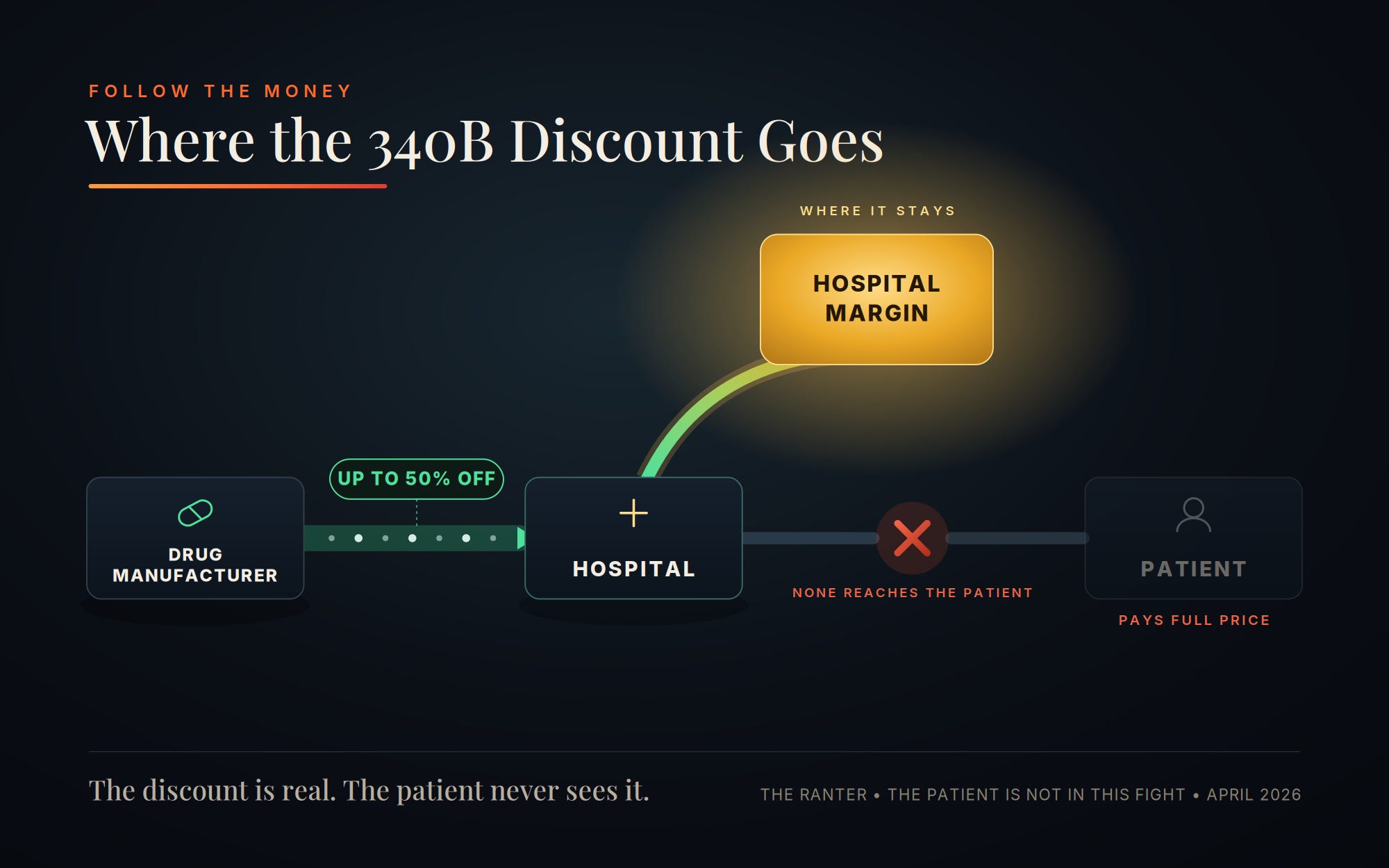
The patient who gets a 340B-discounted drug typically gets billed at the insurer’s negotiated rate, not the discount. The 340B discount stays with the hospital. Nobody in the litigation disputes this. It is the program’s design.
So why the bipartisan state push to expand 340B?
Because drug manufacturers, after the number of 340B contract pharmacy arrangements grew from about 2,000 in 2010 to over 230,000 by January 2026 according to HRSA’s own data, started restricting which pharmacies could dispense their 340B drugs. AbbVie and Novartis adopted 40-mile rules limiting third-party pharmacies near covered hospitals. Hospitals lost revenue. Hospitals lobbied state legislatures. State legislatures passed laws.
In North Dakota, rural healthcare providers testified that 340B revenue funds keep small-town clinics open. That part is true. Some 340B participants are genuine safety-net hospitals that would close without the program’s revenue. Rural hospitals are closing across the country, and 340B revenue is part of the financing structure that keeps doors open in places no for-profit chain will operate.
The same federal program also funds Minnesota hospitals that generated a billion in 340B margin while their state’s actual safety-net hospitals face closure. The program funds the rural clinic and the conglomerate from the same statute. The litigation cannot hold both at once.
When North Dakota argued in court that HB 1473 helps low-income North Dakotans, Judge Traynor was openly skeptical. The state could not show that 340B savings reached patients. Neither could Washington. Neither can any state, because the program’s design does not require it. The state laws expanded 340B without fixing what 340B doesn’t do.
The drug manufacturers will keep raising prices. Insulin list prices climbed past $270 a vial before public pressure forced cuts in 2023, a molecule whose discoverers sold the patent for a dollar. The hospitals will keep collecting 340B margin without minimum charity-care thresholds. Federal preemption rulings will continue. State legislatures will keep losing the same case.
The patient will keep paying the insurer-negotiated price for the drug their hospital bought at up to a 50 percent discount. The drugmakers and the hospitals and the DOJ will keep filing briefs invoking that patient’s interests. None of those briefs result in the patient paying less.
This is what the program looks like after thirty-four years of expansion without a charity-care floor. Three institutions are arguing about who controls the discount. The patient is not in the fight. The patient is the receipt the parties hold up while doing other business.
Related episode: Your Hospital Bill Is Wrong (EP03)
Related read: Why Paying $72,000 Made Money
THE RANTER follows the money through the systems that bill you: healthcare, housing, food, labor, debt, political money. Mechanism over motive.
Newsletter: newsletter.theranter.com | Website: theranter.com
YouTube: @TheRanterOfficial | Instagram: @theranterofficial | TikTok: @theranterofficial | X: @RanterMarkus | Bluesky: @rantermarkus.bsky.social
Every figure above is sourced and linked. Think one is wrong? corrections@theranter.com