

Last year the New York Lottery cleared about $3.1 billion off the people who played it. This spring its answer was a new ad campaign asking them to dream bigger.
A state lottery is a tax. It is the only tax in America you line up to pay, and it is built so the people with the least pay the most.
The gear is simple. You hand over a dollar. About sixty cents comes back to players as prizes. The state keeps most of the rest, the vendors who print the games take a cut, the corner store takes a cut. The jackpot odds sit past one in a hundred million.
And the wins are real, which is the whole trick. The games pay out small and often, a few dollars back here and there, enough that it feels like you are close to even. Add the year together and you were never close. About thirty-nine cents of every dollar you fed it stayed with the state and the vendors.
New York is the biggest operator in the country. Traditional games, the scratch-offs and daily numbers and Powerball, sold $7.81 billion in fiscal 2025. Players got the prize money back and lost about $3.1 billion of it for good. Spread across the roughly 15.8 million adults old enough to buy a ticket, that is about $494 spent and $194 lost per adult, in one year, on one set of games. It does not count the slot machines at the racetracks or the online play, so the real number is higher.
And the loss does not land evenly. The strongest recent study, in the Review of Economic Studies in 2025, found lottery spending falls as income rises, and that it tracks innumeracy and other measures of poor statistical reasoning so closely that Americans would spend 43 percent less if they played without those biases. The heaviest players skew toward less income and less schooling, which is the exact crowd the subway ad is built for.
The pitch that keeps it legal is the public good. New York sends more than $3.6 billion a year from the lottery to public schools, and says so on every billboard. Massachusetts runs the heaviest lottery per person in the country and sells it as hometown pride: its budget sends more than $1.3 billion a year to all 351 cities and towns. The pitch is that buying a scratch-off is how you fund the fire department, that playing is a kind of civic duty. Fuck that.
What neither pitch says is the shape of the deal. The state funds part of its schools and its towns out of money it took mostly from its lower-income residents, one losing ticket at a time, instead of out of a tax that scales with income. A person making $200,000 can buy a ticket and never feel it. The guy who bought forty scratch-offs to pay for it does not get his $194 back.
No new taxes wins elections. A penny on the sales tax would draw a revolt, but this same crowd hands the state about thirty-nine cents on the dollar of their own free will and calls it fun, which is why neither party touches it. Forty-five states and Washington DC run a lottery, with traditional sales over $96 billion in fiscal 2025. Blue states point at the schools. Red states point at the taxes they did not raise: Georgia ran its lottery to more than $1.5 billion for the HOPE scholarship and pre-K last year, sold as college money without a tax hike. Nobody runs on shutting it down, because no one wants to be the one who took the dream away.
So the move this week is small, and it is yours. Add up what you spent on tickets last year, the dollar here and the five there, the quick pick when the jackpot got loud. Look at where that number would sit in a savings account, an index fund, or this month’s electric bill. You will not win the hundred million. You were never going to. But that number is yours, and it is the one part of this whole machine you can switch off without asking a single politician for permission.
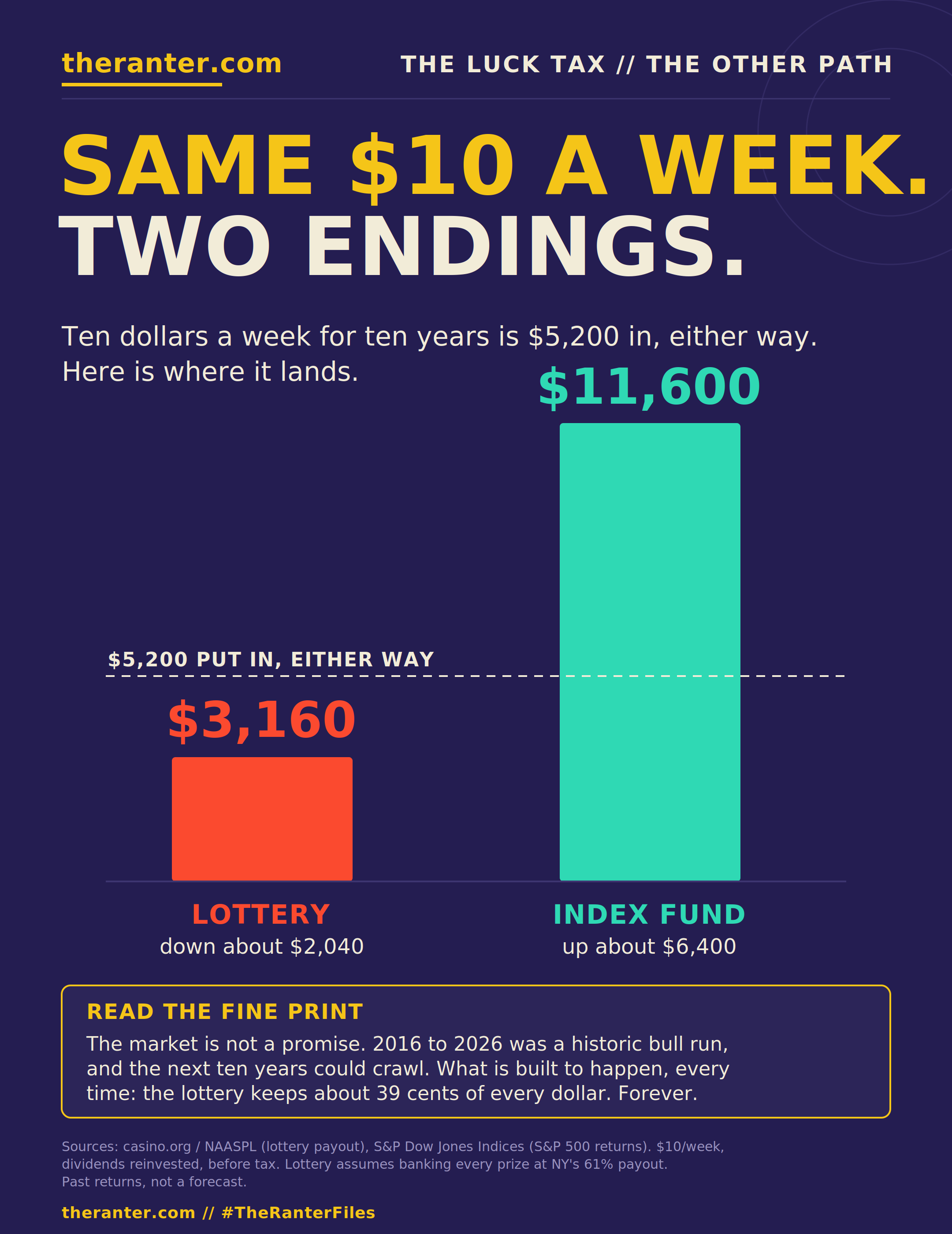
Run the other version. Ten dollars a week, about what the average New York adult already spends on tickets, into a plain index fund instead. Someone who started that in 2016 put in around $5,200 over ten years, and at the S&P 500’s total return across that stretch would be sitting on roughly $11,600 today. I am not going to pretend that is guaranteed. The last ten years were a historic run and the next ten might crawl. But that is the difference in the bet. The market is a wager with the odds roughly in your favor over time, and the lottery is a wager built so the house keeps about 39 cents of every dollar, on purpose, forever. One of those two numbers you can count on.
The lottery will keep asking you to imagine. Imagine the $194 instead.
Figures: New York’s $7.81 billion in traditional-game sales, the roughly 61 percent prize payout, and the resulting $3.1 billion kept by the state and vendors are from NASPL’s FY2025 Lottery Sales and Revenues report, which also gives the national traditional-sales total of about $96 billion; the $494 and $194 per-adult figures are those totals spread across roughly 15.8 million New York adults, an approximation, not a per-player figure. School aid is from the New York Lottery (more than $3.6 billion, FY2025-26). The regressivity finding is from Lockwood et al., Review of Economic Studies 92(4), 2025. Massachusetts local aid ($1,308,713,668, FY2025) is from the state budget. Georgia’s HOPE and pre-K funding (more than $1.5 billion, FY2026) is from the Georgia Lottery. Powerball’s top jackpot odds are about one in 292 million. The $11,600 figure is an illustration, not a promise: it is $10 a week from 2016 to 2026 at the S&P 500’s total return with dividends reinvested, computed from S&P 500 total-return data.
THE RANTER follows the money through the systems that bill you: healthcare, housing, food, labor, debt, political money. Mechanism over motive.
Newsletter: newsletter.theranter.com | Website: theranter.com
YouTube: @TheRanterOfficial | Instagram: @theranterofficial | TikTok: @theranterofficial | X: @RanterMarkus | Bluesky: @rantermarkus.bsky.social
Every figure above is sourced and linked. Think one is wrong? corrections@theranter.com
Freakin brilliant!!!!!!!!! I wish more people saw it this way! Now if you spend that money as a form of entertainment and realize that’s what you are doing, fine. Hell I’ve spent far more than $10/wk on streaming and gaming. My ROI is non-material. But to think of it as a chance to improve your life is simply misguided.