

By Markus Grant | The Ranter
The last article was about the math. Medicare pays 83 cents on the dollar. Medicaid pays 88. Rural hospitals lose money on most of the patients they see, and the patients who pay above cost are too few to cover the gap. Everything else is a consequence.
When a hospital starts losing money, the board has limited options. Cut services. Defer maintenance. Pray that the next fiscal year looks different. Eventually someone at the table says the word “partner.”
Private equity firms are very good at arriving when that word gets said.
As of 2023, private equity firms owned at least 130 rural hospitals across the United States. [1] Apollo Global Management, through its LifePoint and ScionHealth platforms, controlled approximately 71 rural facilities. GoldenTree and Davidson Kempner held roughly 17 through Quorum Health. Sam Zell’s Equity Group Investments held about 15. By 2018, more than 8% of all private hospitals in the country were PE-owned. At least a quarter of those were rural.
The pitch sounds roughly the same every time. A distressed hospital gets an offer from a firm with real capital. Press conference. Promises about investment, jobs, keeping the doors open. The community board votes yes because the alternative is closing without a plan.
What happens next has now been documented across enough cases, by enough investigators, that it is not a theory. It is a receipt. So here is one.
Cerberus Capital Management created Steward Health Care in 2010 by acquiring the Caritas Christi hospital system in Massachusetts. Caritas was a nonprofit Catholic system. Cerberus was a private equity firm named, and I want to be clear that I am not making this up, after the three-headed dog that guards the gates of hell in Greek mythology.
Cerberus acquired Caritas with significant debt loaded at the operating company level. Not on the firm. On the hospitals. This matters for everything that follows.
In 2016, Steward sold its hospital real estate, the buildings, the land, to a real estate trust called Medical Properties Trust. [2] Cash from the sale went to the investors. What stayed behind was a long-term rent obligation. The hospitals no longer owned the buildings they operated in. They rented them.
The hospitals used to own the buildings. Then the buildings started charging the hospitals to be hospitals.
Steward expanded into multiple states, including rural parts of Texas and Ohio. Management fees flowed to affiliated entities that Cerberus also controlled. Staffing ratios dropped. Service lines that lost money (maternity, behavioral health, pediatrics) got cut. On paper the hospitals looked more profitable, because the costs went down. The community noticed slowly. Fewer nurses on the floor. Longer waits. OB units closed and nobody held a press conference about it.
By the time Steward filed for bankruptcy in 2024, the company owed $6.6 billion in long-term rent obligations. $1.2 billion in loans. Nearly $1 billion in unpaid vendor bills. [3] The hospitals did not run out of patients. They ran out of money to operate inside buildings that someone else now owned.
The closures included Carney Hospital in Dorchester, Massachusetts, and Nashoba Valley Medical Center in Ayer. Trumbull Regional Medical Center and Hillside Rehabilitation Hospital in Warren, Ohio. Others across the footprint. The Massachusetts government considered using eminent domain to prevent the closures. [3] When a governor starts talking about seizing a hospital to keep it open, the market is telling on itself.
The Senate Budget Committee documented this playbook in a January 2025 report. [2] Steward was one of two case studies. The other was Prospect Medical Holdings, and the math was worse.
Leonard Green and Partners acquired Prospect in 2010. Over the following decade, Leonard Green extracted between $400 million and $645 million from Prospect through dividends, management fees, and sale-leaseback transactions. [4] This money left the operating company. It went to investors. What stayed behind was debt.
When Leonard Green exited in 2021, Prospect had $3.1 billion in debt and unpaid obligations. [4]
In 2016, while the extraction was ongoing, Prospect acquired the Crozer Health system in Pennsylvania, a four-hospital nonprofit. Prospect made explicit commitments to keep those hospitals open for at least ten years.
By 2022, services were being cut. Maternity shut down. Residency accreditation was lost. In October 2024, the Pennsylvania Attorney General filed a civil lawsuit alleging that Prospect had violated the terms of its 2016 purchase agreement and asked a court to appoint a receiver. [5]
$645 million went out. $3.1 billion in debt stayed. The hospitals that were promised a decade got less than half of one before the math collapsed.
Quorum Health Corporation, controlled by creditors including Davidson Kempner, operated Martin General Hospital in Williamston, North Carolina. Quorum reported $30 million in cumulative losses since 2016. It missed financial reporting requirements to the state for five consecutive years. Then, in August 2023, Quorum closed Martin General. [6]
The nearest hospital is now 25 to 40 miles away. Martin County is small, rural, and aging. Martin General was one of its largest employers. The EMS system described severe strain from longer transport times.
Quorum missed its reporting to the state for five years and then acted surprised the math did not work. Nobody is surprised. The math was documented. The money was already gone.
Here is the part where I am supposed to say this is about greed. It is, partially. But it is also about structure.
If the playbook sounds familiar, it should. In 2005, KKR, Bain Capital, and Vornado Realty Trust acquired Toys “R” Us for $6.6 billion. They put up roughly $1.3 billion of their own money. The other $5 billion was debt, loaded onto the company, not onto the firms. [8] Toys “R” Us spent $450 to $500 million a year just servicing interest. It still controlled 20 percent of the U.S. toy market when it filed for bankruptcy. [8] The company did not fail because it ran out of customers. It failed because the debt was never designed to be survivable. 800 stores closed. 33,000 people lost their jobs. The firms collected roughly $200 million in advisory fees over the course of ownership. [9]
Debt loaded onto the target. Management fees extracted regardless of performance. Real estate separated from operations. Company still generating revenue when it collapsed. Buyers walked away whole.
Steward. Prospect. Quorum. Toys “R” Us. Same playbook.
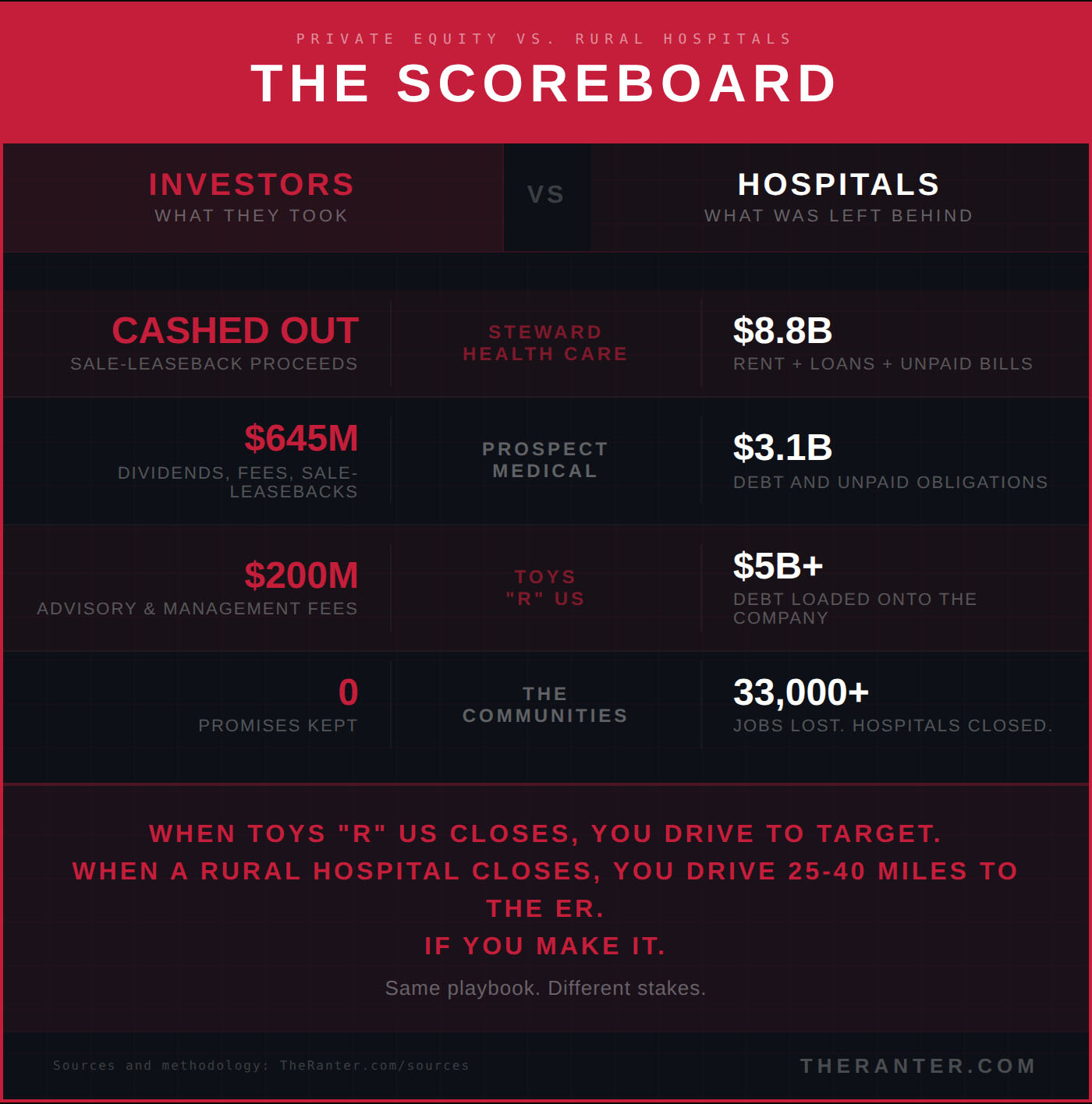
The difference is what happens after. When Toys “R” Us closes, you drive to Target. When a rural hospital closes, you drive 25 to 40 miles to the nearest emergency room. If you make it.
The reimbursement math I described in the last article, the 83-cent problem, is what makes rural hospitals vulnerable to this playbook in the first place. A hospital losing money on every Medicare patient, with a shrinking commercial base, has no good options. The PE pitch arrives precisely because the math is broken. The firm does not cause the crisis. It monetizes the crisis. The difference matters, but the outcome does not change.
What PE adds to the equation is debt, lease obligations, and an exit timeline. A struggling hospital that stays independent loses money slowly. A struggling hospital that gets acquired by PE loses money according to someone else’s schedule, with someone else holding the building.
One more thing. This is the part nobody wants to hear.
Medical Properties Trust, the real estate trust that collected rent from Steward’s hospitals, is a publicly traded company. [7] If you have a 401(k) that tracks a broad index, or a target-date retirement fund that holds real estate investments, there is a decent chance you own a small piece of the company that collected rent from a hospital system while it was running out of money.
The system does not run on villains. It runs on ordinary financial instruments held by ordinary people in ordinary retirement accounts. The rent that helped bankrupt Steward was paid to a trust that pays dividends to shareholders. Some of those shareholders are index funds. Some of those index funds are in accounts with your name on them.
I am not saying that makes you complicit. I am saying the machine is bigger than the people you can see, and some of the gears are in your portfolio.
The next article is about Carney Hospital. It is about what happens to a specific building, in a specific neighborhood, when the math and the money and the structure I have been describing all arrive at the same address on the same Saturday.
SOURCES
[1] Private Equity Stakeholder Project (PESP), “Private Equity Descends on Rural Healthcare,” January 2023. Apollo Global Management/LifePoint/ScionHealth: ~71 rural facilities. GoldenTree/Davidson Kempner: ~17. Equity Group Investments: ~15. JAMA 2024 study on PE acquisitions confirmed 8%+ of private hospitals PE-owned by 2018.
[2] Senate Budget Committee bipartisan staff report, “Profits Over Patients: The Harmful Effects of Private Equity on the U.S. Health Care System,” January 2025. Documented PE acquisition playbook including debt-loading, sale-leaseback structures, management fee extraction, and service line cuts.
[3] Boston Globe Spotlight Team, “Inside Steward Health Care,” 2024 investigation series. Steward bankruptcy filing: $6.6B rent obligations, $1.2B loans, ~$1B unpaid vendor bills. Cerberus Capital Management founded Steward via Caritas Christi acquisition, 2010. Sale-leaseback with Medical Properties Trust, 2016.
https://apps.bostonglobe.com/metro/investigations/spotlight/2024/09/steward-hospitals/
https://apps.bostonglobe.com/metro/investigations/spotlight/2024/09/steward-hospitals/steward-mpt/
[4] ProPublica, “Investors Extracted $400 Million From a Hospital Chain That Sometimes Couldn’t Pay for Medical Supplies or Gas for Ambulances,” September 2020. And “Rich Investors Stripped Millions From a Hospital Chain and Want to Leave It Behind,” February 2021. Senate Budget Committee report, January 2025. Leonard Green and Partners dividend and fee extraction from Prospect Medical Holdings: $400M-$645M over the 2010s. Prospect debt at Leonard Green exit (2021): $3.1B.
[5] Pennsylvania Attorney General civil lawsuit against Prospect Medical Holdings, filed October 29, 2024, Delaware County Court of Common Pleas. Alleged violation of 2016 purchase agreement commitments for Crozer Health system.
[6] UNC Cecil G. Sheps Center rural hospital closure database. Regional reporting on Quorum Health Corporation’s operation and closure of Martin General Hospital, Williamston, NC, August 2023. Quorum: $30M cumulative losses since 2016, $13M loss in 2022 alone, five years of missed state reporting.
[7] Medical Properties Trust, Inc. NYSE: MPW. Publicly traded healthcare REIT. Collected rent from Steward Health Care facilities under long-term lease agreements executed via 2016 sale-leaseback transaction.
https://www.medicalpropertiestrust.com
[8] Private Equity Stakeholder Project, “KKR, Bain Capital, Vornado repeatedly rewarded themselves for adding debt to Toys ‘R’ Us,” 2018. $6.6B acquisition, $5B+ in debt loaded onto the company. $450-$500M annual interest payments. 20% U.S. toy market share at time of bankruptcy filing. The American Prospect, “Private Equity: Looting ‘R’ Us,” 2018.
[9] The Week, “How vulture capitalists ate Toys ‘R’ Us,” 2018. Bain, KKR, and Vornado extracted approximately $200M in advisory and management fees over course of ownership. 800 stores closed, 33,000 employees laid off. PitchBook, “Congress confronts Bain Capital, KKR over Toys R Us liquidation,” 2018.
https://theweek.com/articles/761124/how-vulture-capitalists-ate-toys-r-r
https://pitchbook.com/news/articles/congress-questions-bain-capital-kkr-over-toys-r-us-liquidation
If your rural hospital closed, downgraded, or is at risk: I am collecting stories. Not for outrage. For documentation. What happened, when, what changed. Send it: stories@theranter.com. Your name stays out of it unless you say otherwise.
Subscribe: TheRanterOfficial.substack.com
Main Site: TheRanter.com