

You buy a manufactured home for around $123,000. Cheap compared to a site-built house. Maybe the only door into ownership left.
Then you learn what you bought.
The house is yours. The ground is a subscription.
Lot rent averages around $750 a month, higher in age-restricted communities. The home depreciates from the day you finish unpacking. The lot rent does not. The house ages like a car. The ground bills like a landlord with a spreadsheet.
This is the structural deal that does not show up in the brochure. You bought a depreciating asset, and somebody else owns the dirt it is sitting on.
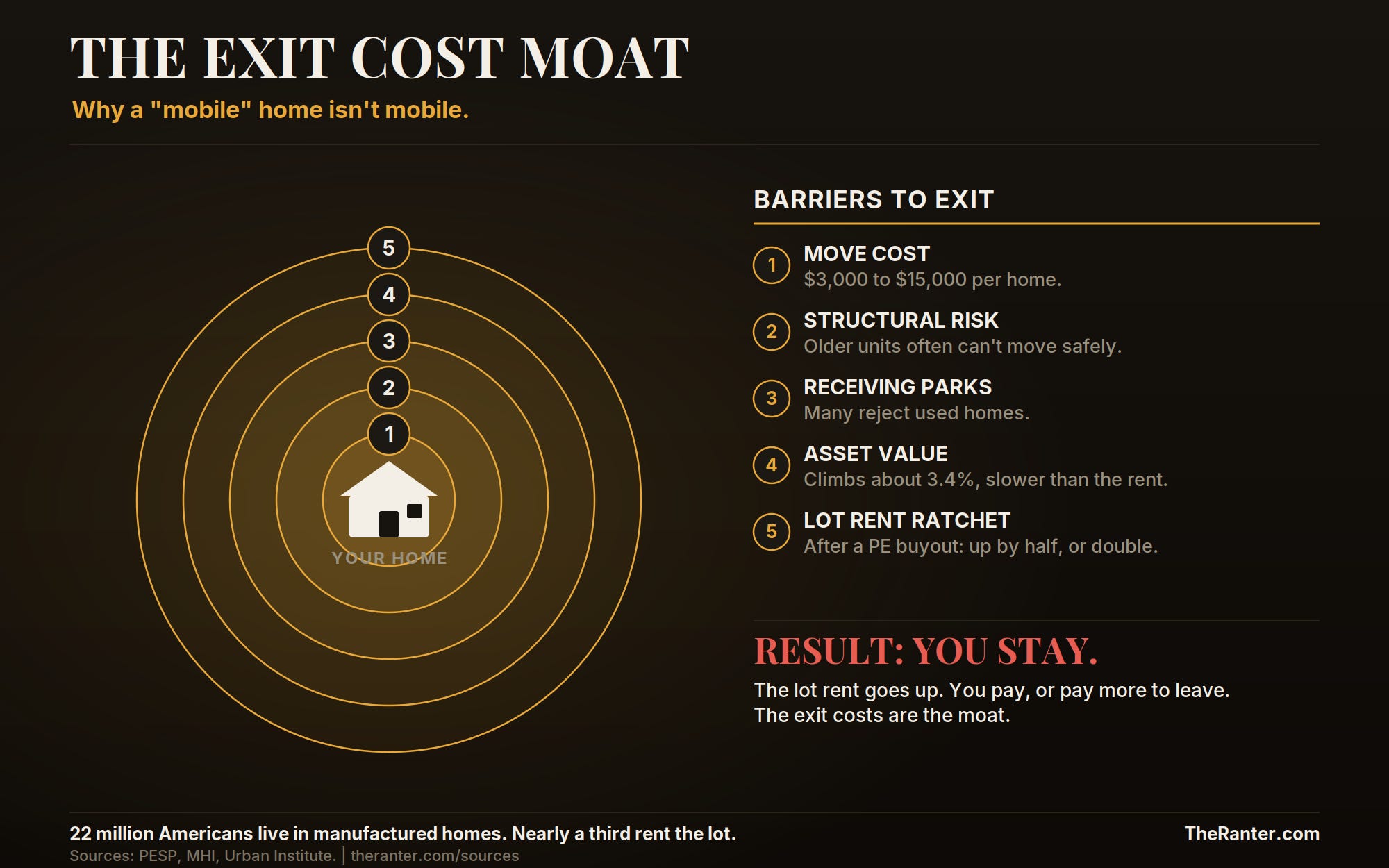
The marketing word is “mobile,” but the actual move costs $3,000 to $15,000 depending on distance and unit age. Many older units cannot be relocated without structural damage, and a lot of parks will not accept used homes anyway. So the lot rent goes up and you stay.
It is mobile the way a grand piano is mobile. Sure. Technically. Bring money, equipment, paperwork, luck, and a priest.
Roughly 22 million Americans live in manufactured homes, and nearly a third rent the lot beneath them.
That makes manufactured housing the largest unsubsidized affordable housing pool in the country. Which is exactly why the spreadsheet showed up.
Two publicly traded REITs dominate the institutional segment, Equity LifeStyle Properties and Sun Communities, alongside RHP Properties, the largest private operator. Between them they control hundreds of thousands of lots. Private equity firms hold more than 1,900 parks with nearly 400,000 lots, per the Private Equity Stakeholder Project’s tracker. Realtor.com ran a piece in early May 2026 documenting what residents have been reporting for a decade: after a private equity acquisition, lot rents jump. In documented cases the rent has risen by half, or doubled, in a single stretch.
Property taxes didn’t double. Insurance didn’t double. The new owner did.
Run the comparison. Site-built homes appreciate at a median rate around 3.8 percent annually. Manufactured homes appreciate a little more slowly, about 3.4 percent, and on a rented lot the rising rent eats the equity. The Private Equity Stakeholder Project figures roughly $10,000 in lost home value for every $100 of monthly rent increase. After five years in a corporate-owned park, the resident has accumulated little or no equity and watched the housing cost climb.
Wall Street did not discover affordable housing. It discovered a customer base that has to ask permission to leave. The math is clean for the owner. Buy the park. Raise the rent. Residents pay or pay more to leave.
The supply-side answer is: build more housing. That has real merit for site-built rental markets, but it does little for the resident already trapped in a park. More supply helps when people can choose. It does not help when the thing they own costs thousands to move, may crack in transit, and may have nowhere to land. The number of lots is only half the constraint. The exit is the other half.
The tenant-protection answer is: stabilize rents. That also has merit, but in many states, manufactured housing communities fall outside the protections written for conventional apartments. Florida and Texas preempt local rent stabilization for mobile home parks. California and Oregon have manufactured housing rent rules that apply unevenly, and New York extended tenant protections to this asset class only in 2019.
Oregon’s caps on annual lot rent increases have slowed the worst spikes in covered communities. New Hampshire’s right-of-first-refusal statute has helped residents buy parks when owners want out. The patchwork helps at the margins. It just wasn’t built for this asset class as a system. State by state, the rules cover what their legislators were thinking about when they wrote them, which is mostly apartments.
In red states, operators often get room to run. In blue states, tenant protections often stop at the apartment door. Different speeches. Same rent notice.
Defuse the trap. Residents buy the park together. The lot rent stops being a rent bill set by a company in another state and becomes a budget line controlled by the people living there. Groups like ROC USA facilitate the conversions, and about 300 parks have converted to resident ownership. There are roughly 43,000 parks in the country. The exit exists. It just comes in pamphlet form while the rent notice comes in the mail.
Saturday’s sidebar tracked the word “facility fee” across hospitals, hotels, gyms, and concert tickets. Same word, every industry. You came for one thing. The fee was attached to the thing beside it.
Facility fee was the polite version. Lot rent is the geological version. Same trick, deeper floor.
You bought a home. The fee is on the ground beneath it. The fee compounds. The exit is theoretical. The contract was signed before you knew you were trapped, because the trap is the product.
Ask who owns the ground before you sign the lot lease. If the answer is a holding company you cannot call, you are buying the walls. Someone else owns the ground, and the ground never stops billing.
THE RANTER follows the money through the systems that bill you: healthcare, housing, food, labor, debt, political money. Mechanism over motive.
Newsletter: newsletter.theranter.com | Website: theranter.com
YouTube: @TheRanterOfficial | Instagram: @theranterofficial | TikTok: @theranterofficial | X: @RanterMarkus | Bluesky: @rantermarkus.bsky.social
Every figure above is sourced and linked. Think one is wrong? corrections@theranter.com