

April 1, Covina, California. FBI agents arrested Gladwin and Amelou Gill outside their home, part of a federal takedown the bureau called Operation Never Say Die. The charge: more than $5.2 million in fraudulent Medicare claims through a company called 626 Hospice, also registered as St. Francis Palliative Care, with Medicare paying out more than $4 million of it. Enrollment records showed a five-year patient survival rate above 97 percent. Hospice is the benefit for people a doctor expects to die within six months. The patients billed as dying were not dying. The money moved anyway. It usually does.
The head of the Centers for Medicare and Medicaid Services, Mehmet Oz, called LA County the epicenter of hospice fraud, put the number at roughly $3.5 billion concentrated there, and criticized California’s oversight publicly and repeatedly.
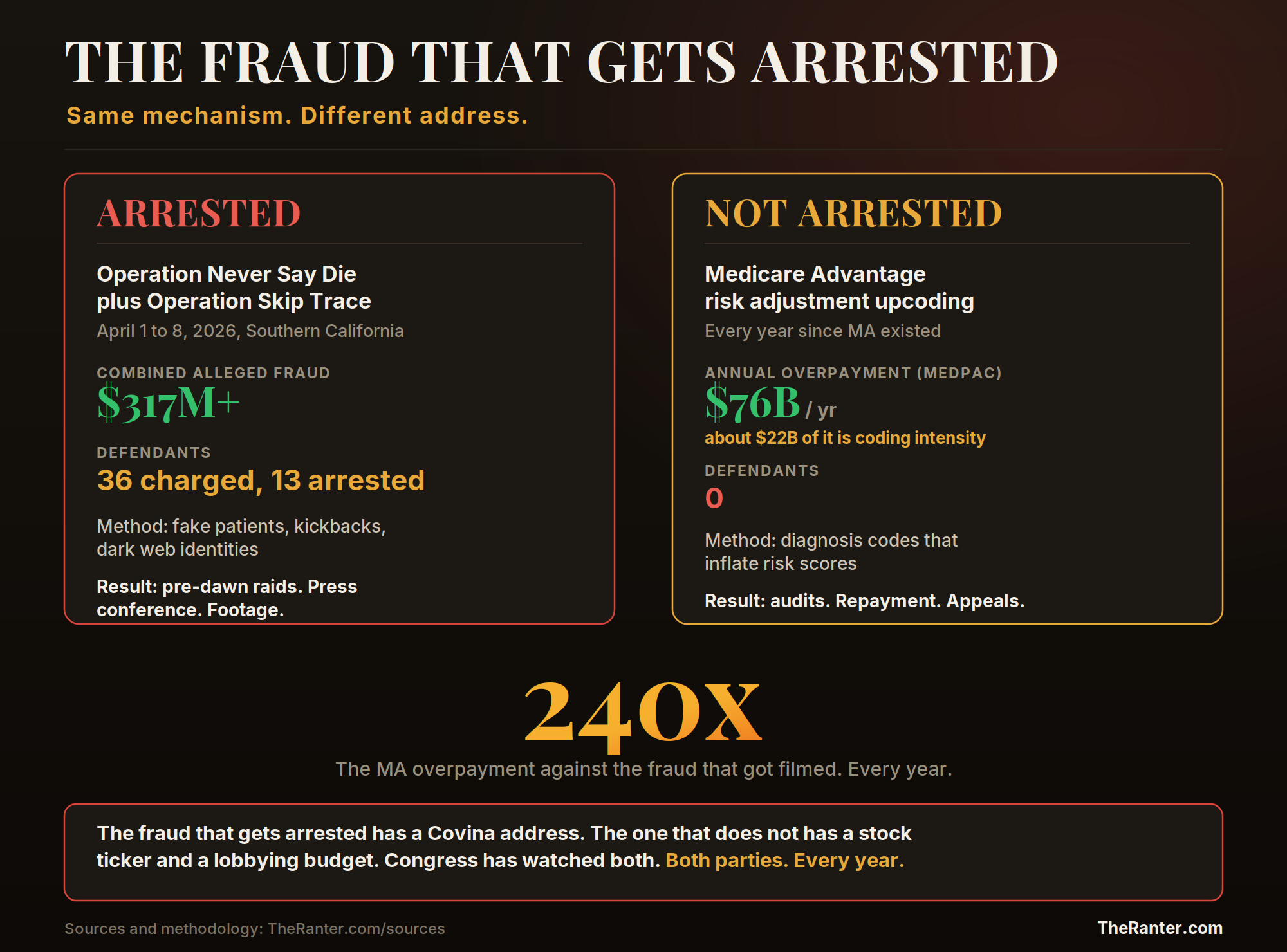
One week later, California Attorney General Rob Bonta announced Operation Skip Trace: 21 people charged, five arrested, across ten Southern California locations, tied to $267 million in Medi-Cal hospice fraud. Defendants had bought personal identities on the dark web and enrolled out-of-state residents through Covered California. The logistics were impressive. The press conference was well-attended.
Both operations were real, documented, and staffed with the correct number of defendants for a press conference.
Here is what did not produce footage.
Medicare Advantage plans will cost the federal government about $76 billion more in 2026 than the same patients would cost under traditional Medicare. That is MedPAC’s estimate, not an activist’s. About $22 billion of it is coding intensity: adding diagnosis codes that raise a patient’s risk score without adding any care. The plans call it aggressive but lawful coding. The mechanism is not a strip-mall address in LA County. It is the largest MA insurers, UnitedHealth and Humana and CVS Health among them, submitting encounter data to CMS that overstates how sick their members are. More codes mean higher risk scores, and higher risk scores mean higher monthly payments. The audit trail sits inside the same companies writing the data.
The DOJ and HHS OIG have documented this for more than a decade. There are no pre-dawn arrests. There are audits, repayment negotiations, and appeals that outlast the news cycle every time.
Put the two next to each other. The two April operations alleged more than $317 million in fraud combined. The MA overpayment runs about $76 billion a year. That is roughly 240 times the size of the takedowns everyone filmed. Not 240 dollars more. 240 times more. Every single year.
The LA County hospice problem is real. Roughly 1,800 hospices in one county, more than 700 tripping multiple fraud red flags in a state audit, and a single office plaza registered to 89 of them. The architecture that made this possible was written in 1982 and never redesigned. Congress set the incentive: $231 a day per patient for routine home care, paid whether the nurse shows up once or not at all. For-profit hospices ran a 16.1 percent margin in 2022; nonprofits ran 0.3 percent. The patients who need the fewest visits are the most profitable, and it shows up in how long they stay enrolled: one JAMA analysis put the median for-profit stay at about 20 days against 9 for nonprofits. Same Medicare benefit. Different extraction pattern. MedPAC has recommended cutting the aggregate cap by 20 percent every year since 2020. Congress has declined every year. Both parties. Every year.
Oz’s framing requires ignoring that the per-diem is federal. The California legislature did not invent it. The fraud concentrates in the county because hospice registrations there grew about 1,500 percent between 2010 and 2021, and the incentive Congress built kept paying out the whole time, across administrations from both parties.
Enforcement theater has a specific shape. It needs defendants, arrests, footage, and a press conference with someone from the current administration in front of the cameras. It also needs the arrests to be small enough to finish. You can arrest the Gills in Covina. You cannot arrest a risk adjustment methodology that the largest publicly traded insurers depend on to hit their quarterly earnings guidance.
The fraud that gets arrested has a Covina address. The fraud that does not has a stock ticker and a lobbying budget, and Congress has watched both run at the same time since before most of the April defendants were in business.
EP03 goes inside the billing system itself: the chargemaster, the code, the pipeline from claim to debt. The address is different. The design principle is the same.
Related episode: Your Hospital Bill Is Wrong
THE RANTER follows the money through the systems that bill you: healthcare, housing, food, labor, debt, political money. Mechanism over motive.
Newsletter: newsletter.theranter.com | Website: theranter.com
YouTube: @TheRanterOfficial | Instagram: @theranterofficial | TikTok: @theranterofficial | X: @RanterMarkus | Bluesky: @rantermarkus.bsky.social
Every figure above is sourced and linked. Think one is wrong? corrections@theranter.com