

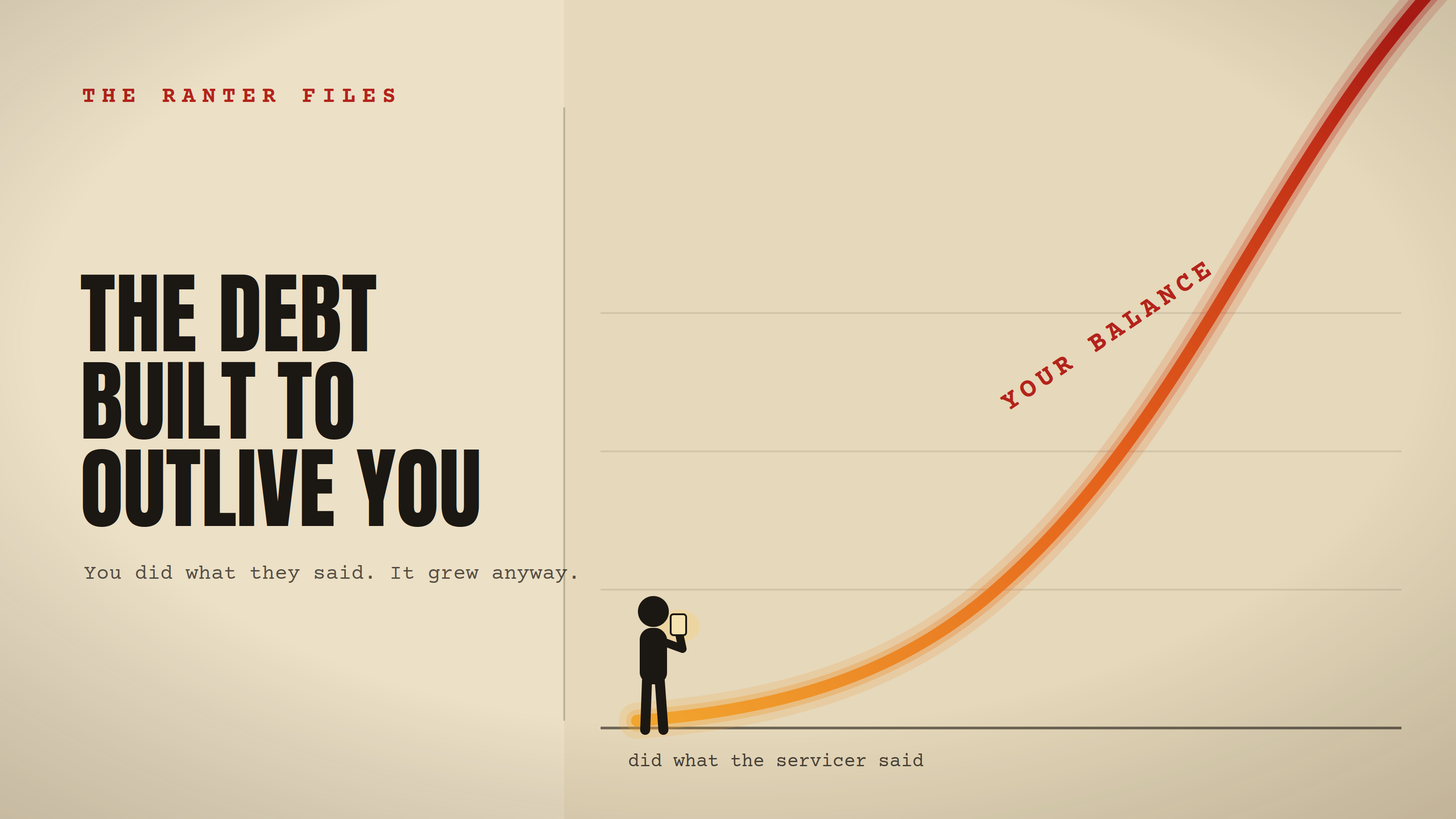
You called your student loan servicer, asked what you could do, took the option they handed you, and your balance went up. That was not a glitch. That was the option working exactly the way it was built to work.
Here is the symptom a lot of people are living right now. The pandemic payment pause is over and default is climbing fast. About 7.7 million federal borrowers were in default as of March, roughly $180 billion owed (NY Fed, federal student loan defaults return, May 2026). The collection machine that rides along with default, the one that seizes your tax refund, garnishes your wages, and docks your Social Security, is switched off for the moment. The Education Department paused involuntary collections back in January while it reworks the rules (studentaid.gov, collections). Paused, not gone. It can be flipped back on once that review wraps.
So let me walk the machine, because the machine is the whole story.
The receipt
A servicer manages your loan and tells you which repayment option to pick. Two of the big ones sit at opposite ends. Income-driven repayment (you pay a slice of what you actually earn, and after 20 to 25 years the rest is forgiven) shrinks the balance over time. Forbearance (you stop paying for a while) lets the interest pile up, so the balance grows and never forgives.
The servicer got paid the same monthly fee either way. But forbearance was less work. So they steered borrowers toward the option that grew the debt. The Navient settlement put a price on it: $1.85 billion across 39 states, with the attorneys general alleging that hundreds of thousands of borrowers were pushed into long-term forbearance instead of the plans that would have helped them (CA Attorney General, multistate Navient settlement, Jan 2022). People did the responsible thing, called and asked, and got routed into the version that quietly made it worse.
The mechanism
This is the part where the help breeds the harm. You reach out. The help you are offered is the thing that inflates the number. A $10,000 loan drifts to $12,000, then $15,000, while you believe you are handling it.
Here is why that steering was close to permanent. Student debt is the hardest consumer debt in the country to erase. Credit card debt clears in bankruptcy, and so do medical bills and a car loan. Student loans only clear if you file a separate lawsuit and prove “undue hardship,” a bar set so high that between 2011 and 2024 fewer than 7,300 of more than 3 million student-loan bankruptcy filers even tried it. Most of the few who do try win. Almost nobody tries.
On top of that sit collection powers no private lender has. The government can garnish up to 15 percent of your wages with no court order (20 U.S.C. 1095a), take your entire tax refund including the Earned Income and Child Tax Credits, and cut into Social Security down to a floor of about $750 a month that has never been indexed to inflation and now sits below the poverty line (CFPB issue spotlight, Social Security offsets). Those Social Security offsets are suspended right now along with the rest of the collections, but the tool is written into the law and waiting. And the reach kept widening for years before the pause: the count of Social Security recipients getting checks docked for student debt went from about 6,200 in 2001 to 192,300 by 2019.
Where both parties sit
This one touches policy design, so both sides get their receipts. The privatization of Sallie Mae started under Clinton and finished under Bush. The CFPB was built to police servicers, then never funded to actually do it, and the Justice Department declined to join the CFPB’s case against Navient under both Obama and Trump. Biden’s broad forgiveness got struck down 6 to 3 in Biden v. Nebraska . And the income-driven plans millions were counting on, including SAVE, are being phased out under the One Big Beautiful Bill Act: eliminated for new loans after July 2026, with current borrowers pushed onto a replacement by 2028.
The profit model held across all of it. When Sallie Mae restructured in 2014, it split the legacy servicing operation into Navient and kept the newer lending business separate. Navient still ended up facing the settlements, so the split did not make anyone untouchable, but it kept the pieces sorted while the fight dragged on. Accountability, when it came, came late. The CFPB ordered $120 million and barred Navient from federal servicing in 2024 (CFPB, Navient federal servicing ban, Sept 2024), long after the borrowers were already boxed in.
The move
Use the pause. Do not wait for the collection machine to switch back on. And do not call and take the first thing offered, either. Ask, by name, for an income-driven repayment plan while it still exists, and get the confirmation in writing. If you are already in default, ask about loan rehabilitation or consolidation, the two paths that pull you out of default before garnishment resumes. Pull up your actual plan at studentaid.gov so you know what you are on instead of trusting a phone rep to tell you. And if you were a Navient borrower who got pushed into forbearance, look into whether you are owed money from that 2024 order.
You were told the responsible thing to do, and then the responsible thing was wired to grow. That gap was designed in, and you did not build it.
THE RANTER follows the money through the systems that bill you: healthcare, housing, food, labor, debt, political money. Mechanism over motive.
Newsletter: newsletter.theranter.com | Website: theranter.com
YouTube: @TheRanterOfficial | Instagram: @theranterofficial | TikTok: @theranterofficial | X: @RanterMarkus | Bluesky: @rantermarkus.bsky.social
Every figure above is sourced and linked. Think one is wrong? corrections@theranter.com