

By Markus Grant | The Ranter
The last article followed the people. Where they went after they left office. Who hired them. What they were paid. This one follows the money in the other direction. Not what happens after. What happens before.
The check arrives before the vote. You can look it up. It is a filing.
Brett Guthrie represents Kentucky’s Second District. He has served in Congress since 2009. For most of that time, nobody outside of Bowling Green had heard of him. He did not generate headlines. He did not appear on cable news. He did not tweet anything that went viral.
What he did was climb the committee ladder.
Guthrie joined the House Energy and Commerce Committee. He became chair of the Health Subcommittee. In January 2025, he became chair of the full committee. Energy and Commerce oversees pharmaceutical regulation, Medicare, Medicaid, and drug pricing. It is the committee that decides which bills reach the floor and which die in markup.
His pharmaceutical industry contributions tracked almost exactly with each step up.
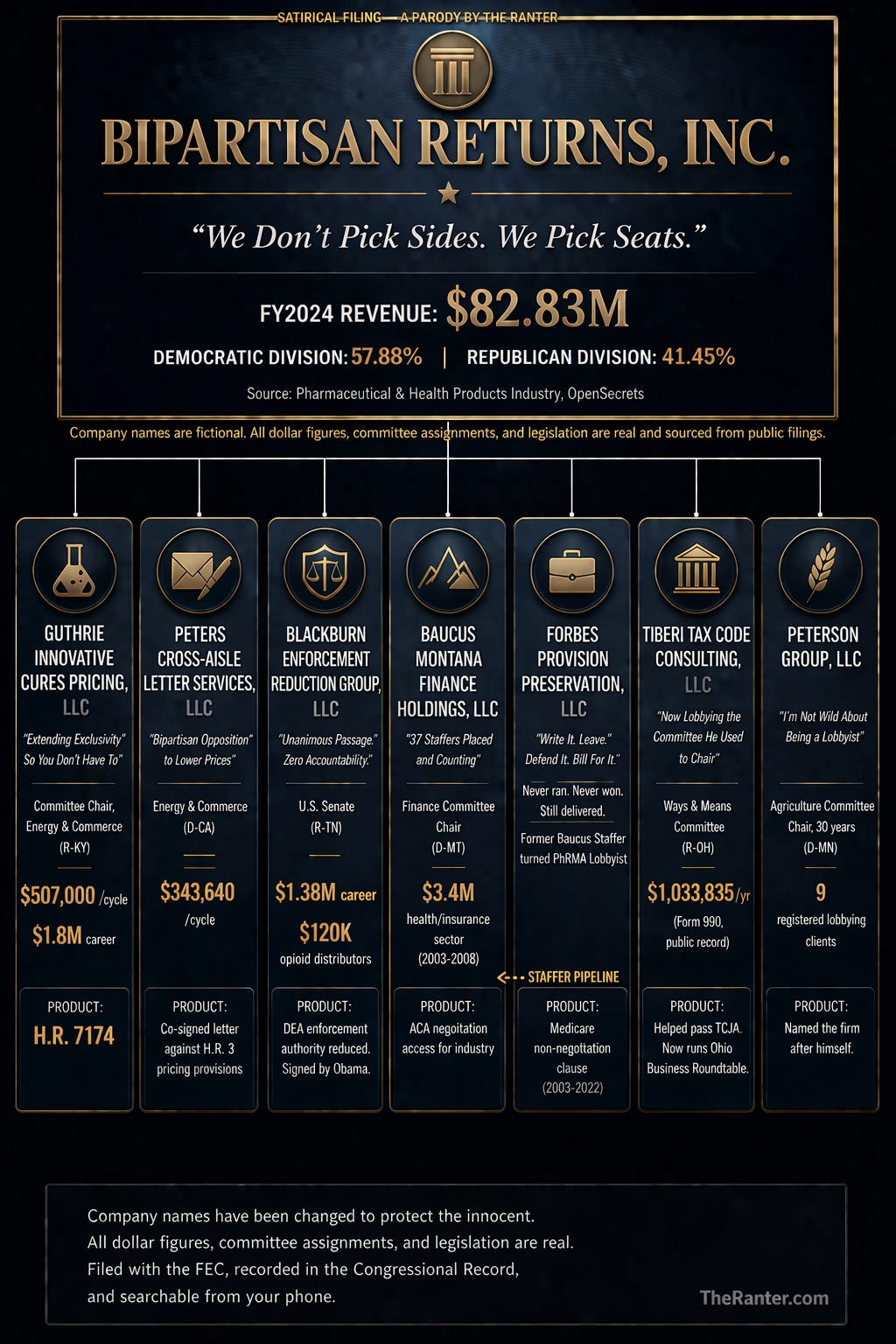
As a backbencher, the numbers were modest. As Health Subcommittee chair, they grew. As full committee chair, they reached $507,000 from pharmaceutical and health product interests in a single cycle. His career total from the sector now exceeds $1.8 million, among the highest of any currently serving Republican House member. [1]
His first major act as chair was introducing H.R. 7174, the Ensuring Pathways to Innovative Cures Act. The name itself is the cover story. The bill would extend the exclusion period for small-molecule drugs from Medicare price negotiation, pushing it from 7 years to 11. If it had been in effect when the Inflation Reduction Act passed, more than half the drugs currently being negotiated would not have been eligible. CMS projected the negotiation program would save Medicare beneficiaries billions in 2026 alone, with additional multi-billion-dollar savings from the next round of negotiations in 2027. [2]
PhRMA lists that timeline extension as a lobbying priority. The man who chairs the committee that controls the bill received more pharmaceutical PAC money than anyone else in Congress that cycle. [3]
The money does not follow the vote. The money finds the committee seat, and the vote follows.
This is not one party’s problem.
In the 2024 election cycle, the pharmaceutical and health products industry gave $82.83 million in political contributions. The split: 57.88 percent to Democrats. 41.45 percent to Republicans. [4]
The American Hospital Association spent $32 million on lobbying in 2025. The American Medical Association spent $24.8 million. PhRMA spent $27.5 million. [6] Their priorities do not always overlap, but their method is identical: fund the committee members who control your legislation, and fund them proportionally to their influence over your bottom line.
The industry does not pick sides. It picks committee chairs. It picks swing votes. It picks the person whose signature appears on the markup. And when that person moves to a new committee, the money adjusts.
Scott Peters, a Democrat from California, sat on the Energy and Commerce Committee. In the 2023-2024 cycle, he received $343,640 from pharmaceutical and health product interests. He co-wrote a letter with Guthrie warning against the most aggressive drug pricing provisions in H.R. 3. He co-sponsored the MINI Act, which would delay certain drug negotiations. [5]
A Republican and a Democrat on the same committee, co-signing the same letter, funded by the same industry.
Max Baucus chaired the Senate Finance Committee during the Affordable Care Act negotiations. From 2003 to 2008, his health and insurance sector contributions totaled $3.4 million, nearly one-fourth of everything he raised during that period. [7] That part of the story was told in an earlier article. Here is the part that was not.
As a senior Finance Committee staffer, Forbes worked on the 2003 Medicare Part D legislation that included the provision banning Medicare from negotiating drug prices. Forbes left the Senate and registered as a lobbyist for PhRMA. During the 2009 ACA debate, he lobbied to defend the very provision he had helped write. [8]
A Sunlight Foundation investigation found that 37 former Baucus staffers had become lobbyists, second only to Mitch McConnell’s office. Five of them represented 27 health and insurance organizations during the ACA negotiations. None appeared on Baucus’s official meeting schedule. [9] They did not need to. They operated through their client organizations’ CEOs, who did. You could sit in the hearing room and watch the senators ask questions that their former employees had written the talking points for, on the other side of the table.
The staff member writes the provision. The chairman collects the contributions. The staffer crosses over to defend the provision from the industry side. The chairman moves on. The provision remains.
Marsha Blackburn of Tennessee introduced a bill in 2016 that the DEA’s own chief administrative law judge later warned would weaken enforcement against drug distributors. The agency’s internal assessment described it as the greatest reduction in the Attorney General’s drug enforcement authority in decades. The bill passed both chambers unanimously. President Obama signed it without a photo op. [10]
Blackburn had received $1.38 million from pharmaceutical interests over her career. An additional $120,000 came from opioid manufacturers and distributors between 2013 and 2017, including McKesson, Cardinal Health, and AmerisourceBergen. [11]
When asked whether she would return the money, she called the suggestion “completely absurd.” To be fair, $120,000 spread across four years is not a lot of money for a law that reshaped federal drug enforcement. If anything, it was a bargain.
The bill was bipartisan. Democrats co-sponsored it. Nobody voted against it. The only people who objected were the DEA agents who could no longer use their primary enforcement tool. Their objection was documented in an internal memo. The memo was leaked to the Washington Post and 60 Minutes. Congress did not revisit the law.
Pat Tiberi served as a Republican congressman from Ohio for 17 years. He sat on the House Ways and Means Committee, where he chaired both the Health Subcommittee and the Tax Policy Subcommittee. In October 2017, he resigned from Congress. His last legislative act was helping pass the Tax Cuts and Jobs Act. [12]
By January 2018, he was President and CEO of the Ohio Business Roundtable, an advocacy organization representing Ohio’s largest corporate CEOs. His 2023 compensation, per the organization’s Form 990: $979,304 in base salary, $1,033,835 total. [13] Down to the dollar. On a form anyone can download from the IRS. In 2024, he publicly urged Ohio’s congressional delegation to extend the tax provisions he had helped write. [14]
The tax-writing committee member now runs the organization that lobbies the tax-writing committee.
Collin Peterson served as a Democratic congressman from Minnesota for 30 years. He chaired the House Agriculture Committee. After losing his seat in 2020, he started the Peterson Group, his own consulting and lobbying firm. He also joined Combest, Sell and Associates, the largest agriculture lobbying operation in Washington. [15]
Peterson told the Red River Farm Network: “I’m not wild about being a lobbyist. I will be giving them strategies and consulting with them on ideas.” [16] By 2025, OpenSecrets listed him as a registered lobbyist with nine clients. He named the firm after himself.
Two committee chairs. Two parties. One designed the tax code, the other regulated the farm bill. Both now work for the industries their committees oversaw.
This is what the pipeline produces. Not corruption in the traditional sense. Nobody passes an envelope under a table. The contribution is filed with the FEC. The vote is recorded in the Congressional Record. The committee assignment is posted on the House website. The lobbying registration is searchable on OpenSecrets. Every piece of it operates in daylight, and you can pull the receipts from your phone while you are standing in line at the grocery store.
The system still produces the same outcome every time: the industry that funds the committee chair gets the legislation the committee chair controls. Nothing that happened was illegal. The rules were written to make sure of that.
The next article is about who writes the rules.
The final article in this series catalogs the armor. Every shield. Every pattern. Every mechanism that protects the people who built this system from the people who pay for it.
Sources
[1] OpenSecrets, Brett Guthrie career contributions, pharmaceutical and health products industry. STAT News, February 2025. Sludge, December 2024. $507,000 figure represents 2024 cycle total from pharma/health products PACs.
[2] Families USA analysis of H.R. 7174 impact. CMS estimates for Medicare Drug Price Negotiation Program savings, 2026-2027. Guthrie press office, H.R. 7174 text.
[3] STAT News, “Claims of Pharma PAC Contributions to Sanders, Warren Overblown,” February 2025. PhRMA lobbying disclosure filings.
[4] OpenSecrets, pharmaceutical and health products industry contributions, 2024 cycle. Split: 57.88% Democratic, 41.45% Republican.
[5] OpenSecrets, Scott Peters (D-CA) contributions 2023-2024. Jacobin, March 2024. Peters-Guthrie joint letter on H.R. 3 pricing provisions.
[6] OpenSecrets, lobbying spending totals 2025. AHA $32M, AMA $24.8M, PhRMA $27.5M.
[7] Montana Standard, June 2009 (Lee Newspapers State Bureau, sourced from Center for Responsive Politics / OpenSecrets). Democracy Now, June 16, 2009. Figure covers Baucus campaign committee and Glacier PAC, January 2003 through 2008. Breakdown: $853,000 pharma, $851,000 health professionals, $784,000 insurance, $467,000 hospitals/nursing homes, $466,000 health services/HMOs.
[8] Sunlight Foundation, “The Legacy of Billy Tauzin,” February 2010. ProPublica, “Medicare Drug Planners Now Lobbyists,” October 2009. Forbes registration as PhRMA lobbyist confirmed via OpenSecrets and National Review.
[9] Sunlight Foundation, June and July 2009. OpenSecrets, April 2013 (37 Baucus staffers became lobbyists). Meeting schedule analysis confirmed five named staffers absent from official logs.
[10] Washington Post / 60 Minutes joint investigation, October 2017. DEA internal assessment. Congressional Record (unanimous passage).
[11] Washington Post / 60 Minutes joint investigation, October 15, 2017. Blackburn donations from opioid industry 2013 to June 2017: $120,000. OpenSecrets, Marsha Blackburn career pharmaceutical contributions ($1.38M). Individual confirmed figures: $17,500 from Cardinal Health, $15,000 from McKesson (American Bridge PAC / USA Today reporting, 2018).
[12] Wikipedia, Pat Tiberi. Ballotpedia. Governor’s Office of Workforce Transformation biography.
[13] ProPublica Nonprofit Explorer, Ohio Business Roundtable Form 990, filed November 2024 (2023 fiscal year). CEO compensation: $979,304 base, $1,033,835 total.
[14] Ohio Business Roundtable press release, “Pat Tiberi Urges Ohio Congressional Delegation to Support Bipartisan Tax Package,” January 2024.
[15] Agri-Pulse, “Peterson joins Combest Sell firm,” March 2021. Park Rapids Enterprise, March 2021. The Peterson Group website.
[16] Red River Farm Network, March 2021. Park Rapids Enterprise, March 2021.
[17] OpenSecrets, Collin Peterson lobbying profile, 2025. Nine clients listed.