

There used to be a bottom rung. The cheap studio over the laundromat. The room you rented by the week, hot plate on the counter and a bathroom down the hall. It was never nice. It was the place you could afford in a bad year, the first apartment, the landing spot when things went sideways. That rung is being sawed off, one unit at a time.
Harvard’s Joint Center for Housing Studies has been counting. Between 2014 and 2024, the country lost 2.5 million rental units that went for under $600 a month. That is a 30 percent cut to the cheapest housing in America, in a single decade.
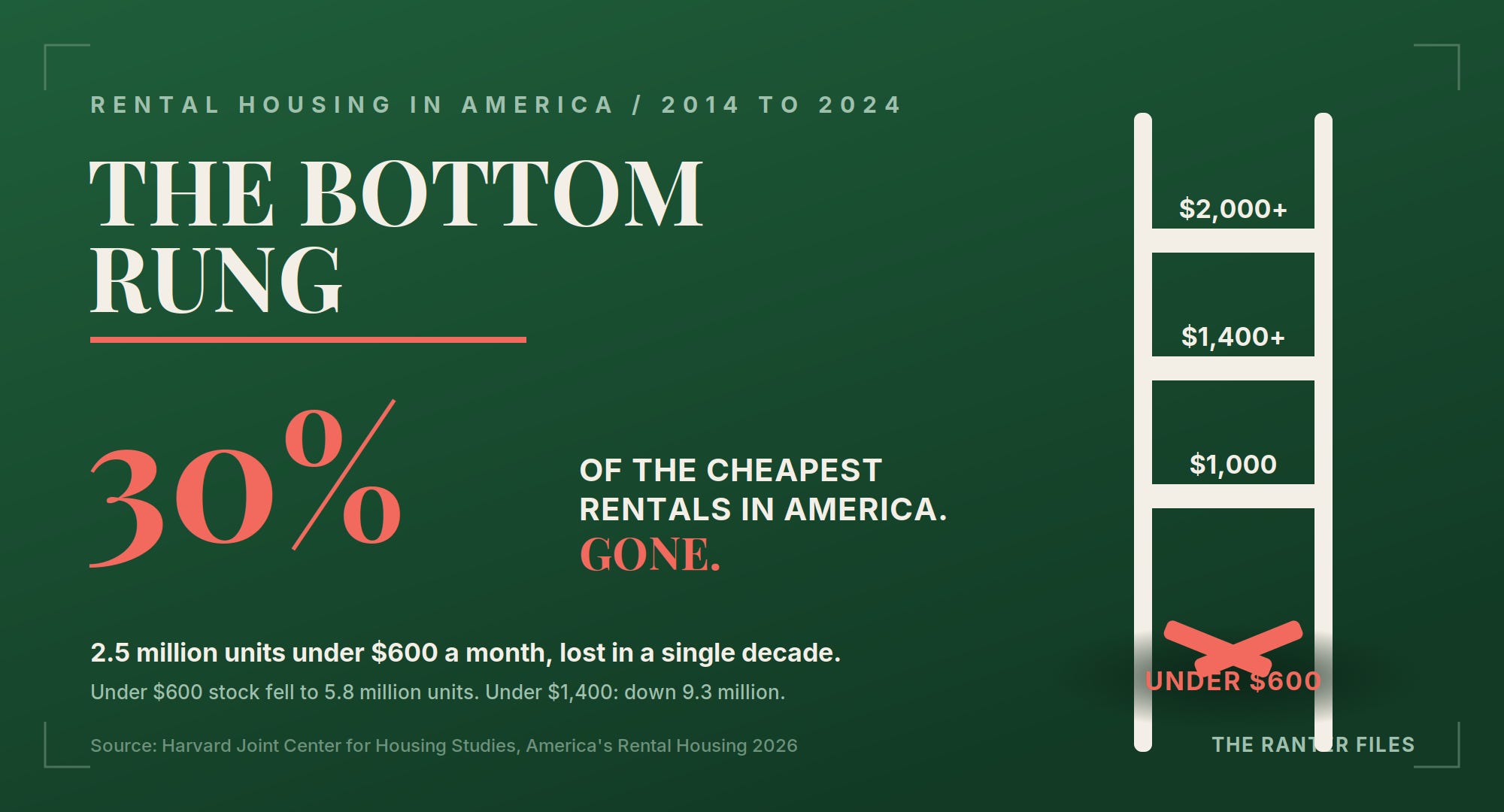
The reason is narrow, and it is not a villain. The cheap units are not being replaced. Over the same ten years, builders added 11.8 million apartments renting at $1,400 or more, and 5.8 million of those go for $2,000 and up. New construction goes to the top of the market, because that is where the math works and where the renters with money are. The old cheap stock gets renovated up, converted to something pricier, or knocked down, and nothing cheap gets built behind it. The bottom rung is not being repriced. It is being removed.
And the people pushed off the bottom do not disappear. By 2024, 22.7 million renter households were spending more than a third of their income on rent, 2.3 million more than in 2019.
You feel this even if you never rent at the very bottom, because the bottom is what everything else stands on. When the $500 unit disappears, the person who lived there does not vanish. They move up into the $800 unit, which pushes its tenant toward the $1,100 unit, and the squeeze climbs the whole building. The floor falling out is why the middle keeps getting more expensive.
The move this week is quick. Search what a newly built or recently renovated apartment in your area asks right now, then hold it next to what you pay. The gap between the two is the cliff you are standing near. If your rent sits well below it, you are living on borrowed cheap, and the renewal letter is the price notice for the whole tier above you. Know that number before the letter shows up, not after.
And once you do land a place, the rent you finally agree to travels somewhere specific, through a structure most renters never get to see.
Figures: Harvard Joint Center for Housing Studies, America’s Rental Housing 2026, covering 2014 to 2024 and drawing on U.S. Census Bureau and American Community Survey data. The under-$600 stock fell by 2.5 million, a 30 percent decline, to about 5.8 million units. The rent bands are inflation-adjusted; JCHS does not state the base year in its public summary.
Related episode: Where Your Rent Goes
THE RANTER follows the money through the systems that bill you: healthcare, housing, food, labor, debt, political money. Mechanism over motive.
Newsletter: newsletter.theranter.com | Website: theranter.com
YouTube: @TheRanterOfficial | Instagram: @theranterofficial | TikTok: @theranterofficial | X: @RanterMarkus | Bluesky: @rantermarkus.bsky.social
Every figure above is sourced and linked. Think one is wrong? corrections@theranter.com