

A young woman I know worked at a daycare. She watched her supervisor mix bleach with Fabuloso and wipe down the toddler nap mats. That was the standard cleaning protocol. The bottles sat next to each other under the sink. Nobody had told her any different.
Bleach and Fabuloso don’t mix. Fabuloso’s own FAQ says so. The CDC says the same thing in plainer language: do not mix household cleaners, and the mix can release chlorine gas. American poison control centers logged more than two thousand chlorine-gas exposures from cleaner mixing in 2017 alone, and those are just the calls. A Buffalo Wild Wings manager died in 2019 from a similar accidental mix.
This is what the absence of federal training standards looks like in a room.
The oversight gap
There is no national childcare safety curriculum. Federal money flows through the Child Care and Development Fund, $11.6 billion in fiscal 2023, but CCDF is a participation floor for subsidies, not a teaching standard. The training requirement varies by state. Texas mandates 24 hours of pre-service training plus 24 hours per year. New York wants 15 hours in the first six months and 30 hours every two years. Chemical safety is rarely a separately mandated topic. It gets bundled into “health and safety,” and the state gets to decide what that means.
Licensure inspections cycle from annually to every three years. License-exempt categories are everywhere. Complaint-driven unannounced inspections happen, but the trigger requires someone in the building to know that mixing bleach with Fabuloso is wrong and to know who to call. In a workforce where the median tenure is short and the median wage sits in the bottom 5 percent of all U.S. occupations, that condition is rarely satisfied.
Where the money goes
Eight of the eleven largest childcare chains in the United States are owned by private equity. The Congressional Research Service finds that fifteen of the sixteen largest receive some private equity funding. KinderCare is the biggest. Its 2023 fiscal year, per its S-1 filing: $2.5 billion in revenue, $102.6 million in net income. That is a net margin of four cents on the dollar. Looks lean.
Then you read the rest of the filing.
Profit is the wrong line to watch. Money leaves a private equity company through rent paid to landlords the sponsor controls, interest on debt the sponsor loaded onto the operating company, and management fees the sponsor charges itself. Sometimes the company borrows new money just to mail the owners a check. Net income is what is left.
The company carries $2.4 billion in total lease obligations, with $285.8 million expected to be paid out in fiscal 2026 alone, and long-term debt including interest of $1.2 billion. The filing’s related-party section discloses lease agreements with affiliated entities. In March 2024, eight months before going public, KinderCare took out an incremental term loan and made a $320 million distribution to KC Parent, which then paid $276.9 million to Class A unitholders and $42.6 million to profit-interest unitholders. The operating company borrowed money so its private equity owners could pay themselves a dividend. The deal is right there in the filing.
Bright Horizons is publicly traded. Its 10-K explains the business model in plain terms: continued profitability requires that the company “pass on our increased costs, such as labor and related costs, to our customers.”
The second extraction
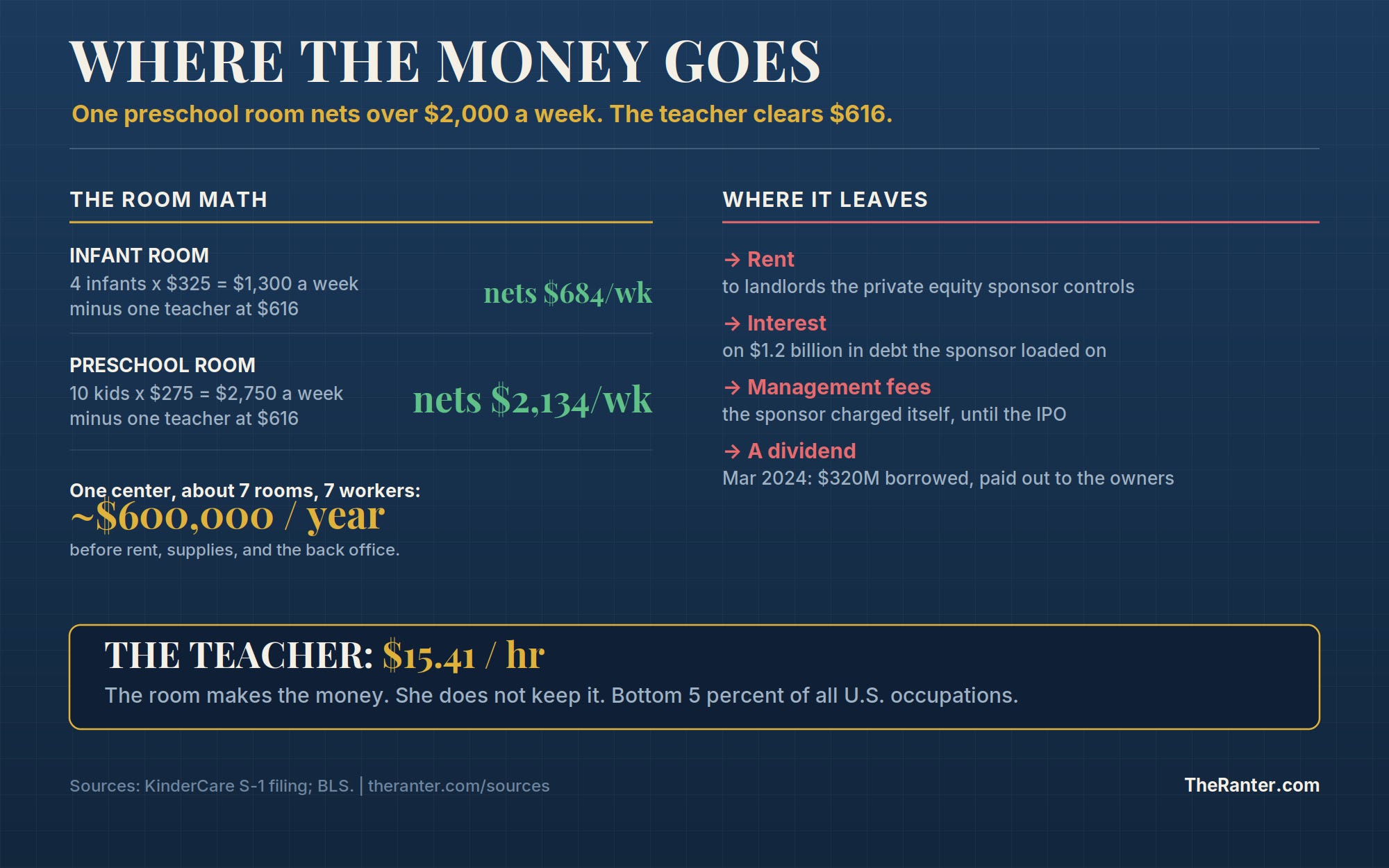
Run the numbers at the room level. The infant room loses money on its own. $325 a week times four infants is thirteen hundred. The worker watching them at $15.41 an hour clears $616. The room nets the center about $684 a week. That is the slot every parent fights to get into. It is also the slot the chain pretends is the price floor.
The preschool room is where the math turns. Ten four-year-olds at $275 a week is twenty-seven fifty in revenue. One teacher, still $616. The room nets the center over two thousand dollars a week on one worker. Stack one infant room, two toddler rooms, and four preschool rooms in a single center and you have twelve thousand a week off seven workers, before rent, before supplies, roughly six hundred thousand a year per center before the back office takes its cut.
Some of that pays rent on a building the PE owners’ affiliate happens to own. Some of it pays interest on debt the PE owners loaded onto the operating company. Some of it paid the management fee back to the sponsor until the IPO made them stop disclosing it.
The worker has done a version of this math herself. She knows what she brings in for the room. She knows what she takes home. She also knows that nobody is going to pay her more by next Tuesday.
So the second extraction begins. After they take the money, they come for the meaning. The job is framed as a calling. The worker is told she is doing something noble. The cost of the job, in money, gets reclassified as the price of doing good. Pay too low to live on becomes a moral test the worker is supposed to pass. The Cleveland Fed reports that childcare pay does not cover a living wage for a single adult plus one child in any state. Median wage is $15.41 an hour, bottom 5 percent of all U.S. occupations. Turnover runs 65 percent above the median occupation. The worker mixing bleach with Fabuloso has been there three weeks because the worker who would have known better got a job at Target.
What the bill says, and who has refused to pay it
Infant childcare costs more than public college tuition in 38 states. The federal affordability threshold is seven percent of family income. The average family is paying more than twenty.
Build Back Better had $400 billion in it for childcare and universal pre-K. The House passed it in November 2021. Joe Manchin killed it on Fox News a month later. Every Senate Republican opposed it. The American Rescue Plan’s Child Care Stabilization Program kept the industry alive with about $24 billion. It expired in September 2023. Neither party renewed it.
There is precedent for what comes next
Public charter schools were a bipartisan idea in 1991. Within a decade, the extraction model had emerged. The Department of Education’s Office of Inspector General has documented extensive related-party transactions between charter management organizations and their own real estate affiliates. National Heritage Academies moved to sell more than two-thirds of its schools to its own real estate arm for more than $850 million. In Academica’s Florida network, schools paid 17.7 percent of their total expenses in rent to Academica-owned landlords, against 11.5 percent for schools with unrelated landlords. The public paid twice. Once for the school. Again through inflated lease payments to entities the owners controlled.
The 2025 federal policy law moved childcare money into the same shape. Section 45F, the employer-provided childcare tax credit that has existed since 2001, was expanded from 25 percent to 40 percent of qualified expenses, with the maximum credit raised from $150,000 to $500,000. Small businesses get 50 percent up to $600,000. The pre-tax childcare savings cap rose from $5,000 to $7,500. The expansion explicitly added contracted intermediaries to the list of qualifying recipients. Big chains with corporate-client portfolios, the same chains owned by private equity, are sitting on the largest single demand pipeline they have ever had. The federal money flows to corporations, which route it to providers who happen to be the chains we just walked through. The supply problem at the worker level is untouched. So is the training standard. So is the inspection cycle.
Different parties have voted on this bill. The same bill keeps not passing. The mechanism does not have a party.
Standards first
If Medicare and Medicaid fraud bother you, and they should, you have not been paying attention. Childcare is the same setup with less oversight. The money keeps flowing. The standards never showed up. We are subsidizing an industry where the buyer has no choice, the workers have no leverage, the inspectors visit once every three years, and the owners are taking cash out through rent paid to their own affiliates. Add federal subsidies on top without changing any of the upstream conditions and the only thing that grows is the funnel.
So you want to save money. You are going to do it with the people who take care of your kid.
Yes, there is fraud in these programs. The dollar value of recipient-level fraud is dwarfed by provider-level fraud, contractor capture, and intermediary skim. But the framing matters now.
When a person on assistance games a benefit, the response is “scrap the program, people are lazy, fix it by removing it.” When the same federal government pays $34.8 billion a year in direct subsidies to a fossil fuel industry that already books record profits, the response is “energy security, market dynamics, complicated.” The same 2025 law that expanded the Section 45F childcare credit also added about $40 billion in new fossil fuel subsidies over the next decade. Paid for, partly, by the families who can’t afford daycare. The framing tells you who the rules are written for.
The honest answer is to design the program so the fraud is auditable, and then audit it. We don’t scrap the Pentagon for failing audits, oil subsidies for going to profitable companies, or the mortgage interest deduction for benefiting buyers who didn’t need it. We keep those programs and accept the leakage because the beneficiaries have political weight. Childcare doesn’t, yet, and welfare recipients never will.
We under-train police, teachers, and the people we hand babies to. Then we say these are the three things we value most. The first question is not how much money. It is what kind of room. Standards on training, on inspection, on who is allowed to own a chain subsidized with public money. Build the plan. Then spend the money.
A one-page document with the chemistry, the alternatives, and a basic disinfection protocol fits on one side of one sheet of paper. What the training policy reads and what the room looks like on the floor are always two different things. The document probably exists. Page 47 of an employee handbook. A PDF on a training portal she clicked through in week one. Wherever it lives, it is not above the sink. Somebody’s job is owning that document. Nobody’s job is putting it in her hand.
Before we throw federal money into a room nobody has inspected, ask the questions any first-time parent already knows to ask. What does the room look like. Who trained the worker. Who is the landlord. Who is taking the cash out. The answer is Gordon Gekko, Henry Kravis, Stephen Schwarzman, Carl Icahn, Mitt Romney, Donald Trump, and the guy who ran WeWork. If all of them had a kid together, that kid would look like Jean-Baptiste Emanuel Zorg. Feel better about her future?
The worker I know did not know that mixing bleach with Fabuloso was dangerous. The next day, she did. So did her coworkers. So did the workers at two other centers. One person walked back to the floor. Nobody else had. The cleaning bottles came out from under the sink at three centers in one day. The system that is supposed to know this stuff did not know it. The system that is supposed to fund and enforce it did not fund or enforce it. A one-page document was sitting between safe and unsafe. Nobody had put it in her hand.
Well, fuck that plan.
THE RANTER follows the money through the systems that bill you: healthcare, housing, food, labor, debt, political money. Mechanism over motive.
Newsletter: newsletter.theranter.com | Website: theranter.com
YouTube: @TheRanterOfficial | Instagram: @theranterofficial | TikTok: @theranterofficial | X: @RanterMarkus | Bluesky: @rantermarkus.bsky.social
Every figure above is sourced and linked. Think one is wrong? corrections@theranter.com