

THE RANTER FILES
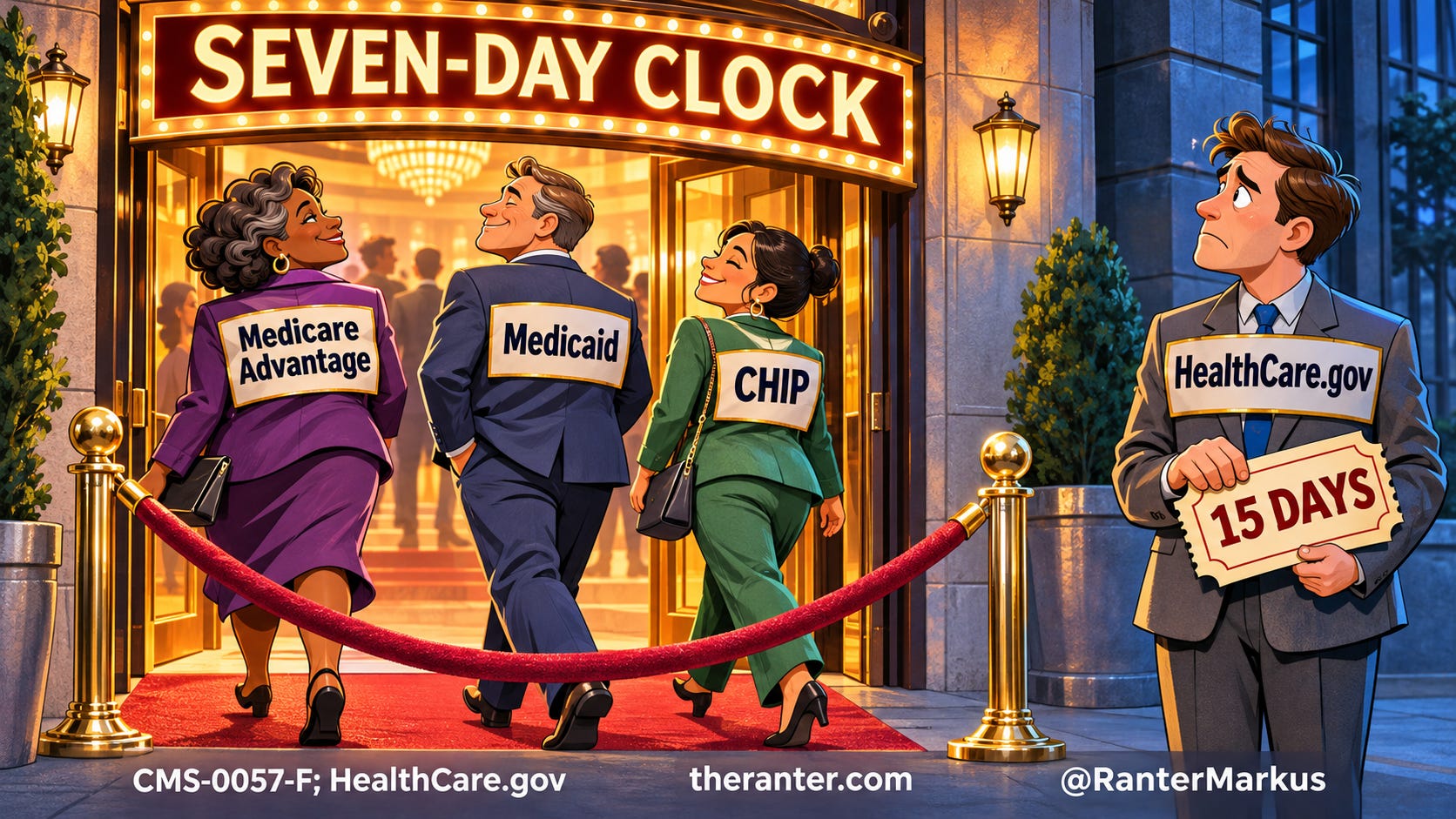
15 days. That is the general federal deadline for a HealthCare.gov insurer to answer a standard, non-urgent prior authorization request for medical care, the permission slip some treatment needs from a guy in a cubicle before it happens (HealthCare.gov). Starting in 2026, Medicare Advantage and Medicaid plans have been moving to seven calendar days for the same request. The federal rule that set that clock left HealthCare.gov plans out by name (CMS). Just looked right at you and kept walking. It did make insurers in the federally run marketplace show you how often they turn people down. Open enrollment is running right now, so that part is worth your time.
Before December 15
Look up the insurer’s prior authorization numbers. Insurers in the 28 states where the federal government ran the marketplace in 2025 had to post their 2025 approval and denial rates for medical care, not drugs, on their own websites by March 31, 2026. States that run their own marketplace are not covered, even some that use the HealthCare.gov website (KFF). Search the insurer’s site for “prior authorization metrics.” KFF found these pages hard to find and hard to read, and it could not locate CVS’s at all. Give it a minute anyway.
Compare before you click enroll. December 15 is the last day to pick a plan that starts January 1, and you have to pay the first premium. January 15 is the last day of open enrollment (HealthCare.gov).
If you get denied anyway, appeal. Don’t just take the no and go lie down. You have 180 days from receiving the denial notice to file an internal appeal. Use the insurer’s form, or write a letter with your name, claim number and member ID, and add a letter from your doctor if you can get one. Your state’s Consumer Assistance Program can file it for you. If the care is urgent, you can ask for an outside review at the same time (HealthCare.gov).
I opened one
Ambetter Health’s Florida marketplace plan, issuer 49004, reports 419,452 standard prior authorization requests in 2025 and 88,079 denials. That is 21.00 percent, to two decimal places, which is a hell of a lot more precision than I have ever gotten out of an insurance company on the phone (Ambetter Health). Its median standard decision took 0 days, so most answers came the same day. Its appeal line reads 2,137 approved out of 3,670. Put that 3,670 next to the 88,079 for a second.
Then read page one. It warns that the numbers may differ from what the company reports to regulators and “should not be relied upon as a complete or definitive representation.” So the transparency report comes with a note asking you not to lean on the transparency report. I respect it. It is the most candid line on the sheet.
KFF looked at eight marketplace insurers. The share of standard requests denied ran from 3 percent at GuideWell to 25 percent at Centene, the company behind Ambetter. When standard marketplace denials did get appealed, 43 percent were overturned. Push back and they fold more often than you’d think. Treat those as questions to bring to an insurer, not a clean ranking: some insurers reported national numbers instead of state ones, and the services that need permission and the people asking for them differ from company to company (KFF).
One clock missing
The 2024 rule from the Centers for Medicare and Medicaid Services covers Medicare Advantage, Medicaid, CHIP and HealthCare.gov insurers. All of them have to post their numbers and give a specific reason when they deny a request. Then the deadline shows up: 72 hours for urgent requests, seven calendar days for standard ones, “excluding QHP issuers on the FFEs” (CMS). Gotta love bureaucratic poetry! That is federal speak for your HealthCare.gov plan. Everyone else in the club got the seven-day clock. HealthCare.gov plans kept 15 days.
CMS has since proposed closing that gap. Under a proposed rule, HealthCare.gov insurers would have to tell your doctor within seven calendar days on a standard request for medical care, and within 72 hours on an urgent one, beginning October 1, 2027 (CMS). A proposal that would start next October does nothing for anybody picking a plan this month.
To be fair to the clock, most answers come way faster than 15 days. KFF found the typical standard decision took about a day in every market in 2025 (KFF). The deadline is for the requests that sit, and the sheet is for the requests that end in a no. Look at both.
If someone you know is shopping on HealthCare.gov this month, do them a favor and hand them one search: the insurer’s name plus “prior authorization metrics.” December 15 is not moving for anybody.