

Last November, in the Oval Office, President Trump told reporters that the new White House ballroom would not cost taxpayers anything. “Not one penny,” he said, “is being used from the federal government.”
That was six months ago. This week, Senate Judiciary Committee Chairman Chuck Grassley released a $72 billion immigration enforcement bill. Tucked inside it: $1 billion in taxpayer money for security improvements tied to the ballroom project.
The original announcement, in July 2025, said the structure would cost about $200 million, paid for by Trump and what the White House called “many generous patriots”. The estimate climbed to $300 million by late October and $400 million by this spring. On October 20, 2025, the East Wing demolition began. The donor list came out three days later: thirty-seven names, no donation amounts disclosed. Tech giants, defense contractors, crypto founders, Cabinet families. Alphabet’s $22 million came from a $24.5 million settlement of a Trump lawsuit, routed to the ballroom fund.
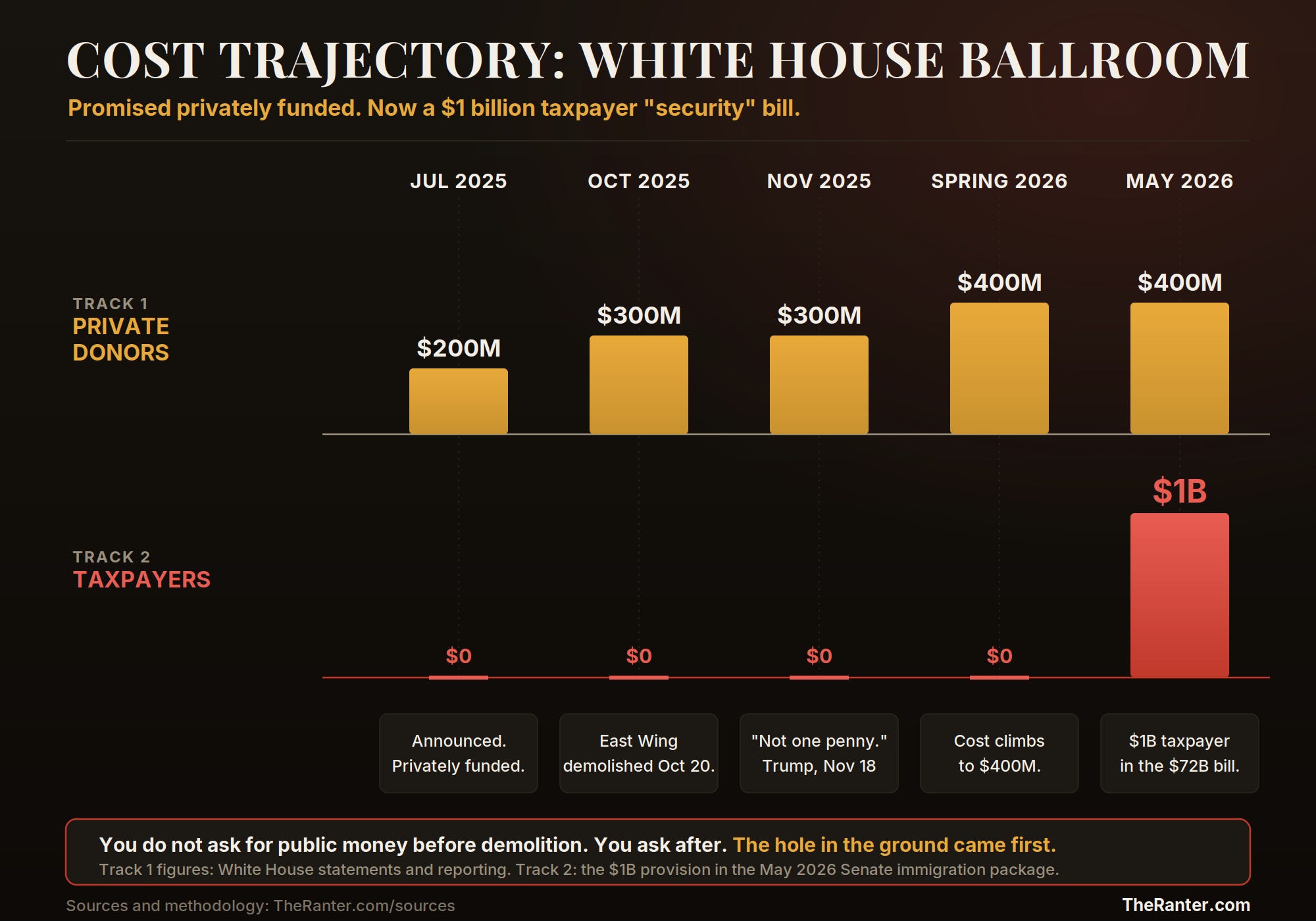
By the time the funding question reopened, the East Wing was already gone. The site was a hole in the ground.
Then the framing shifted. In court filings this spring, the administration argued the new structure was “vital” for security, would be built with materials that could withstand drone attacks, and would include underground medical facilities and a bomb shelter. The ballroom was no longer a venue. It was infrastructure.
The order matters. You don’t ask for public money before demolition. You ask after.
Grassley’s bill provides the $1 billion. It rides inside a $72 billion immigration enforcement package most Republicans want to vote yes on regardless. The ballroom security funding is the rider. The immigration spending is the carrier.
This trick is older than the building it’s running through. Both parties have used must-pass bills to bury items their members couldn’t defend on a clean vote. In December 2009, Senator Ben Nelson held up the Affordable Care Act vote until the bill carried a permanent 100 percent federal Medicaid match for Nebraska, alone. The “Cornhusker Kickback” was stripped out three months later in reconciliation. The ACA had already passed. In 2005, Senator Ted Stevens attached a roughly $223 million earmark for an Alaska bridge to a transportation bill. The “Bridge to Nowhere” became its own scandal, and the earmark was eventually pulled. The transportation bill it rode in on was already law.
So riders themselves are not partisan. Stuffing things into bills nobody wants to vote against is just how trades work in this building.
The Republican framing on this one is that the $1 billion is Secret Service security infrastructure, not ballroom construction, and the bill explicitly bars the funds from being used on non-security elements. That distinction is real. Every president gets security upgrades. Every president gets them inside larger appropriations packages.
But the bait-and-switch is something else. The president said in November that not one penny of federal money would be used. He demolished the East Wing of the White House. He raised hundreds of millions from donors whose names are protected by a contract that excludes the White House from conflict-of-interest protections. And once the demolition was irreversible, the funding ask emerged in a category, security, that is harder to challenge than ballroom construction would have been on its own.
That sequence is one administration’s. Both parties run riders. Not both parties did this. Pretending otherwise to keep things tidy would be a lie.
If you want to do something with this, the move is the same as it was last week. Tomorrow’s news cycle will not cover the ballroom. It will cover the immigration bill. Your senator’s office is going to take calls about the immigration position, not the ballroom position. The two votes are the same vote. So when you call, ask this: “Does this bill include funding for the ballroom security project?” That’s the sentence. The staffer logs it. The aggregate is what gets reported up.
There is a version of this where none of that matters. The bill probably passes either way. The ballroom probably gets finished either way. I am not pretending a phone call breaks the trade.
What I am saying is that the next time you hear a major project will be paid for by private donors at no cost to the public, the question to ask is what the security supplement looks like in eighteen months. Watch for which must-pass bill it rides in. By the time the funding ask is public, what’s already irreversible is usually already irreversible.
That’s the pattern. The hole in the ground tells you the rest.
THE RANTER follows the money through the systems that bill you: healthcare, housing, food, labor, debt, political money. Mechanism over motive.
Newsletter: newsletter.theranter.com | Website: theranter.com
YouTube: @TheRanterOfficial | Instagram: @theranterofficial | TikTok: @theranterofficial | X: @RanterMarkus | Bluesky: @rantermarkus.bsky.social
Every figure above is sourced and linked. Think one is wrong? corrections@theranter.com