

About 116 million private-sector workers have no union contract. Most of them can be fired for no reason at all.
Every time a politician gets caught doing something ugly, somebody says it. Let’s wait until all the evidence is in. Don’t rush to judgment. That sounds fair, and it’s a courtesy almost nobody else in America gets. You’re about to make a hiring decision next Tuesday, so it’s worth knowing which bar you’re using.
The bar everywhere else
Prison is the one place we demand proof beyond a reasonable doubt. That isn’t absolute certainty, but it’s the highest bar we have, and it’s high on purpose, because the government is taking away your freedom.
Everything below prison runs on a lower bar called a preponderance of the evidence. In plain English, more likely than not. Civil lawsuits use it. So do the agencies that can end a career. In 1981 the Supreme Court ruled that the SEC could bar a man from working with investment advisers on a preponderance of the evidence, the same bar as a fender-bender lawsuit.
In 1995 a criminal jury acquitted O.J. Simpson. In 1997 a civil jury looked at the same two deaths, used the lower bar, and found him liable for $33.5 million. Same man, same deaths, two answers, and the second jury only had to find it more likely than not.
Most jobs don’t even get that
Most working people never get a bar at all. In 2025, 124.6 million people worked in the private sector and 8.4 million of them were covered by a union contract. That leaves about 116 million without one. For most of them the default is at-will employment, which the Labor Department’s own journal sums up as firing for “good cause, bad cause, or no cause at all.” There are limits. Your boss can’t fire you for your race or for reporting a safety problem, and some people have a written contract. But nobody has to prove anything to a court first.
No hearing. No jury. A manager decides you’re more trouble than you’re worth, and you’re cleaning out your desk by Friday.
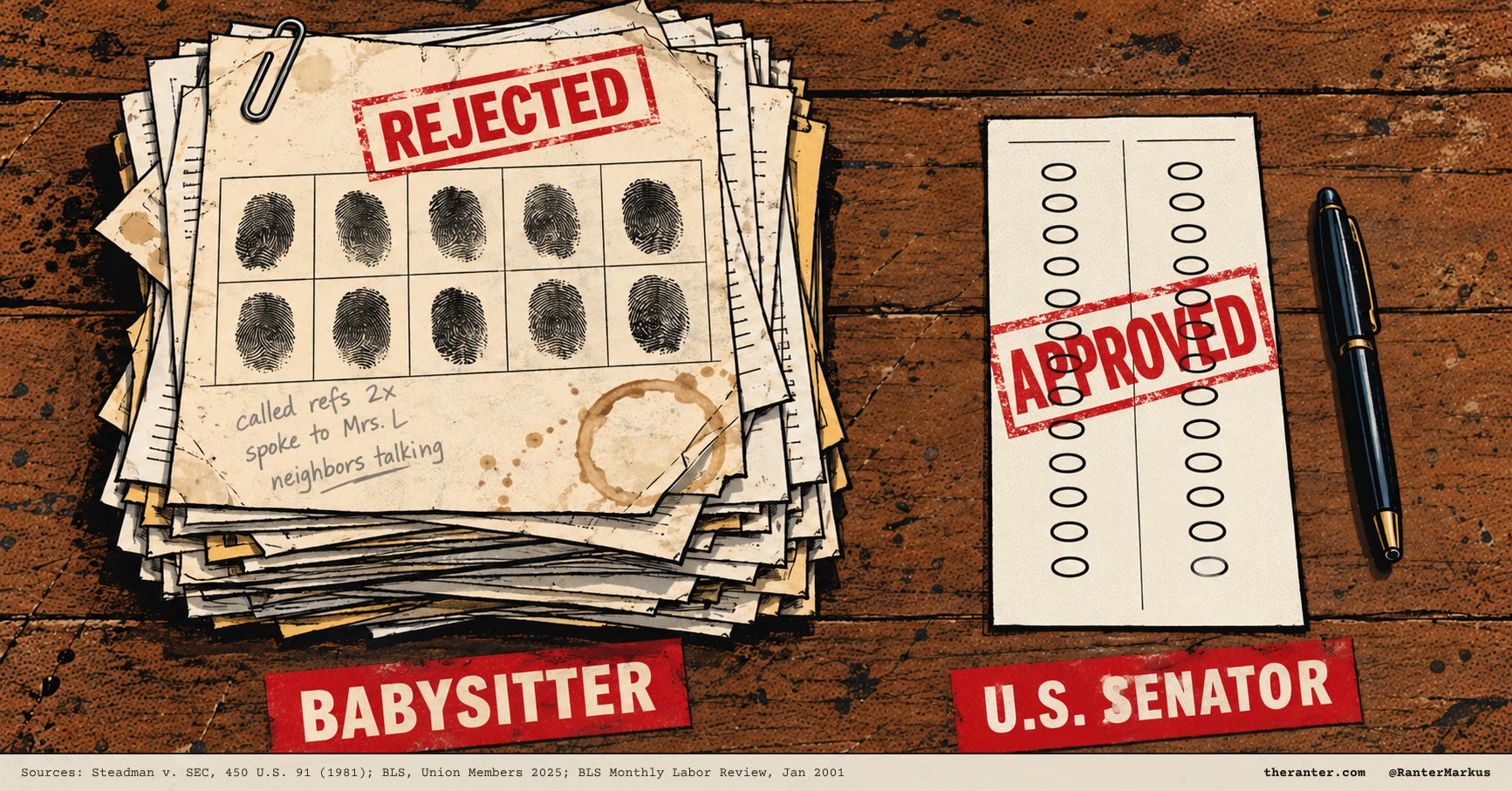
You run your own life the same way. You don’t hire the babysitter the neighbors whisper about. You don’t keep the accountant after a client sues him for skimming. You don’t wait for a conviction. You make a call with what you know, because if you’re wrong, your kids or your money pay for it.
The one hire we grade on a curve
Then a senator or a governor or an attorney general gets caught, and suddenly we want a criminal trial before we’re allowed to think anything.
Guilt or innocence is a legal finding, and it belongs in a courtroom. Fitness for a job is an employment decision, and your vote is that decision. You’re the employer.
“Let the process play out” asks you to use the prison bar on a hiring question. It also asks you to wait, and the process is slow. Investigations take years. An election takes one Tuesday.
I’m not saying an accusation should end anybody. A rumor isn’t evidence, and a lawsuit somebody filed isn’t a finding. The fair bar is the one the rest of us live under: a judge, a jury, an ethics committee or an inspector general looked at the evidence and decided. When a finding like that exists, you’re allowed to use it. That’s the whole standard.
Before you vote
Pick the candidate on your ballot you feel most protective of. Pull up their record, the findings and not the rumors. Then ask the question you’d ask about anybody else you hire: if this person applied to watch my kids or keep my books, with this record, would I say yes?
If the answer is no, ask the harder one. When I say I’m waiting for all the evidence, which decision am I putting off, and who’s paying while I wait?
Related read: Three Seats Opened in Eight Days
THE RANTER follows the money through the systems that bill you: healthcare, housing, food, labor, debt, political money. Mechanism over motive.
Newsletter: newsletter.theranter.com | Website: theranter.com
YouTube: @TheRanterOfficial | Instagram: @theranterofficial | X: @RanterMarkus | Bluesky: @rantermarkus.bsky.social
Every figure above is sourced and linked. Think one is wrong? corrections@theranter.com