

June 13, 2026
This week a federal judge declined to block a UFC card set for the South Lawn of the White House on June 14, staged for the President’s 80th birthday and the country’s 250th. Seven federal agencies are working the event.
The same week, crews finished repainting the Lincoln Memorial Reflecting Pool in what the President calls American flag blue. The pool did have real problems, leaks and a failing filtration system, and the work got pushed for the anniversary. Worth doing. The President had said the job would run a million and a half to two million dollars. The contracts came in around $14.8 million.
Underneath all of it, a fragile ceasefire with Iran that both sides keep testing.
The room had room.
Then there is the food rule. A USDA proposal to end something called broad-based categorical eligibility for SNAP is sitting at the White House budget office, one step from a public rollout. The Food Research and Action Center, which flagged it this week, says it would increase hunger for families and children.
Broad-based categorical eligibility is a plumbing rule, which is why nobody fights about it on television. A family already approved for another assistance program has, in most states, been allowed to qualify for food benefits without sitting through a second, separate asset test. The state uses the determination it already made and does not force the family to prove poverty twice. Ending the rule brings the second test back. More paperwork. More families with a little in savings, a used car worth a bit too much, a second part-time job, knocked off the rolls. The cut does not arrive labeled as a cut. It arrives as a form.
Here is the reason they give. Waste and fraud. Tighten the rules, stop the wrong people from getting food, protect the integrity of the program. Fine. Let’s take that seriously, because there is a tool built for exactly that. It is called an audit.
The Pentagon has been legally required to pass one since 2018. It has failed eight years in a row, the most recent this past December. One piece of the military passes, the Marine Corps, and the general who runs their books said the audit found no fraud and no price gouging, because that is what an audit is for. The other 840 billion dollars cannot account for itself, and the plan on the table is to raise it to one and a half trillion.
So keep the fraud standard. It just points one direction. We run it on a family proving twice that they are poor enough for groceries. We do not run it on the largest agency in the government, the one that has never once passed the test it was ordered to take. They went looking in the kitchen instead of the hangar.
We have seen this exact rule before. The first Trump administration proposed nearly the same change in 2019. USDA’s own analysis put it at 3.1 million people pushed off food assistance and 500,000 children losing automatic free school meals. People filed comments. A lawsuit followed. The rule did not survive, and it was formally withdrawn in 2021. It is back now, at the budget office, waiting. No official 2026 head-count has been published yet. The Center on Budget and Policy Priorities estimates this version reaches further, around 6 million people and more than 1.8 million children, because more states lean on the rule today than did six years ago.
There is an old line, the one history hangs on Marie Antoinette, that she heard the peasants had no bread and said let them eat cake. She almost certainly never said it. The line survived anyway because it captures something clean: the contempt of a person so far from hunger that she hears it as a menu problem.
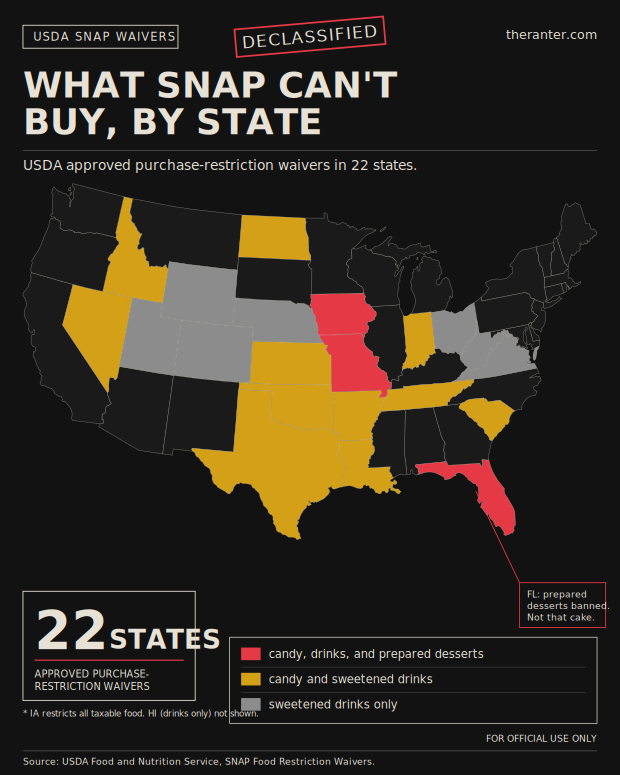
The 2026 version is more precise. Antoinette’s contempt at least assumed the poor could buy the cake. Over the past year USDA has approved waivers in more than twenty states letting them pull items out of what SNAP is allowed to buy: soda, sweetened drinks, energy drinks, candy. Florida went one further and wrote prepared desserts onto the banned list. So Florida has its answer for Marie Antoinette. Not that cake. Whether a family qualifies to be standing in the store at all is the separate question the budget office is working on right now.
Stack it and look at it. Fewer people qualify. The ones who still do get a shorter list of what they are allowed to want. And the people writing those rules spent the same week handing the South Lawn to a fight promoter.
Food aid gets cut by both parties. In 1996 a Democratic president signed the welfare overhaul that ended the old guarantee and built the work-requirement machinery every administration since has widened. The instinct that treats the lunch tray as the first place to look for savings is bipartisan, and decades old.
This one belongs to a single administration that chose it this month, on its own. I am not going to launder that into a tidy on-the-other-hand. Both sides have trimmed food aid over the years, and this specific cut, this week, next to the cage match, did not need the other side’s help to happen.
If you want to do something with this, the straight answer is that the comment window is not open yet. The rule is still at the budget office. When it posts to the Federal Register, a public comment period opens, and that is worth showing up for, because last time the comments and the lawsuits were part of what beat it. Until then, the live lever is Congress. Your House member and the Senate Agriculture Committee can lean on this while it is still a draft. The sentence to give a staffer is short: how many children does this proposal remove from food assistance, and where is that number published? They cannot answer it yet, because the number is not public, which is exactly the thing worth making them go look for.
I am not going to tell you a phone call stops it. The rule might post and take effect anyway. The lawn already has its fight. The pool already has its coat. What pressure does, the same way it did in 2019, is force the count into the open, on the record, where it can be read back later. In this building, the number on the record is the only thing that outlives the news cycle.
The room is never empty. There is always money for the thing that looks powerful. It goes quiet at the tray.
If you are new here, The Ranter is the animated series I write and voice. This piece is the policy side of the hunger machine. The episode is the grocery-shelf side: the shrink ray that quietly empties the bag, the dollar store that moves in after the supermarket leaves, and the egg company that explained away a record year by blaming the birds.
Sources & Receipts
UFC card on the White House South Lawn, June 14, judge declined to block, seven federal agencies supporting. The Hill. https://thehill.com/video/white-house-ufc-event-to-cost-60m-plus-labor-from-7-federal-agencies/11874998/
Lincoln Memorial Reflecting Pool repaint, President’s claim of $1.5 to $2 million against roughly $14.8 million in awarded contracts. Washington Post, via NBC Washington. https://www.washingtonpost.com/politics/2026/06/04/lincoln-memorial-reflecting-pool-trump/
Fragile US-Iran ceasefire, ongoing negotiations, strikes traded as recently as June 11, 2026. Reuters. https://www.reuters.com/world/middle-east/us-iran-trade-attacks-second-day-undermining-shaky-ceasefire-2026-06-11/
USDA proposal to end broad-based categorical eligibility for SNAP, described as increasing hunger for families and children. Food Research and Action Center, June 11, 2026. https://frac.org/blog/usda-proposal-to-end-broad-based-categorical-eligibility-for-snap-would-increase-hunger-for-families-and-children
2019 categorical eligibility rule, USDA estimate of 3.1 million people off food assistance and 500,000 children losing automatic free school meals, formally withdrawn in 2021. Federal Register, document 2019-15670. https://www.federalregister.gov/documents/2019/07/24/2019-15670/revision-of-categorical-eligibility-in-the-supplemental-nutrition-assistance-program-snap
2026 projection of roughly 6 million people and more than 1.8 million children affected. Center on Budget and Policy Priorities. (ADD CONFIRMED CBPP URL BEFORE PUBLISH)
SNAP food restriction waivers across more than twenty states, covering soda, sweetened drinks, energy drinks, and candy, with prepared desserts added in Florida. USDA Food and Nutrition Service. https://www.fns.usda.gov/snap/waivers/foodrestriction