

By Markus Grant | The Ranter | The County Hospital, Part 3
Carney Hospital opened on June 9, 1863, during the Civil War. Its first patients were soldiers. The Daughters of Charity of Saint Vincent de Paul ran it for over a century. A Carney team performed the first abdominal surgery in Boston, and the first plastic hip operation in the United States happened inside that building. For 161 consecutive years, it served the people who walked through its doors.
It closed on a Saturday. August 31, 2024. No ceremony. No buyer. The emergency department shut down the night before. The last patients were transferred. The sign stayed up.
The building is still there.
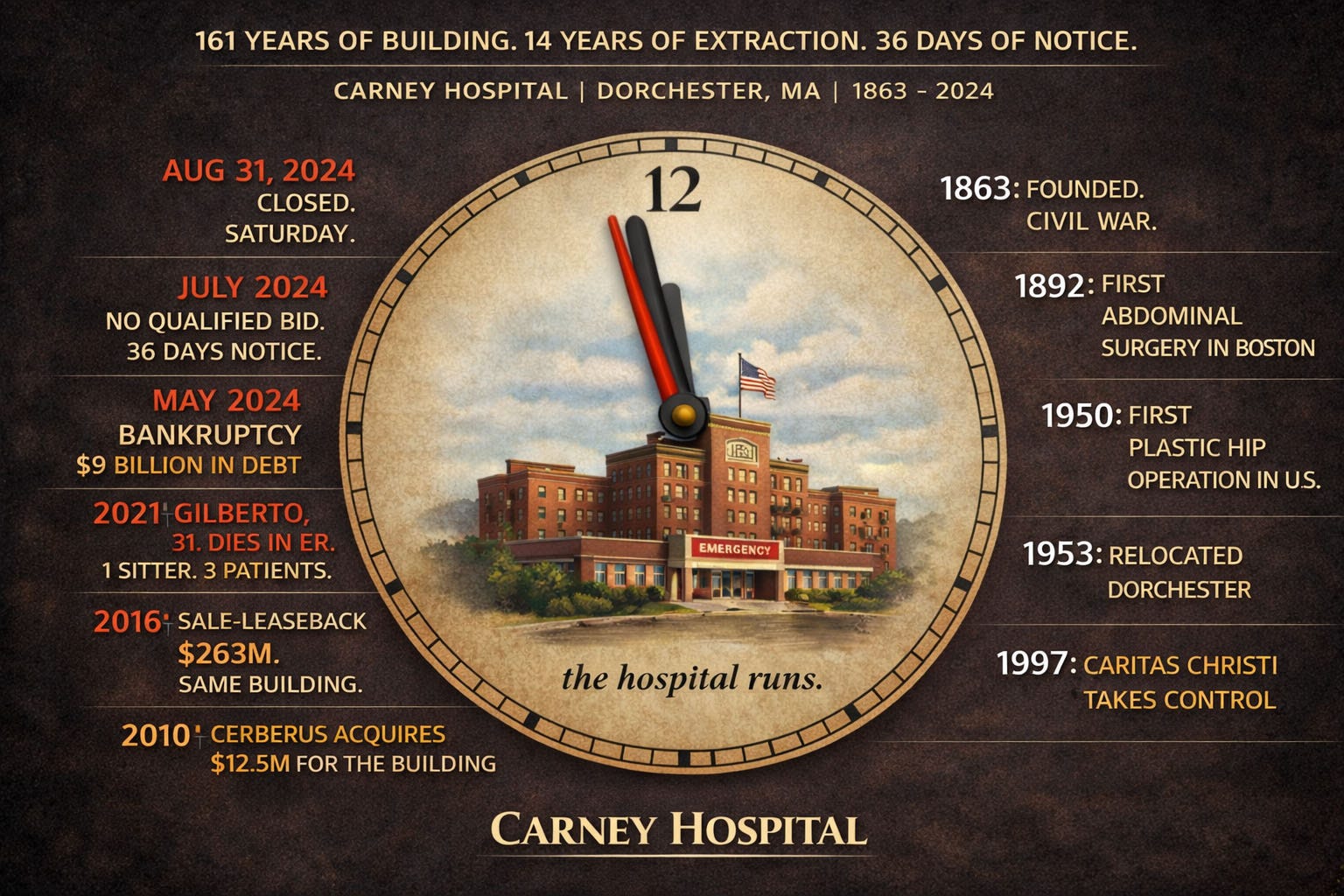
Carney sat at 2100 Dorchester Avenue, on a 12.7-acre campus in Lower Mills. It was a teaching hospital and a Primary Stroke Service facility, with 122 licensed beds, 50 of them psychiatric, serving adolescent, adult, and geriatric patients. It ran a Clozapine Clinic, one of very few in the area, for patients with severe and persistent mental illness who needed weekly blood draws and close monitoring. It ran a 200-language interpreter service where the top patient languages were Vietnamese, Spanish, Haitian Creole, Cape Verdean Creole, and Cantonese. [1]
Thirty thousand people came through that emergency department every year, the sixth-highest volume ED in Boston. [2] Two hundred and four thousand outpatient visits annually, nearly a thousand of them psychiatric admissions. [1]
The neighborhood it served, Dorchester and Mattapan combined, has 167,000 people. [2] The population is predominantly Black and Latino. Median income is below the Boston average. Premature mortality, deaths before 65, runs double the rate of wealthier neighborhoods. Mattapan has the lowest life expectancy in the city. [2]
Seventy-four percent of Carney’s revenue came from Medicare and Medicaid. [1] This is a safety-net hospital by every definition that exists. The payer mix alone tells you it was never going to generate the margins a private equity firm needs to service debt.
Yet.
Cerberus Capital Management acquired Carney in 2010 as part of the Caritas Christi deal. I covered the acquisition in Article 2. What I did not cover is what happened to Carney inside the system.
The ICU had 16 beds when Steward took over. By the time of closure, it had 4. [3] A recovery nurse who had worked at Carney for 48 years watched the count drop year by year. Four beds. In an ICU. Serving a neighborhood where premature death is twice the city rate.
On June 2, 2021, a 31-year-old man named Gilberto Melendez-Brancaccio was in Carney’s emergency department. He was in a behavioral health crisis, chemically and physically restrained, and having trouble breathing. His doctors ordered continuous one-on-one monitoring.
One sitter was watching three patients. [4]
Gilberto went into respiratory arrest, and nobody was in the room. Federal investigators found that inadequate training and staffing were reasonable contributing factors to his death. [4]
An internal nurse email from September 2023, two years later and nothing fixed, described arriving for a shift to find four nurses for 25 patients. [5] The email said this is seriously dangerous and no one should be expected to work like this.
The hospital was not failing because the community did not need it. Thirty thousand ER visits a year. The hospital was failing because the financial structure it had been placed inside was not designed to keep it open. The 2016 sale-leaseback with Medical Properties Trust sold the Carney property for $263 million. Steward had paid $12.5 million for the same building less than a decade earlier. [6] The money from the sale went to investors, and the rent stayed with the hospital. The payer mix that was nearly three quarters government-funded was now also carrying a lease it could never cover.
The hospital was counting down. The neighborhood just did not know the number yet.
On May 6, 2024, Steward filed for Chapter 11 bankruptcy. Nine billion dollars in debt. [7] The company ran a sale process for its eight Massachusetts hospitals, and Steward’s attorneys said they contacted hundreds of potential buyers.
On July 26, Steward announced that Carney and Nashoba Valley Medical Center in Ayer had received no qualified bids. Both would close by the end of August. [8]
I want to unpack “no qualified bid” because the phrase sounds like nobody showed up. Somebody showed up.
Insight Health System, a physician-owned company from Michigan that runs hospitals for low-income patients, bid on all of Steward’s Massachusetts hospitals, including Carney. Steward rejected it. The company said Insight lacked the financial capacity to actually operate the hospitals. [9] Two people briefed on the process told the Globe that Insight offered virtually no money for operations. Just an agreement to assume the lease payments. [10]
The real obstacle was the building. Apollo Global Management held the mortgage on the property. The campus was assessed at $76 million. Any buyer of the hospital’s operations would still owe rent to Apollo’s real estate structure. For a hospital where nearly three quarters of the revenue comes from government payers that reimburse below cost, there is no business model that covers that rent. The math from Article 1 and the structure from Article 2 arrived at the same address and produced the same answer. [11]
A bankruptcy judge in Houston named Christopher Lopez approved the closure on July 31. He called it painful, said keeping the hospitals open would threaten the entire hospital system in Massachusetts. [12]
A bankruptcy judge in Houston decided whether Dorchester keeps its hospital.
Massachusetts state law requires 120 days’ notice before an essential hospital service can close. Steward announced July 26. It closed August 31. That is 36 days. [8]
Federal bankruptcy law overrode the state requirement. Massachusetts officials acknowledged they could not compel Steward to comply. The Attorney General, Andrea Campbell, lives blocks from Carney, and her old city council district included it. She wrote to Steward reaffirming its obligations but did not take enforcement action to compel the hospital to stay open. [13]
The Department of Public Health held a hearing at Florian Hall in Dorchester on August 13. Hundreds showed up. The Steward representative was booed off the podium. [14] The DPH Commissioner told the room the closure feels unfair, then said DPH cannot legally require a hospital to keep a service open to the public. [14]
The Boston City Council voted 12 to 1 for eminent domain. [15] Governor Healey did use eminent domain, but not for Carney. She used it for St. Elizabeth’s Medical Center in Brighton, offering $4.5 million against Apollo’s $200 million assessment. [16] For Carney, she said no qualified operator had stepped forward. The state could seize the property but could not force someone to run a hospital inside it. [17]
So. A 161-year-old hospital with 50 psychiatric beds in a state that already has a psychiatric bed shortage. That hospital closed because a private equity firm loaded it with debt, sold the building, went bankrupt, and no one who could afford the rent wanted to run a safety-net hospital at a loss. The state could not force it to stay open. The city could not force it to stay open. The bankruptcy court in Houston said go ahead and close it.
The market did what markets do. It left.
Here is what the market left behind.
753 people lost their jobs [18], 448 full-time, 131 part-time, 174 per diem. Combined with Nashoba, 1,243 jobs gone.
Boston EMS documented a 20 percent increase in transport times for former Carney-area patients. [2] The nearest ER, Beth Israel Deaconess Hospital-Milton, is 2.2 miles away and 6 minutes off-peak, fourteen minutes in traffic. Boston Medical Center, the next major ER, is 6.1 miles and 31 minutes in Boston traffic. [1]
For patients who take the bus, BID-Milton is an 8-minute ride from the Ashmont T stop. The bus runs every 30 minutes.
Brigham and Women’s Faulkner Hospital, five miles northwest, went from 8 patients per night in hallway beds to 20 per night within three months of Carney’s closure. [19] That is not a statistic. That is a hallway.
Codman Square Health Center in Dorchester started seeing patients arrive sicker than usual. The CEO said the level of acuity is elevating in our urgent care practice. [20] New patients at Codman now wait 4.5 months for a primary care appointment. [2] Urgent care volume at Codman jumped 12 percent. [2]
Fifty psychiatric beds disappeared from a city that already did not have enough. Eliza Williamson of NAMI Massachusetts said during the closure proceedings that even if there was a place for these patients to go, transfers would be deeply challenging. But there is nowhere for people to go. [21]
The Clozapine Clinic was supposed to continue in an adjacent office building, but without hospital infrastructure, continuity for complex patients was not guaranteed. [1] Eighteen months later, the behavioral health gap remains. [22]
A social worker named Malaka Mims warned that without nearby psychiatric access, people in crisis would turn to police rather than hospitals, and that, she said, can be problematic in so many ways. [20]
She is being generous with the word problematic.
I said in Article 1 that the mechanism does not care what state you are in. Here is the proof.
Massachusetts expanded Medicaid. Carney’s catchment area had 65 to 74 percent MassHealth enrollment. [2] The coverage was there. The patients were insured. The hospital still closed.
Not because of a coverage gap. Not because a red-state governor blocked expansion. Not because rural voters elected someone who defunded their hospital. Massachusetts is as blue as a state gets. The governor is a Democrat. The AG is a Democrat. The city council voted 12 to 1 to try to save it. They still lost.
Carney closed because coverage does not fix the reimbursement rate. Medicaid was paying. It was paying roughly 88 cents on the dollar of actual cost. Medicare was paying 83 cents. [24] And nearly three quarters of Carney’s patients were on one or the other. The coverage was in place. The math still did not work, and when you layer a sale-leaseback and $9 billion in bankruptcy debt on top of that math, the coverage is not even the conversation anymore.
If you read Article 1 and thought this is a red-state problem, Carney is the receipt that says no. The mechanism does not have a party. It has a payment rate.
The Carney campus is vacant. Twelve point seven acres. Nearly 730,000 square feet of building. Apollo Global Management holds it through a subsidiary called Silver Carney Dorchester LLC. Assessed at $76 million. [2]
In October 2025, HYM Investment Group signed an agreement with Apollo. HYM is led by Thomas O’Brien, the former director of Boston’s own redevelopment authority. As of March 2026, the proposal is 500 residential units, a 350,000-square-foot healthcare facility with no operator secured, and ground-floor retail. [23]
Mayor Wu has said the city will oppose any effort to rezone the property for uses other than healthcare. [11]
As of right now, the building where 30,000 people a year went to the emergency room, where 161 years of continuous hospital care was delivered, where a Clozapine Clinic monitored the most vulnerable psychiatric patients in the neighborhood, where Vietnamese and Haitian Creole and Cape Verdean Creole speakers found interpreters who could explain what was wrong. That building is a vacant lot with a development proposal and no healthcare operator.
When a hospital closes, the building is still there for a while. People drive past it. The sign stays up. The parking lot empties slowly. The community loses the thing before the building confirms it.
Dorchester lost Carney Hospital on a Saturday. The building has not confirmed it yet. But the hallways at Faulkner have. And the wait list at Codman has. And the behavioral health gap that is still open eighteen months later has.
The next article is not about a hospital. It is about a question I keep getting asked. Why don’t you name the villain? Why don’t you pick a side? Because everything that happened to Carney was technically legal, technically rational, technically within the rules of the game. Chasing motive is a trap. The next piece explains why this series works the way it does.
Sources
[1] Steward Carney Hospital Transition and Closure Plan, submitted to Massachusetts DPH, August 12, 2024. 122 licensed beds, 81 staffed, 50 psychiatric beds, 31,090 ED visits (Q3 2023-Q2 2024), outpatient volumes, interpreter utilization, employee counts.
[2] Dorchester Health Planning Working Group Report, April 22, 2025. 167,276 catchment population, 28,136 FY23 ED visits (sixth-highest volume in Boston), 204,061 outpatient visits, 65-74% MassHealth enrollment, demographic and health outcome data, 20% EMS transport time increase, 12% urgent care volume increase at Codman, 4.5-month primary care wait.
[3] Dorchester Reporter, “Simply unsafe: pols, advocates mount urgent push to save Carney,” August 11, 2024. Recovery nurse testimony: ICU reduced from 16 beds to 4 under Steward.
[4] Boston Globe Spotlight Team, “People died as Steward executives enriched themselves,” September 6, 2024. Gilberto Melendez-Brancaccio death at Carney, June 2, 2021. Federal investigation findings.
[5] Boston Globe Spotlight Team, September 2024 investigation. Internal Carney nurse email, September 2023: four nurses for 25 patients.
[6] OCCRP investigation, “How Private Equity and an Ambitious Landlord Put Steward Healthcare on Life Support,” October 8, 2024. MPT paid $263 million for Carney property in 2016 sale-leaseback. Steward had paid $12.5 million for the same property. Private Equity Stakeholder Project, “The Pillaging of Steward Health Care,” June 2024.
[7] Steward Health Care Chapter 11 bankruptcy filing, May 6, 2024. Approximately $9 billion in debt.
[8] CommonWealth Beacon, “Steward to close hospitals in Dorchester, Ayer,” July 30, 2024. GBH News, “Carney Hospital and Nashoba Valley Medical Center to be closed,” July 26, 2024. 36-day timeline vs. 120-day state law requirement.
[9] WBUR, “A Michigan company wanted to buy all of Steward’s Mass. hospitals,” August 5, 2024. Insight Health System bid and Steward’s rejection.
[10] Boston Globe reporting on Insight bid details, August 2024.
[11] Dorchester Reporter, “US judge okays Carney closing on ‘a final basis,’” August 6, 2024. Senator Nick Collins on property valuation obstacle. Mayor Wu letter to Apollo.
[12] Fierce Healthcare, “Steward Health Care plans to close 2 Massachusetts hospitals,” July 2024. Judge Christopher Lopez approval, July 31, 2024.
[13] Dorchester Reporter, “AG’s office will seek ‘accountability,’” February 2024. AG Campbell’s response and proximity to Carney.
[14] WBUR, “Employees, residents plead for Carney at closure hearing,” August 13, 2024. Florian Hall hearing, DPH Commissioner Goldstein testimony.
[15] GBH News, “Boston City Council proposes taking over Carney Hospital by eminent domain,” August 7, 2024. 12-1 vote.
[16] WBUR, “Why Mass. is seizing one formerly Steward-owned hospital,” August 19, 2024. Eminent domain for St. Elizabeth’s, $4.5 million offer, Apollo $200 million+ assessment.
[17] GBH News, “1 year since Carney and Nashoba closures, gaps in service are clear,” August 28, 2025. DPH Commissioner Goldstein: “the state isn’t in the business of running hospitals.”
[18] Boston.com, “Here’s how many employees are slated to lose their jobs,” August 5, 2024. WARN notice: 753 employees.
[19] Boston Globe, “Steward closures are worsening Massachusetts ER overcrowding,” November 25, 2024. Faulkner: 8 hallway patients to 20 per night.
[20] Bay State Banner, “Health centers see influx of patients, longer wait times since Carney closure,” October 1, 2024. Codman CEO Dr. Guy Fish on rising acuity. Social worker Malaka Mims quote.
[21] WBUR, “Judge approves Carney, Nashoba Valley closures,” July 31, 2024. Eliza Williamson / NAMI Massachusetts testimony on psychiatric bed shortage.
[22] Dorchester Reporter, “The Carney shut down 18 months ago, but the behavioral health gap remains,” March 12, 2026.
[23] Dorchester Reporter, “Carney redevelopment plans could be filed within weeks,” March 11, 2026. HYM Investment Group / Thomas O’Brien proposal.
[24] American Hospital Association, “2024 Costs of Caring” report, April 2025. Medicare reimbursed hospitals at 83 cents on the dollar (2024 data). AHA January 2024 fact sheet: Medicaid pays approximately 88 cents on the dollar of actual hospital costs nationally.
Main Site: TheRanter.com