

Somewhere inside Amazon, a team had a problem. They had made it easy to cancel Prime, and people were canceling Prime. So they fixed it. They rebuilt the cancellation flow into something slower, with more steps and more chances to talk you out of it on the way down. And then, because somebody in that room had read a book, they gave the project a name.
They called it Iliad.
The Iliad, Homer’s account of the Trojan War, ten years of siege, remembered mostly for the fact that almost nobody trapped inside it got out clean. That is the name a company picked, on purpose, for the act of leaving a $14.99 subscription, and they meant it. They named it after the feeling.
The receipts. Somebody wrote them down.
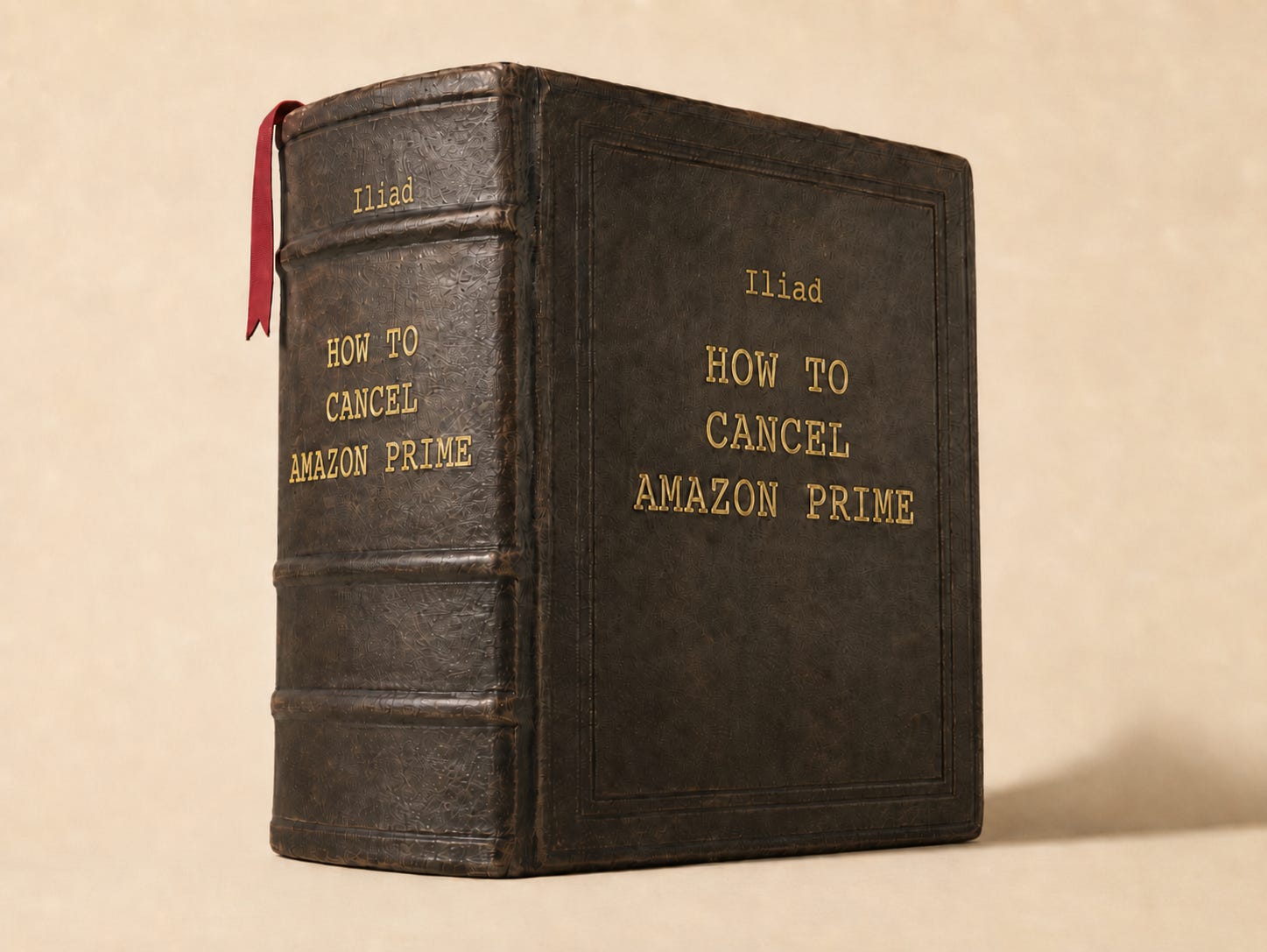
The FTC’s case against Amazon put the name “Iliad” into the record, alongside the finding that the company enrolled roughly 35 million people into Prime through nonconsensual sign-ups. In September 2025, Amazon settled for $2.5 billion, a $1 billion civil penalty plus $1.5 billion in refunds, which the FTC called the largest penalty it has ever won for a rule violation. Signing up took one or two clicks. Leaving Prime, by Amazon’s own documented design, ran four pages, six clicks, and fifteen options, each one a chance to talk you out of it. Across the wider market, a sweep of 642 sites by the FTC, ICPEN, and GPEN found 76 percent using at least one dark pattern, and 81 percent hiding auto-renewal terms during the signup itself.
The money lands on you. C+R Research found average American subscription spending runs about $219 a month, while people believe they spend about $86. That $133 gap between what you pay and what you think you pay is the thing the design was built to protect.
The mechanism is called negative-option marketing, and it runs on one trick. You agree once, it renews on its own forever, and the burden of paying attention flips onto you. Saying yes is a single decision. Saying no is a job you have to keep doing, every month, against a system that is hoping you forget.
Companies measured that asymmetry and then tuned it, the way you tune anything you are trying to optimize. Chegg’s now-CEO wrote in an internal email that cancellation should have “some pain involved”. Well, fuck that guy. They built the friction in on purpose and then measured it to make sure it held. Somebody sat in a meeting, drew the harder path, and shipped it as the plan. And yes, every company wants to keep the customers it has. Keeping them by hiding the exit is the part the FTC just fined.
And before anyone sorts this onto a team, look at the record, because it does not split evenly. The negative-option rule was written in 1973 and sat mostly untouched for five decades, under presidents of both parties. ROSCA has been on the books since 2010 and stays underused. That much is bipartisan drift, plain neglect. The last chapter runs one way. In 2024 the FTC passed a click-to-cancel rule, requiring that leaving be as easy as joining, on a 3-to-2 vote, with both Republican commissioners dissenting. In 2025 the Eighth Circuit vacated it on a paperwork technicality, a missing economic analysis, before it ever took effect, and afterward the FTC did not move to revive it, reopening the narrower 1973 rulemaking instead. Meanwhile Democratic lawmakers moved to write click-to-cancel into statute, and the bill that would settle it, the bipartisan Unsubscribe Act, sits in Congress doing nothing. The receipts point where they point. The tool to fix this was built, a court erased it on a technicality, and no one with the power to bring it back has. Until someone does, the renewal hits your card on the first of the month, every month, exactly as designed.
What you can actually do, since the rule is dead:
Audit by statement, not by memory. Pull your card and bank statements and sort for recurring charges. You will not remember the ones that matter. That is the point.
The day you start a free trial, set a reminder to cancel two days before it bills. The trial is the signup. The bill is the trap closing.
When you cancel, screenshot the confirmation. These flows sometimes “fail” the cancel and keep charging. The screenshot is your receipt.
If the maze stonewalls you, stop fighting it on their turf. Call your bank and dispute the charge. You owe the maze nothing.
You are not bad at this. The exit was engineered to be worse than the entrance, by people who named the engineering after a war. Sort by total cost, cancel by screenshot, move on.
Figures: the Amazon receipts come from the FTC case FTC v. Amazon.com, Inc., No. 2:23-cv-0932-JHC and the September 2025 settlement announcement: the Iliad name, the 35 million figure, the $2.5 billion total, and the four-page cancellation flow against a one-or-two-click signup. The FTC’s own superlative is the largest penalty for a rule violation, not the largest under ROSCA. The market numbers come from the FTC, ICPEN, and GPEN dark-patterns sweep and C+R Research. The Chegg email is in the FTC’s Chegg complaint. The policy record: the 1973 Negative Option Rule, ROSCA (2010), the 2024 click-to-cancel rule and the dissent, the Eighth Circuit vacatur, the reopened 1973 rulemaking, the Click to Cancel Act, and the Unsubscribe Act.
Related episode: Ticketmaster Junk Fees
THE RANTER follows the money through the systems that bill you: healthcare, housing, food, labor, debt, political money. Mechanism over motive.
Newsletter: newsletter.theranter.com | Website: theranter.com
YouTube: @TheRanterOfficial | Instagram: @theranterofficial | TikTok: @theranterofficial | X: @RanterMarkus | Bluesky: @rantermarkus.bsky.social
Every figure above is sourced and linked. Think one is wrong? corrections@theranter.com